// SMALL BUSINESS
Social Media Marketing Services: What They Actually Include and What They Cost to Run Well

If you have searched for social media marketing services and landed on page after page of agencies describing themselves as the right choice for your business, you still do not have an answer to the actual question: what are you paying for. Social media marketing services typically combine four things: a content plan built around your business and audience, the actual posts (written copy and graphics or video), scheduling and publishing on a realistic cadence, and responding to comments and messages, with a regular report showing what happened. Full service pricing scales mainly with how many platforms are covered and how many posts go out each week, not with a single number that applies to every business. This guide breaks down what is actually included, what a sustainable posting cadence looks like for a small business rather than an influencer account, how a social media content calendar works, cost factors to ask about instead of chasing a single price, and when doing it yourself still makes more sense than hiring anyone.
Why is it hard to know what you are actually paying for?
Three things make this term especially confusing to shop for.
The first is vocabulary. Social media marketing, social media management, content marketing and digital marketing for small business are used almost interchangeably by different providers, even though they can describe quite different scopes of work. One company's management package might cover only scheduling three posts a week. Another company's marketing package might include strategy, paid advertising and reporting on top of the same three posts. The word in the package name tells you very little on its own.
The second is that almost every page competing for this search is written by a company trying to sell the service, not explain it. That is not dishonest by itself, but it means the comparisons, the cadence advice and the pricing examples you find are usually built to make that specific company look reasonable, not to give you a neutral starting point.
The third is that posting frequency advice varies by platform in real and meaningful ways, and keeps shifting. What counted as a sensible cadence on one platform a few years ago is not necessarily what works today, and a short video platform rewards a different rhythm than a platform built around longer, less frequent posts. Generic checklists that say post daily everywhere are rarely written with a small business's actual time and budget in mind.
None of this means social media marketing is not worth paying for. It means the buyer has to ask sharper questions than the marketing pages suggest, which is what the rest of this guide is for.
What do social media marketing services actually include?
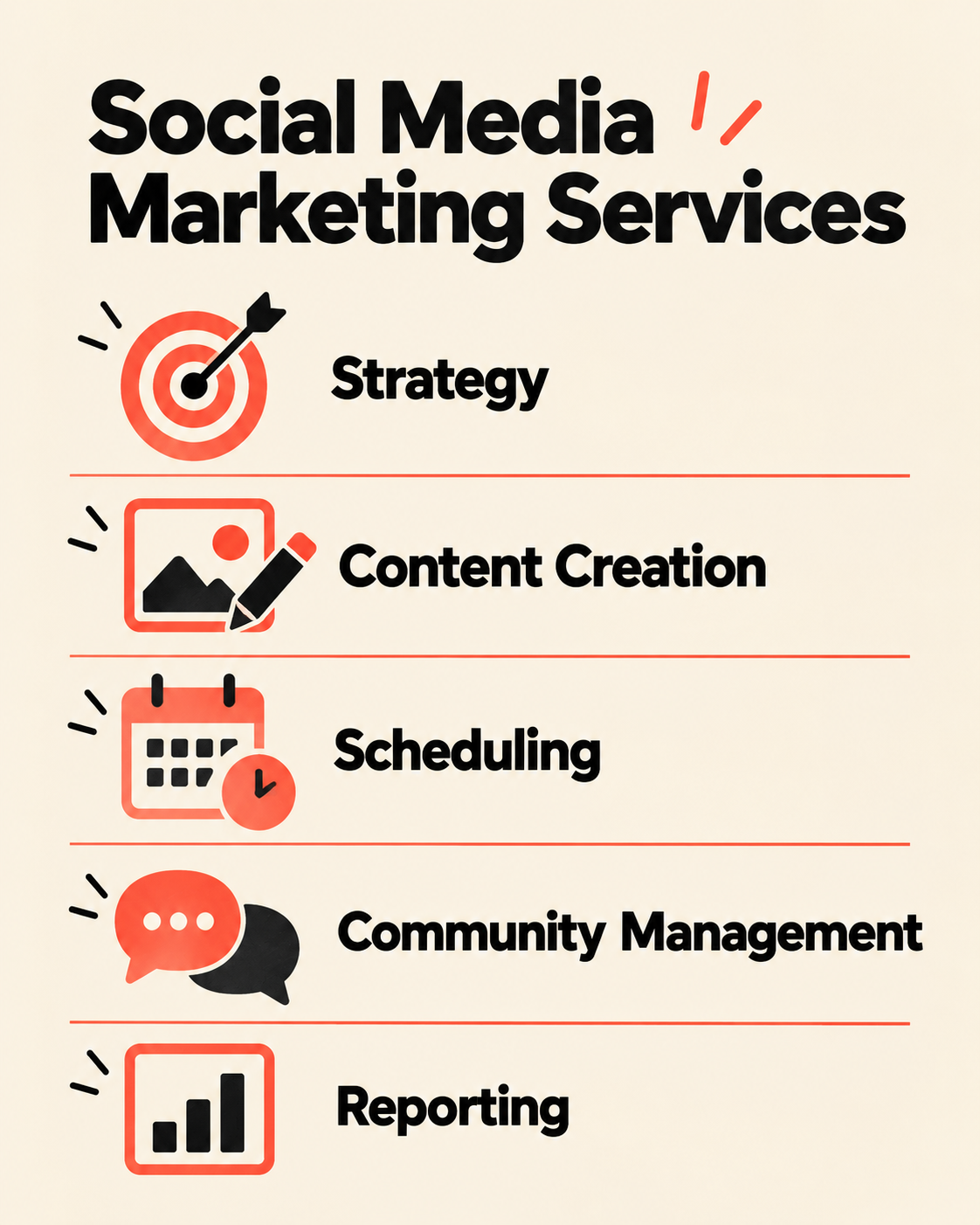
Strip away the branding on any package and most social media marketing services are built from the same five pieces, though not every provider includes all five.
Strategy and planning. Deciding which platforms actually matter for your business, what kind of content fits each one, and what a realistic goal looks like, such as more enquiries or more recognition in your local market, rather than a vague goal like going viral.
Content creation. The actual posts: written captions, graphics, short video, or a mix, built around your business rather than generic stock templates. This is usually the part that takes the most time and the part where quality varies the most between providers.
Scheduling and publishing. Getting the content out at a consistent cadence using a scheduling tool, so posting does not depend on someone remembering to do it manually every day.
Community management. Responding to comments, messages and reviews on the platforms being managed. This is often the part left out of cheaper packages, even though it is frequently the part customers notice most directly.
Reporting. A regular, honest look at what happened: reach, engagement, follower growth, and ideally some sense of enquiries or traffic that can be traced back to social media, though tracing a sale or a call back to one specific post is rarely exact.
A separate, related piece that some providers bundle in and others bill entirely apart is paid social advertising: running ads on top of organic posting. Organic content and paid advertising are different skills and different costs, and a package that blends the two without being clear about which spend goes where is worth questioning before you sign anything.
How often should a small business actually post, and what does a realistic content calendar look like?
There is no single correct number of posts per week that applies to every business, and any guide that hands you one exact number without asking about your business is guessing.
What does hold up across most small businesses: consistency on one or two platforms done well beats a thin, irregular presence spread across five. A social media content calendar is simply a plan, usually a spreadsheet or a shared calendar, that lays out what gets posted, on which platform, and roughly when, a week or a month ahead of time. Having one, even a basic one, is what actually separates businesses that post consistently from businesses that post in bursts and then go quiet for a month.
Platforms differ in how often they reward posting. Photo and short update platforms tend to work well with content a few times a week rather than daily, with short lived formats such as stories used more often if someone has the time. More professional, text heavy platforms tend to work better with less frequent, more substantial posts rather than high volume. Platforms built around short video tend to reward more frequent posting, which is also why they take more ongoing time to maintain well.
A sensible starting content calendar for most small businesses covers one or two platforms where their actual customers spend time, a mix of a few content types such as a behind the scenes look, a customer question answered, a seasonal or local angle, and a product or service highlight, and a cadence the business or its provider can actually sustain for months, not just for the first busy week. A calendar that looks impressive on paper but nobody can keep up after six weeks is worse than a smaller one that actually runs.
What should you check before hiring a social media marketing provider?
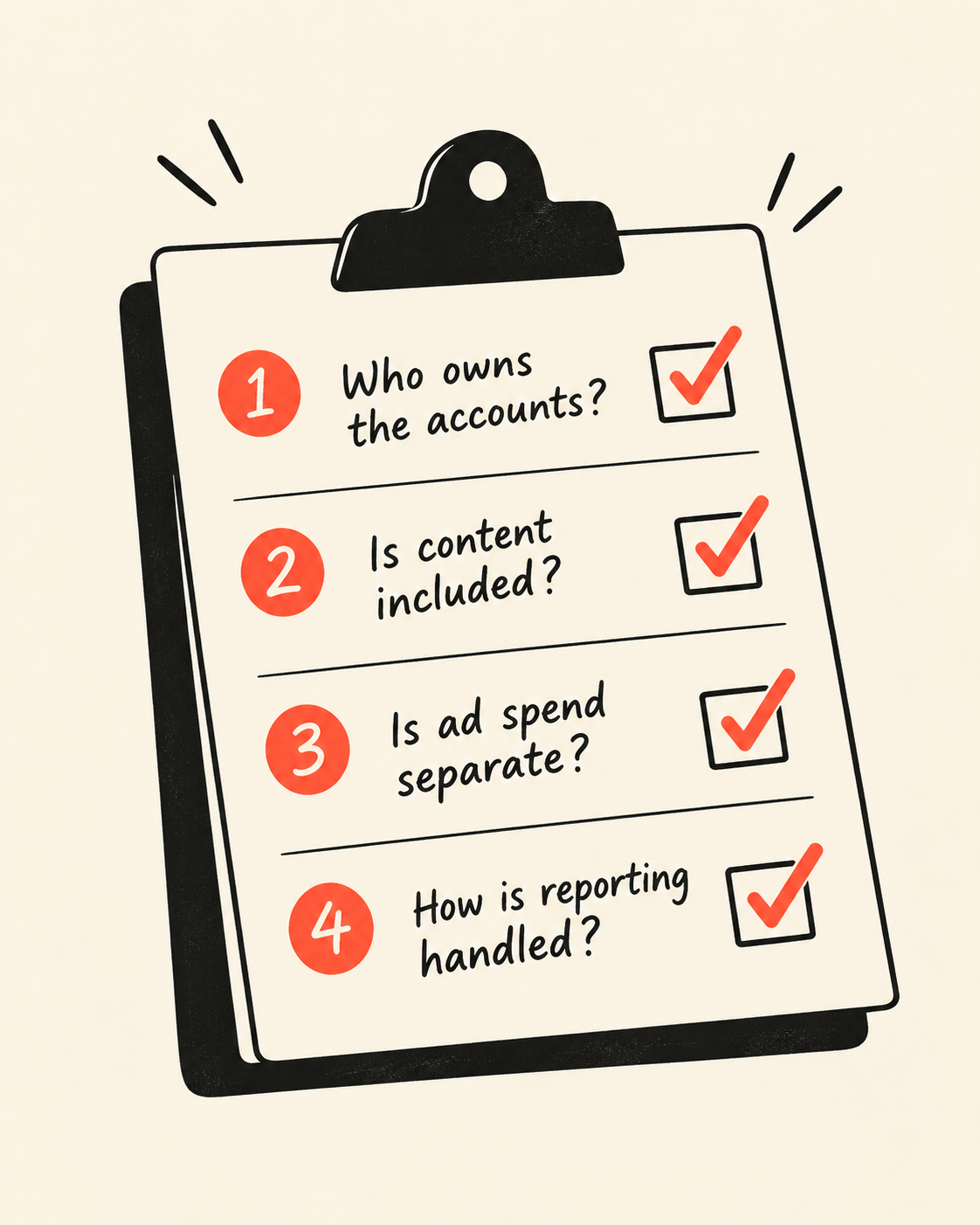
Use this as a working checklist during any sales conversation.
Can they name the platforms and cadence they recommend for your specific business, and explain why? A provider who proposes the same platforms and the same daily posting schedule to every client, regardless of what the client sells, has not actually looked at your business.
Is content creation included, or only scheduling? Ask directly whether the price covers writing and designing the posts, or only publishing content you or someone else supplies. These are very different amounts of work and should be priced differently.
Who owns the accounts and the content afterwards? Your social media accounts and the content created for them should remain yours if you end the arrangement. Ask this plainly before signing anything.
Is community management included? If responding to comments and messages is not part of the package, find out who is expected to do it, since an unanswered comment or message on a business page looks worse than no comment at all.
Is paid advertising spend separate from the management fee? Ad spend, what you pay the platform itself to boost reach, is usually billed on top of a management or content fee, not included in it. A proposal should say this clearly rather than letting the two blur together.
What will you actually be able to see yourself? A credible provider shares real reporting, ideally with access to the business accounts themselves, rather than only sending a summary slide you cannot verify independently.
What happens in a slow month, or if you want to pause? Seasonal businesses in particular should ask how flexible the arrangement is, and whether pausing for a month costs a fee or simply reduces that month's invoice.
What does this look like in practice?
These are examples only, meant to show how the pieces above fit together differently depending on the business. They are not a promise of what any specific engagement would include, since the right approach depends on the business.
Example: a local retail shop with a loyal but small following. The owner already posts occasionally but inconsistently. A realistic starting engagement might be a simple content calendar covering two platforms, a few posts a week built around new stock, behind the scenes moments and customer questions, with the owner still handling comments personally since that personal touch is part of what customers like about a small shop.
Example: a service business that gets most of its work through word of mouth and referrals. Here, the goal of social media is less about daily posting and more about having an active, trustworthy looking presence that a referred customer checks before calling, so a lighter cadence focused on finished work and customer questions can matter more than high volume.
Example: a business trying to reach a younger audience for the first time. Short video usually needs a more frequent, hands on cadence than the business has managed before, which is exactly the kind of gap where paying for help, rather than asking an already busy owner to also become a video editor, tends to make sense.
In every case, the pattern is the same: the right cadence and platform mix follow from who the actual customers are and where they already spend time, not from a generic package.
Should you do this yourself first, or hire help now?
Doing it yourself tends to make sense if you have a real sense of your own voice and customers, an hour or two a week you can commit to consistently, and your current gap is mainly about building the habit of posting regularly rather than running out of ideas. A basic content calendar, even a one page document, is often the single biggest improvement a business can make on its own before spending anything.
Hiring help tends to make more sense once you want content created for you rather than just scheduled, once comments and messages are going unanswered because nobody has time, once you want to add paid advertising on top of organic posting and do not have the expertise to manage it, or once the time cost of staying consistent yourself is clearly outweighing what it would cost to pay someone.
A few signs it may be too early to hire a provider: you do not yet know who your customers actually are or what they respond to, in which case paying for content before that is clear often produces polished posts that do not land. You are expecting social media alone to produce a steady stream of new customers quickly, since organic social media tends to build recognition and trust over time rather than producing an immediate, predictable spike the way a paid advertisement sometimes can. Or your website and basic business information such as hours, services and contact details are not in good shape yet, since social media usually sends an interested person to your website or your Google Business Profile next, and a weak landing spot undercuts the work.

What consistent social media marketing work can add
- +A steadier presence instead of bursts and silence
Posting on a schedule, even a modest one, tends to look more trustworthy to a potential customer than an account that goes quiet for months at a time.
- +Content built around your actual business
A provider who writes and designs posts around what you sell frees up the time an owner would otherwise spend trying to come up with ideas.
- +Comments and messages that do not go unanswered
Community management means an enquiry left in your comments or messages gets a timely reply instead of sitting there.
- +A clearer picture of what is working
Regular reporting gives an ongoing view of reach and engagement, rather than a guess based on how busy a feed looks.
- +Content that supports a modern, AI readable website
Posts and a website work better together when the same clear, accurate information about your business appears in both places.
- +Room to start small
A single platform done consistently can prove the approach before committing to a bigger content calendar.
What does social media marketing cost, and what should you ask about pricing?
Cost depends on a handful of factors rather than one number that applies to every business: how many platforms are covered, how many posts go out each week, whether content is created from scratch or only scheduled, whether community management and reporting are included, and whether paid advertising spend sits on top of the management fee. Because those factors vary so much between businesses, we do not publish a single figure here, and a provider who quotes a firm monthly price before asking about your platforms, your cadence and your goals is guessing.
What is worth asking directly: exactly what is included in the price, platform by platform. Is content creation part of it, or only scheduling. Is community management included, and if not, who handles it. Is ad spend separate from the management fee, and who controls that budget. What will you be able to see yourself, through direct account access or regular reporting, rather than only taking someone's word for progress. And what happens if you want to pause or stop, including whether you keep the content and the accounts.
A sensible next step is a short, low pressure conversation about what your business actually needs. Message us on WhatsApp at +1 306-518-7811 or call +1 833-998-1234. You can also book a free 15-minute discovery call at underdogcreativesolutions.com/contact.
How Underdog approaches content and social media
Underdog Creative Solutions is a Saskatoon based agency working with small and growing businesses across Canada and the United States. Our content solutions work starts with a plan built around your actual customers and platforms, not a generic package applied the same way to every client, and covers the content itself, scheduling and community management together rather than splitting them into separate add-ons.
We also build websites, set up AI receptionists and build AI business automation, and for many businesses the pieces connect naturally. A modern website that Google and AI tools such as ChatGPT can read gives a visitor who finds you through social media somewhere clear to land. An AI receptionist and simple automation help make sure an enquiry that comes in through a comment or a message actually gets followed up, instead of getting lost once the conversation moves off social media.
You do not need all of this to start. Most businesses begin with whichever gap is causing the most day to day friction, whether that is an inconsistent social presence, a website that is hard to find, or enquiries slipping through the cracks, and we would rather help identify that starting point than sell a bundle you do not need yet.
Frequently asked questions
Talk to Underdog about your business
Have questions about your website, content, AI receptionist or business automation? Message us on WhatsApp at +1 306-518-7811 or call +1 833-998-1234. You can also email support@underdogcreativesolutions.com.
Follow Underdog Creative Solutions on Facebook, Instagram, LinkedIn, and YouTube for practical AI and marketing ideas for Canadian small businesses.