// SMALL BUSINESS
Content Creation for Saskatoon Small Businesses

Your last five customers did not find you by walking past your storefront. They searched for something on their phone, maybe a question, maybe a service, maybe just the name of your business to check you were real before they called. What they found, or did not find, shaped what they did next. Content creation is the work of making sure something useful is there when that search happens: a clear page that answers the question, a post that shows the work you actually do, a paragraph that a person, or increasingly an AI tool such as ChatGPT, can read and understand. For a Saskatoon small business without a marketing team, that can sound like one more job nobody has time for. This guide breaks it down into what it actually means, what a realistic monthly rhythm looks like, where AI drafting actually helps, and where a person still needs to check the work before it goes out.
Why content creation gets neglected in Saskatoon small businesses
Most Saskatoon owners already know they should be doing something with content. What is less clear is what counts, how much is enough, and whether it is worth the time. That uncertainty tends to produce one of two outcomes. Either nothing gets published for months at a stretch, so the website and social accounts look abandoned to anyone who checks them, or a business signs a contract with an agency without understanding what they are buying, and ends up unable to judge whether the work is any good.
Both outcomes share the same root cause: content creation gets treated as a single vague task instead of a small set of concrete, repeatable pieces. A service page that answers one real customer question. A short post about a job you finished. An update to a page that has gone stale. None of these are hard on their own. The difficulty is deciding which ones matter and building a rhythm you can actually sustain around a business that already keeps you busy.
There is a second cost that is easy to miss. Search itself has changed. Google shows AI generated summaries above the usual list of links for many searches, and tools such as ChatGPT are now a starting point for some customers looking for a local business. Both draw on content that is clear, accurate, and easy to parse: real service pages, consistent business details, and plain answers to common questions. A business with no content, or content that is outdated and inconsistent, is harder for those tools to describe accurately, on top of being harder for a person to find.
What content creation means for a Saskatoon small business
Content creation, sometimes called content marketing, means regularly publishing material that answers a question your customers already have, written so both people and AI tools can understand it, and checked by a person before it goes live. That is a broader definition than social media alone, and broader than blogging alone. For a small Saskatoon business it usually spans four kinds of material.
Website content. The pages that describe what you do, who you do it for, and how to reach you. This is the foundation, because it is what a search engine or an AI tool reads first when trying to understand your business.
Blog or article content. Longer pieces that go deeper on a topic your customers ask about: how a process works, what something costs to think about, how to choose between options. This is where you can show real expertise instead of just listing services.
Social media content. Shorter, more frequent posts that show your work, your team, and your business as it actually operates day to day. Whether you handle social media management yourself or hand the posting schedule to someone else, this builds familiarity and trust more than it drives search visibility on its own.
Local listing content. Your Google Business Profile posts, photos, and Q&A answers. Often overlooked, but it is frequently the first thing a nearby customer sees, and it feeds directly into local search and map results.
None of these need to be produced constantly to matter. What matters is that each piece is accurate, answers something real, and is kept current enough that it still reflects your business today.

How a content creation process actually works
A workable content process has four repeatable parts, whether you handle it yourself or bring in help.
Finding topics. If you are hunting for small business content ideas, the best source is not guesswork, it is the questions you already get asked. Every enquiry call, every comment at the counter, every question in a quote request is a potential piece of content. Keep a running list. When the same question comes up three or four times, that is a page or a post worth writing.
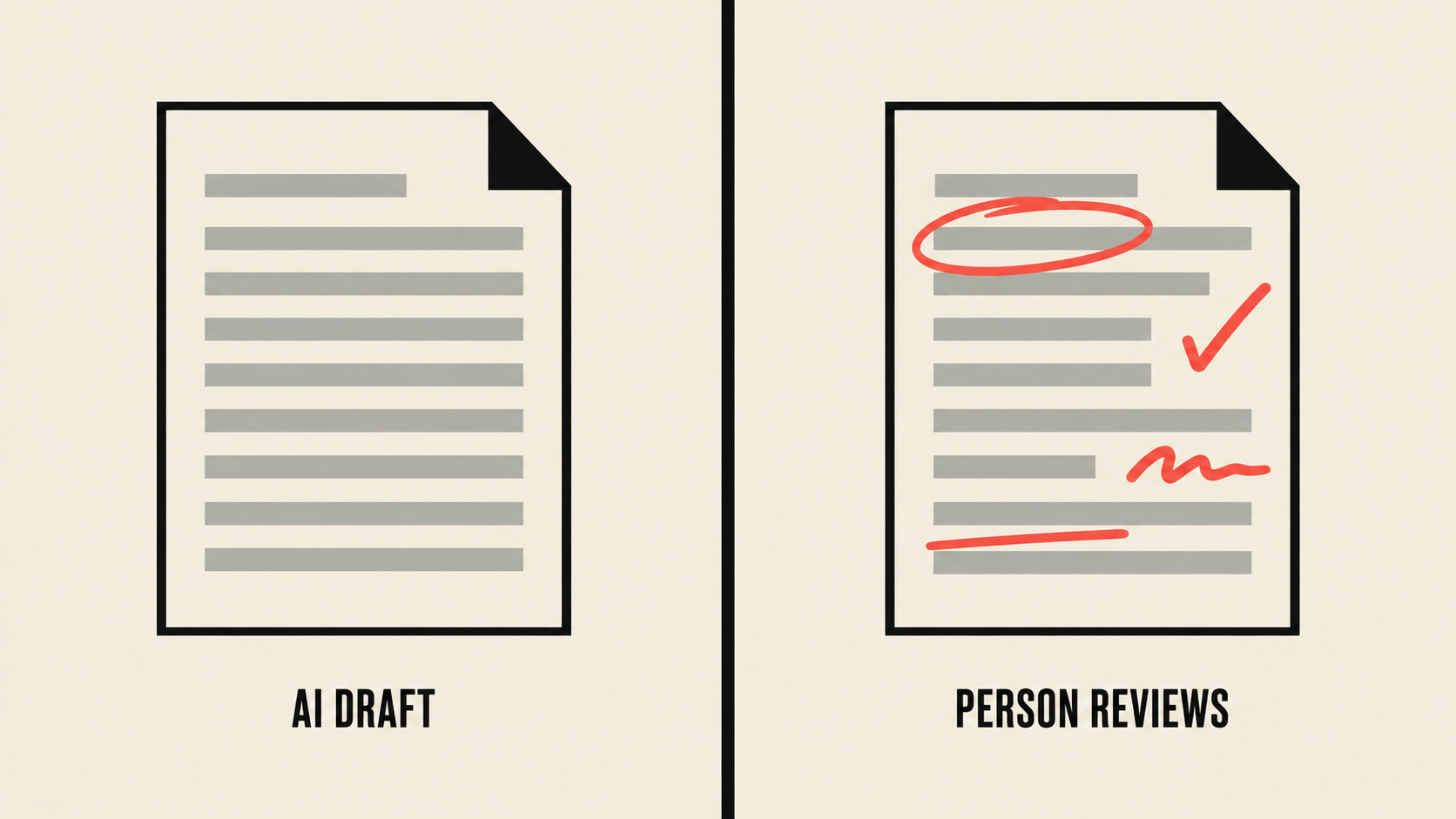
Drafting. Someone, or something, produces a first version. This can be a person writing from scratch, or an AI tool producing a draft from notes or a voice memo. Either way, a draft is not a finished piece.
Review. A person who knows the business checks the draft for accuracy: correct prices are never invented, local details are right, the tone sounds like your business, and nothing promises something you cannot deliver. This step is not optional, and it is where most of the real judgment in content creation actually happens.
Publishing and reuse. The finished piece goes up in the right place, and gets a second life where it fits: a paragraph from a longer article becomes a social caption, a customer question becomes a line in your FAQ, a finished job becomes a photo post with a short explanation.
The order matters. Skipping straight to drafting without a real topic produces generic content nobody was searching for. Skipping the review step is where invented statistics, incorrect details, and off brand tone slip through, whether the draft came from a person in a hurry or from an AI tool.

A realistic monthly rhythm for a small Saskatoon business
Most small businesses do not need to publish every day, and trying to can burn out an owner faster than it builds an audience. A more sustainable rhythm looks something like this, adjusted to what your business and your season can support.
One solid piece of core content a month. This is a new or meaningfully updated page or article that answers a real customer question in depth. Over a year, that becomes twelve pieces of content that keep working for you long after they are published, instead of twelve months of posts that disappear from feeds within a day.
Regular, lighter social posts. A handful of shorter posts a week showing real work, a behind the scenes moment, or a seasonal update. These do not need heavy production. A phone photo with a short, honest caption usually performs better than something that looks overly polished.
A quarterly check of what already exists. Old pages with outdated details, service lists that no longer match what you offer, or a Google Business Profile that has not been touched in months all send the wrong signal to a searcher and to an AI tool trying to describe your business accurately. Fixing an existing page is often a better use of an afternoon than writing a new one.
Seasonal adjustments. A Saskatoon landscaping business has a very different content need in April than in December. Build a rough seasonal outline once, and let it guide what you prioritize each month rather than starting from a blank page every time.
There is no fixed number of posts that guarantees a result, and any guide that promises one is guessing. What matters more than volume is whether what you publish is accurate, useful, and kept current.
Where AI drafting helps, and where a person must review
AI tools are a real help for parts of this process. They can turn a rough voice note into a first draft, suggest a few headline options, summarize a long explanation into a short social caption, or rework one piece of content into three shorter versions for different platforms. Used this way, they save real time on the parts of writing that are mostly mechanical.
They are not reliable for the parts that require judgment or verification. An AI tool has no way to know your actual prices, your actual wait times, a customer's actual experience, or a fact specific to Saskatoon that has not been confirmed. Left unchecked, a draft can quietly invent a statistic, misstate a service, or produce a generic claim that does not sound like your business at all.
A workable rule: AI can draft, a person must approve. Every piece that goes out under your business name should be read by someone who knows the business, checked for anything invented or inaccurate, and adjusted so it sounds like you rather than like a template. This is not a limitation of the technology so much as ordinary care, the same care you would apply to any employee's first draft.
How content connects to your website and AI search tools
Content does not work in isolation. A well written page sitting on a slow, disorganized website, or one that is hard for a search engine to find, will not perform the way the same content would on a clear, well structured site. This is part of why a modern website and ongoing content are usually discussed together rather than as separate projects.
The same logic applies to AI tools. When someone asks ChatGPT or a similar tool for a recommendation in a category, or asks Google's AI generated summary a question, those tools draw on content that is specific, current, and consistently worded across your website and your listings. A business with clear service pages, an accurate Google Business Profile, and a handful of real customer questions answered in plain language gives those tools something concrete to work with. A business with a thin, outdated, or inconsistent web presence gives them very little, and no business can guarantee it will be the one an AI tool happens to mention.
None of this is instant, and it is worth being honest about that. Content built this month does not usually change what shows up in a search tomorrow. It builds up over months, the same way a reputation does.
Who this suits, who it does not, and what to do first
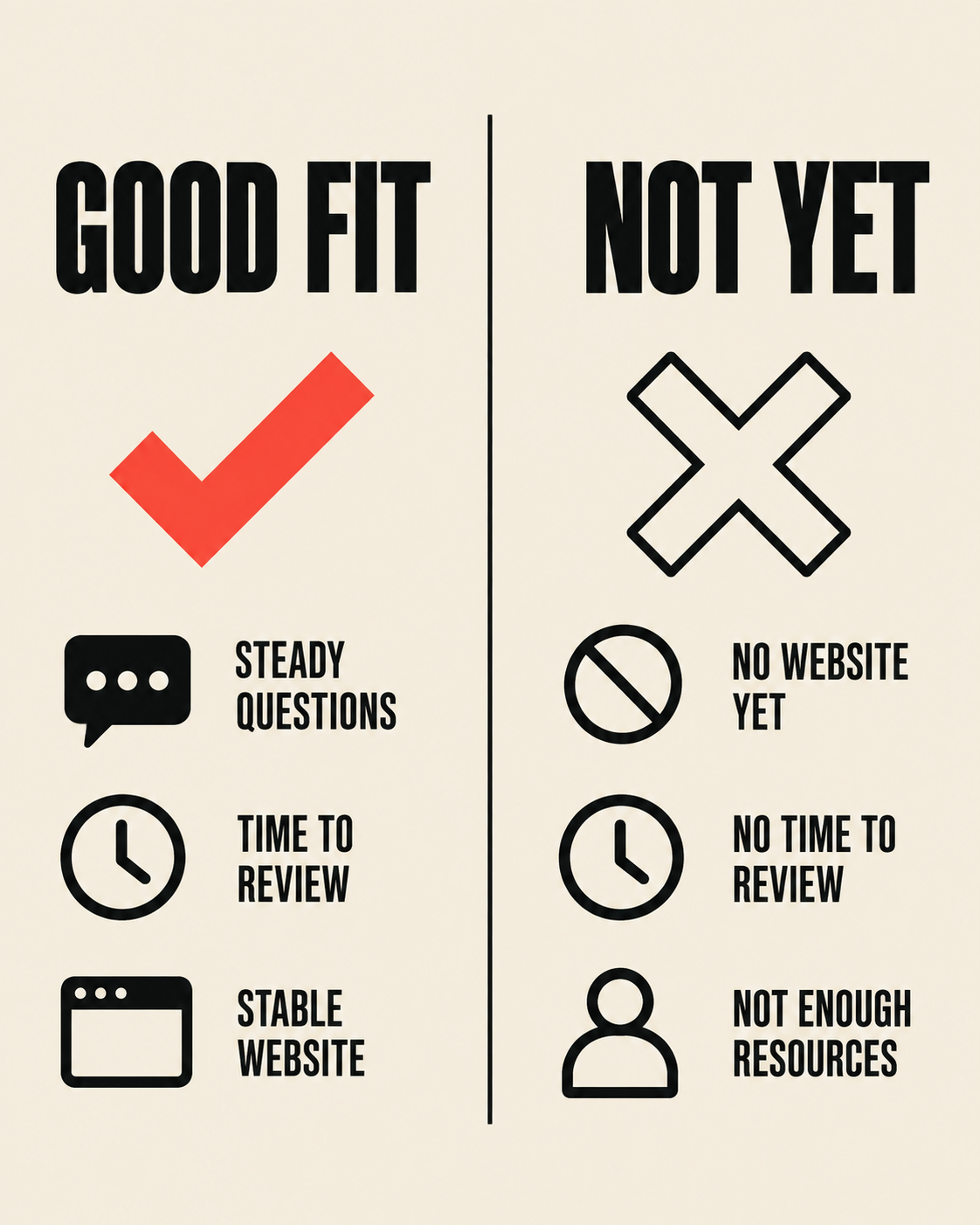
Ongoing content creation tends to suit a business that already has a steady flow of the same few customer questions, one where an owner or a staff member can spare a short, regular block of time to review drafts even if someone else writes them, and one that already has a stable website to publish onto.
It is probably not the right first project if your website itself is outdated or missing basic information, since content built on top of a weak foundation will not do much work. It is also not the right fit if nobody in the business can commit even a small amount of time to reviewing what goes out, because unreviewed content is a real risk, not a shortcut.
What to do first: write down the five questions you get asked most often, in the words customers actually use. That list, more than any content calendar template, is the starting point for everything else in this guide.
What consistent content creation can do for your business
- +Clearer answers for customers
Real questions get real answers instead of customers having to call and ask.
- +A more complete picture for AI tools
Clear, current content gives search engines and AI assistants accurate material to draw on.
- +Less repeated explaining
A well written page answers a common question once instead of you explaining it on every call.
- +A record of your actual work
Regular posts build a visible history of jobs done and problems solved, useful to any new customer checking you out.
- +Content that keeps working
A well built page or article can keep answering the same question for people long after you publish it.
- +A stronger local listing
Regular Google Business Profile updates keep your local presence current and easier to trust.
What content creation costs and how to take the next step
There is no single price for content creation, because the cost depends on real factors: how many pieces you need each month, whether you want website pages, articles, social posts, or all three, how much research or local verification each piece needs, whether photography or video is involved, and whether you want ongoing management or a one time project. A fair quote should say plainly what is included and how many revisions are covered, rather than quoting a flat number with no detail behind it.
The clearest way to get an honest answer is to describe what you need. Message us on WhatsApp at +1 306-518-7811 or call +1 833-998-1234, and we can talk through what a realistic starting point looks like for your business. You can also book a free 15-minute discovery call at underdogcreativesolutions.com/contact.
How Underdog approaches content creation
Underdog Creative Solutions is a Saskatoon based agency working with small and growing businesses across Canada and the United States. Our content work covers website pages, articles, and social content, built around the real questions your customers ask rather than generic templates, with every piece reviewed by a person before it goes live.
Content connects naturally with the other work we do. A modern website that Google and AI tools can read gives your content somewhere solid to live. An AI receptionist captures the enquiries that content brings in, so nothing gets missed after hours. Business automation can help keep customer records and follow ups organized as those enquiries turn into jobs. You do not need all four services to get value from any one of them, and we would rather help you work out where to start than sell a bundle you do not need.
Frequently asked questions
Talk to Underdog about your business
Have questions about your website, content, AI receptionist, or business automation? Message us on WhatsApp at +1 306-518-7811 or call +1 833-998-1234. You can also email support@underdogcreativesolutions.com.
Follow Underdog Creative Solutions on Facebook, Instagram, LinkedIn, and YouTube for practical AI and marketing ideas for Canadian small businesses.