// SMALL BUSINESS
SEO for Small Business in Canada: What It Actually Takes (and Where AI Search Fits In)

SEO for a small business in Canada means making your website and your Google Business Profile easy for search engines, and increasingly AI tools like ChatGPT and Google's AI Overviews, to find, understand and trust. In practice that starts with three things almost any owner can do without hiring anyone: claiming and completing your Google Business Profile, making sure your website clearly states what you do and where you work, and asking recent customers for reviews. Everything else, from technical fixes to ongoing content, builds on that foundation. If you have searched for SEO for small business and landed here, you have probably already read a few guides that talk about rankings, keywords and algorithms without answering the question you actually have: where do you start, and is this worth your time and money right now. This guide answers that plainly, covers what has changed now that people search inside ChatGPT and Google's AI Overviews as well as the traditional results page, and is upfront about what SEO cannot promise.
Why is SEO advice for small businesses so confusing right now?
Three things make SEO advice for small business owners in Canada harder to sort through than it should be.
The first is that most SEO content online is written by a software company, an agency selling SEO services, or a freelancer trying to rank for the same competitive term you are researching. Software company content tends to explain concepts at a level built for marketing teams, not a business owner who also answers phones and does the books. Agency content often blends real information with a sales pitch, so it is hard to tell which parts are useful advice and which parts exist to make you nervous enough to call.
The second is that search itself changed meaningfully in the last few years. Google added AI Overviews that answer many questions directly at the top of the results page. A growing number of people now start a search inside ChatGPT, Perplexity or Google's Gemini instead of typing into a search box. None of this replaced the classic Google results page, but it added a second, less understood system that a small business now has to think about, on top of the first one it was already unsure about.
The third is cost and timeline claims. Search this exact topic and you will see confident numbers: guaranteed rankings within a set number of months, a specific return on investment, or a fixed monthly price that supposedly applies to every business. Real SEO work does not come with guarantees, because search engines do not publish their exact ranking formulas and every business starts from a different baseline. A claim that sounds too precise is worth treating with caution.
None of this means SEO is not worth doing. It means the starting point should be plain language, not promises.
What does SEO for a small business actually mean today?
SEO, short for search engine optimization, is the ongoing work of making a website easy to find, easy to understand and trustworthy enough that search engines want to show it to people searching for what you offer. That has always had three broad parts, and a fourth has now joined them.
Technical SEO is making sure your website works properly: it loads reasonably fast, works well on a phone, uses a secure connection (the small lock icon in the browser), and does not have broken links or pages that confuse search engines about what they are looking at.
On-page SEO is what is actually written and coded on each page: a clear page title, a heading that matches what a visitor is looking for, and body content that answers the question a searcher actually has, rather than vague marketing language.
Off-page SEO, sometimes called authority or trust, is what other parts of the internet say about your business: reviews, mentions on other websites, and consistent business information, the same name, address and phone number everywhere it appears online, often called NAP consistency.
The newer fourth part is AI findability, sometimes called AI search optimization or generative engine optimization. This means making the same website content easy for AI systems such as ChatGPT, Google's AI Overviews and Perplexity to read, extract and summarize accurately when someone asks a question your business could answer. The encouraging part is that AI findability and classic SEO overlap heavily. A page that is well structured, clearly written and factually accurate helps both a human reader scanning a Google results page and an AI system trying to summarize an answer. They are not two separate projects. They are the same project with one more audience.
How do Google search and AI tools actually decide what to show?
Understanding the basic mechanics, in plain language, makes every decision after this point easier.
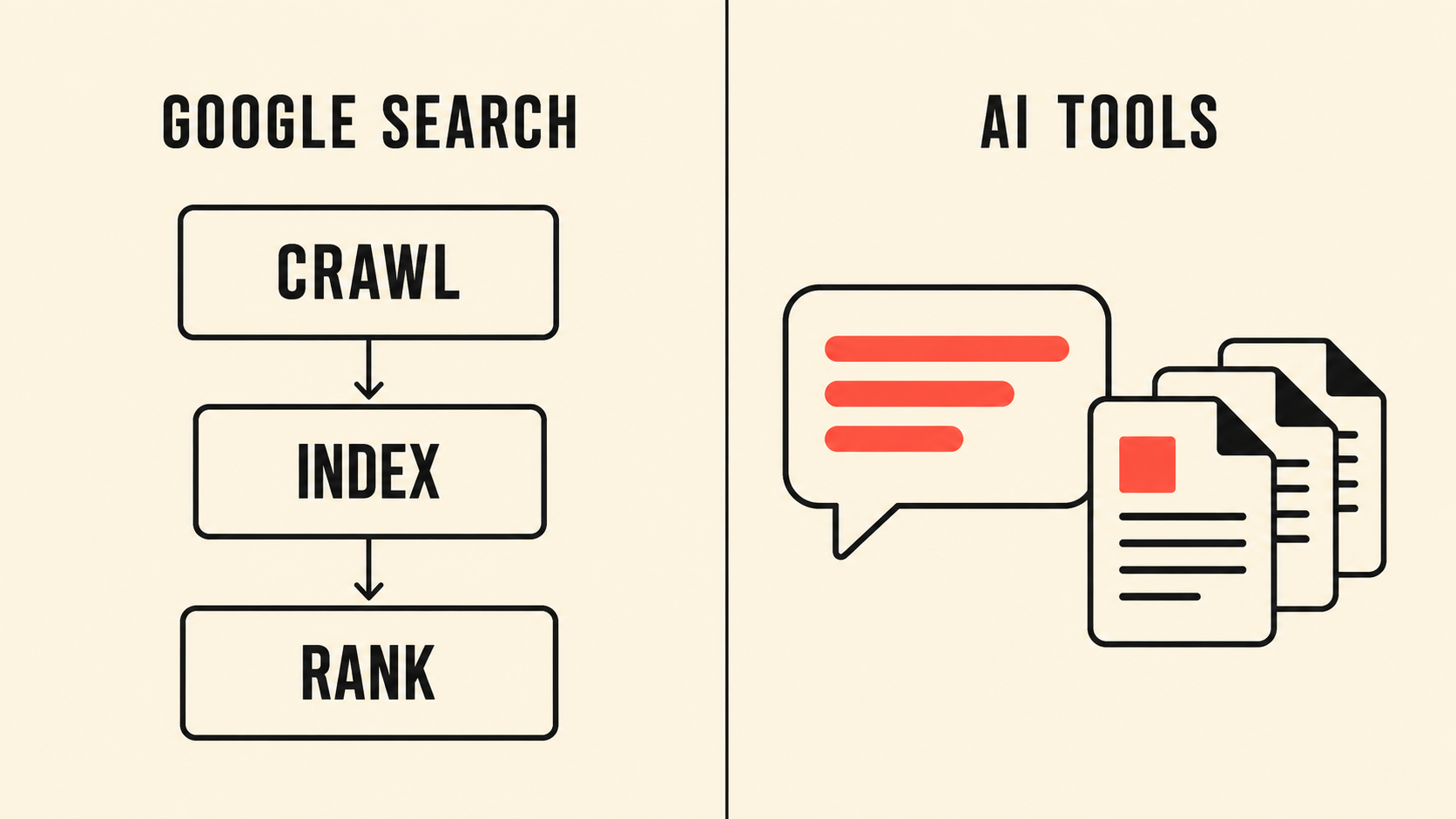
Google search still runs on three steps: crawling, where automated programs called crawlers or bots follow links around the web to find pages, indexing, where Google stores a processed copy of what each page contains, and ranking, where an algorithm decides which indexed pages best answer a specific search, using signals such as relevance to the search terms, the clarity and quality of the content, how trustworthy the site appears, and how well the page works on the device someone is using.
AI tools work in a related but different way. Google's AI Overviews draw on Google's own index and add a generated summary above the usual results, often pulling from a handful of pages it judges as clear and reliable answers to that specific question. ChatGPT, Perplexity and similar tools each work a little differently: some search the live web when you ask a question, others were trained partly on web content and also do live lookups for current information. What they tend to have in common is a preference for content that states a clear answer plainly, near the top of the page, backed by specific, checkable details rather than vague claims.
A practical way to think about it: classic SEO asks whether Google will rank your page for a search. AI findability asks whether an AI system, when summarizing an answer, would find your page clear and trustworthy enough to draw from or mention. Nobody, including the people who build these systems, can guarantee that a specific business will be the one an AI tool picks to mention on any given question, and any vendor who promises otherwise is not describing how these systems actually work.
Where should a small business start with SEO?
Start with the things that need no budget beyond time, in this order.
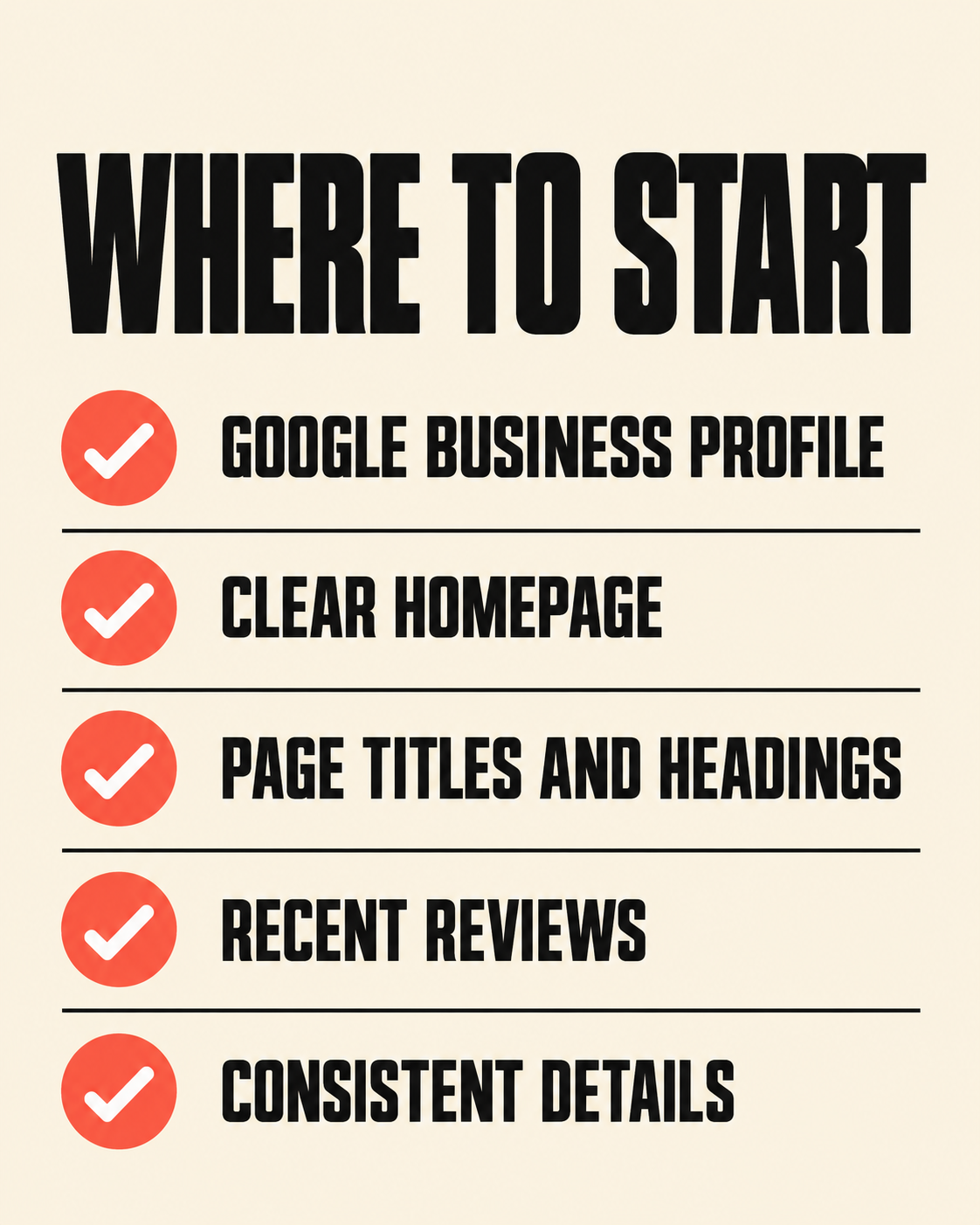
Claim and complete your Google Business Profile. This free listing is often the first thing a potential customer sees, whether they search on Google Maps, in regular search results, or ask an AI tool about businesses nearby. Fill in every field: your correct business category, service area or address, hours, phone number and a plain description of what you do. Add real photos. Keep hours updated, especially around holidays.
Make sure your website clearly states what you do and where. This sounds obvious and is still one of the most common gaps. A homepage that only shows your business name and a slogan, with no plain sentence describing your services and location, is harder for both search engines and AI tools to match to a relevant search.
Fix the basics that affect every page: a clear, unique page title and a short description for each main page, headings that describe what the section actually covers, and images with a short text description, called alt text, so both search engines and screen readers understand what they show.
Ask recent customers for a review, and reply to the reviews you get. A steady trickle of recent, specific reviews, what was done and roughly when, is one of the more reliable trust signals for both local search rankings and AI systems trying to judge whether a business is real and well regarded.
Check that your business name, address and phone number are written exactly the same way everywhere they appear online: your website, your Google Business Profile, any directory listings and your social media profiles. Small inconsistencies, like a missing suite number in one place, make it harder for any system to be confident it has correctly matched your business.
A small business that does only these five things consistently is doing more real SEO work than plenty of businesses that have paid an agency and never checked whether the basics were even in place.
What does showing up in AI search actually require?
Once the basics above are in place, a few additional things help specifically with AI findability, without requiring a rebuild of your website.
Write in a way that answers the question directly, early. AI systems tend to favour content where the direct answer to a likely question appears in the first sentence or two of a section, with supporting detail after it. Burying the answer under several paragraphs of scene setting works against you with both a busy human reader and an AI system trying to extract a clean answer.
Use specific, checkable facts instead of vague claims, and be able to back them up. A sentence like our team has years of experience does very little on its own. A sentence describing specifically what you do, for whom, and in what area gives both a person and an AI system something they can actually use.
Add structured data where you can. Structured data, often implemented through something called schema markup, is a behind the scenes way of labelling information on your page, such as your business hours, your services or a set of frequently asked questions, in a format search engines and AI tools can read directly rather than having to guess at from the visible page. A web developer or a modern website platform can usually add this without changing how the page looks to a visitor.
Make sure nothing is accidentally blocking AI tools from reading your site. Some websites, often without the owner realizing it, have technical settings that tell automated crawlers to stay away from parts of the site. This is worth checking with whoever manages your website, since it can quietly keep both search engines and AI tools from seeing content you want found.
Be patient about proof of impact. Unlike a Google ranking, which you can check yourself with a search, there is currently no reliable, publicly available way for a small business to see exactly how often an AI tool mentions it, or to guarantee that any specific change will lead to a mention. Anyone who promises that ChatGPT or Google's AI Overviews will recommend or cite your business by name is promising something nobody can actually deliver.
What this looks like in practice
These are examples to illustrate how the pieces fit together for different kinds of small businesses. They are examples only, not a template to copy, since the right starting point always depends on what is already in place.
Example: a home renovation contractor. The Google Business Profile lists a vague category and no service area, so it rarely appears for nearby searches. The website homepage says the company name and little else. A realistic first pass: correct the Google Business Profile category and service area, add a homepage sentence naming the specific services and cities served, and add a short page for each main service, for example kitchen renovations and bathroom renovations, instead of one page trying to cover everything at once.
Example: a bookkeeping practice serving clients across Canada. Because the business has no single physical location that matters to clients, the priority shifts away from local search and toward clear service pages, a frequently asked questions section written in plain language, and consistent information across the website and any professional directories the business is listed on, since that consistency matters for AI systems trying to describe what the business does and who it serves.
Example: a retail shop with a loyal but small local following. Reviews are the most efficient lever available. A short, low pressure habit of asking happy customers to leave a review, combined with keeping the Google Business Profile accurate through seasonal hour changes, often moves the needle faster than a full website rebuild would.
In each case, the pattern holds: fix what is inaccurate or missing before adding anything new, and match the effort to how the business actually gets found, rather than following a generic checklist regardless of fit.
Who should hire help, and who can start on their own?
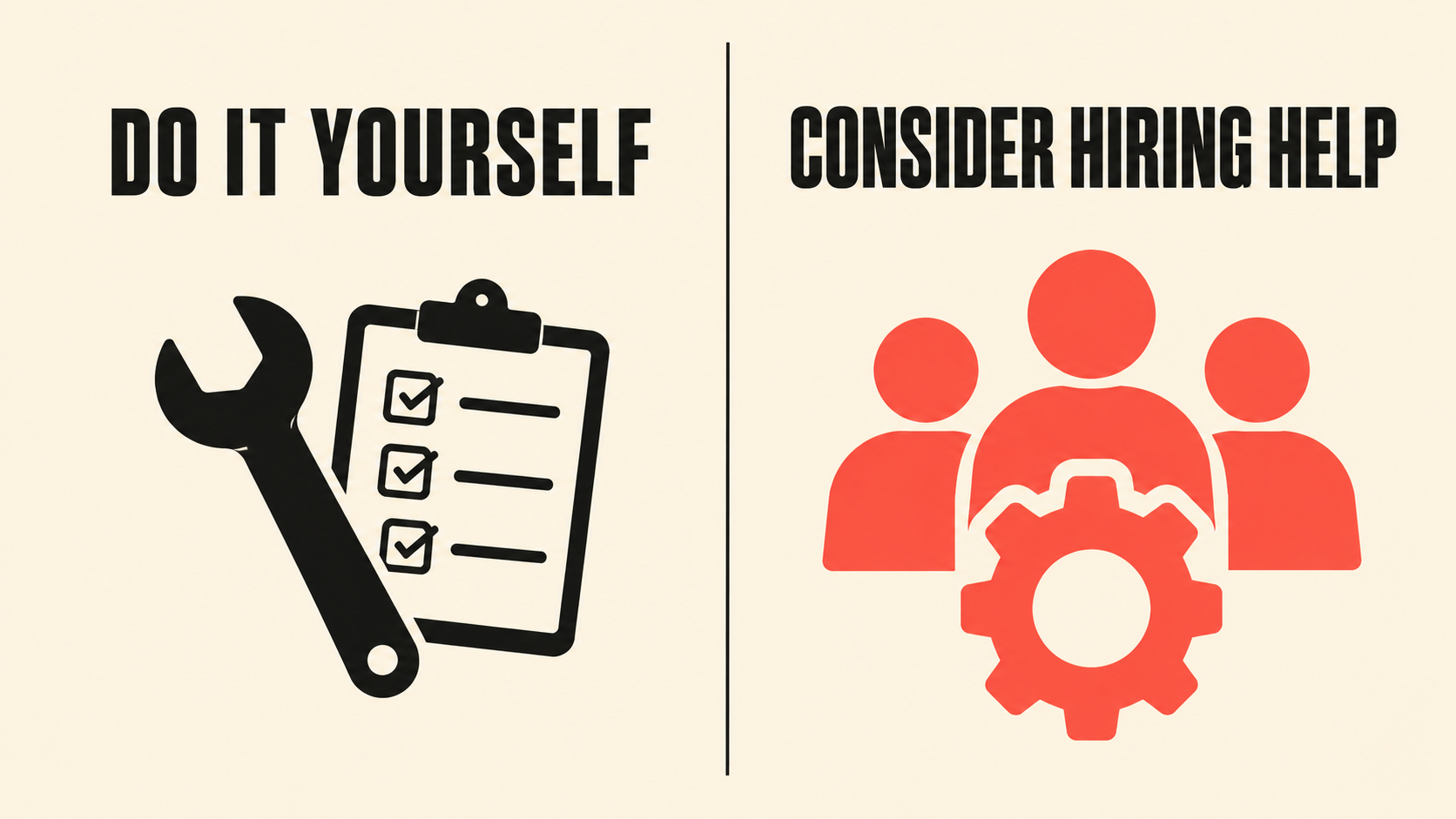
Doing the basics yourself makes sense if your website already exists and mostly works, you have an hour or two a week you can commit consistently, and your main gap is completing your Google Business Profile, tidying page content, and building a habit of asking for reviews. None of that requires specialized skills, just consistency.
Hiring help tends to make more sense once the work moves into technical territory you are not comfortable touching yourself, such as fixing site speed issues, adding structured data, or restructuring a site with dozens of pages, or once you want a steady stream of new content and do not have the time to write it yourself, or once you are in a highly competitive market where doing the basics well is no longer enough to stand out.
A few signs it may be too early to hire an SEO provider at all: your website does not exist yet or needs a rebuild first, since polishing SEO on a broken foundation wastes money, you have not yet claimed your Google Business Profile, since that single free step often produces more visible movement than an early paid engagement will, or you are expecting a guaranteed first page ranking within a set number of weeks, since no legitimate provider can promise that and a proposal that does is a warning sign, not a selling point.
If you do decide to hire someone, ask them to explain, in plain language, what they would do first for your specific business and why, rather than accepting a generic package. A provider who cannot answer that clearly before you have signed anything is unlikely to answer it more clearly after.
What consistent SEO and AI findability work can add
- +Easier for the right customer to find you
More of the people already searching for what you offer, in your area, can actually find your business online.
- +Fewer inconsistent or outdated details online
A completed, accurate Google Business Profile and website reduce the chance someone reaches an old phone number or the wrong hours.
- +A website that keeps working over time
Clear, well organized pages continue attracting search traffic long after they are published, unlike an ad that stops the moment you stop paying for it.
- +Better odds of being described accurately by AI tools
Clear, specific, consistent information gives AI systems something accurate to work from if they do summarize or mention your business, though no outcome can be promised.
- +A stronger base for everything else you do online
Reviews, social media and any paid advertising all work better when they point to a website and profile that are already accurate and complete.
- +A clearer sense of what is and is not working
Free tools like Google Business Profile insights and Google Search Console give an honest, no cost view of how people are finding you, without needing to rely on anyone's sales pitch.
What does SEO cost in Canada, and what should you ask before you hire someone?
Cost depends on a handful of factors rather than one number that applies to every business: how much work your website and Google Business Profile need before they are in reasonable shape, whether you want a one time cleanup or ongoing monthly work, how competitive your specific market and location are, how much new content you want created on a regular basis, and whether you are also paying for supporting work like a full website rebuild. Because those factors vary so much, we do not publish a single figure here, and any provider who quotes a firm monthly price before looking at your website and profile is guessing.
What is worth asking directly before you hire anyone: what specifically would you do in the first month, and why that first. Is this a one time project, an ongoing retainer, or both. What will you be able to see or measure yourself, using free tools like Google Business Profile insights and Google Search Console, so you are not only taking someone's word for progress. And what happens if you want to stop working with them, including whether you keep ownership of anything built. A provider who answers these plainly, without pressure to sign immediately, is worth far more consideration than one who leads with a guaranteed result.
A sensible next step is a short, low pressure conversation about where your website and Google Business Profile currently stand. Message us on WhatsApp at +1 306-518-7811 or call +1 833-998-1234. You can also book a free 15-minute discovery call at underdogcreativesolutions.com/contact.
How Underdog approaches SEO and AI findability
Underdog Creative Solutions is a Saskatoon based agency working with small and growing businesses across Canada and the United States. Our website solutions work focuses on building sites that are easy for both people and AI tools to read: clear structure, accurate and consistent business information, and the technical basics done properly from the start, rather than added on as an afterthought.
We also create ongoing content, set up AI receptionists and build AI business automation, and for many businesses the pieces connect naturally. A website that is easy to find only helps if the business can then answer the enquiries it generates, which is where an AI receptionist and simple automation tend to matter next. Ongoing content keeps a website relevant to search engines and AI tools over time, rather than going stale after launch.
You do not need all of this at once. Most businesses start with whichever gap is causing the most day to day friction, whether that is a website that is hard to find, a phone that goes unanswered, or admin that eats up evenings, and we would rather help identify that starting point than sell a bundle that is not needed yet.
Frequently asked questions
Talk to Underdog about your business
Have questions about your website, content, AI receptionist or business automation? Message us on WhatsApp at +1 306-518-7811 or call +1 833-998-1234. You can also email support@underdogcreativesolutions.com.
Follow Underdog Creative Solutions on Facebook, Instagram, LinkedIn, and YouTube for practical AI and marketing ideas for Canadian small businesses.