// SMALL BUSINESS
AI Automation Agency: What It Is and How to Choose One for Your Small Business

Search "AI automation agency" and most of what comes up is written for people trying to start one, not for a small business trying to hire one. That is a different question, and it deserves a direct answer. An AI automation agency is a company that connects the tools your business already uses, such as your calendar, your customer list, your invoicing software and your website forms, and adds AI where it helps handle the repetitive work in between: sorting enquiries, drafting replies for a person to approve, or moving details from one system to another without anyone retyping them. The agency's job is to design that connective work, build it, test it against real examples from your business, and hand it over in a way you can actually run. The harder part is not understanding what these agencies do in theory. It is telling a good one from a risky one before you sign anything, working out what a fair engagement actually looks like, and knowing which decisions should never leave your own hands. That is what this guide covers.
Why is it hard to evaluate an AI automation agency from the outside?
Most small business owners shopping for an AI automation agency run into three problems at once.
The first is vocabulary. Terms such as workflow, integration, AI agent and orchestration get used loosely, and two agencies can mean different things by the same word. It is easy to nod along in a sales call without being sure what you actually agreed to.
The second is that a lot of the content ranking for this exact search is aimed at people who want to start an automation agency themselves, not hire one. That content is not wrong, it is simply answering a different question, which leaves the actual buyer with thin, scattered advice.
The third is pricing. Engagement models vary widely, from a single fixed price build, to a paid discovery phase before anything is scoped, to an ongoing monthly retainer. Without a plain explanation of what drives the cost up or down, it is hard to know whether a quote is reasonable for your situation or padded.
None of this means hiring an agency is a bad idea. It means the buyer has to do a bit more homework than the marketing pages suggest, and that homework is what the rest of this guide is for.
What does an AI automation agency actually do, step by step?
An AI automation agency's real output is usually one or more automated workflows built inside the tools you already have accounts with, plus documentation explaining how they work and how to change them later. Some providers call the same work business process automation or workflow automation instead of AI automation, and others sell the connecting piece on its own as ai integration services. The label varies more than the underlying work.
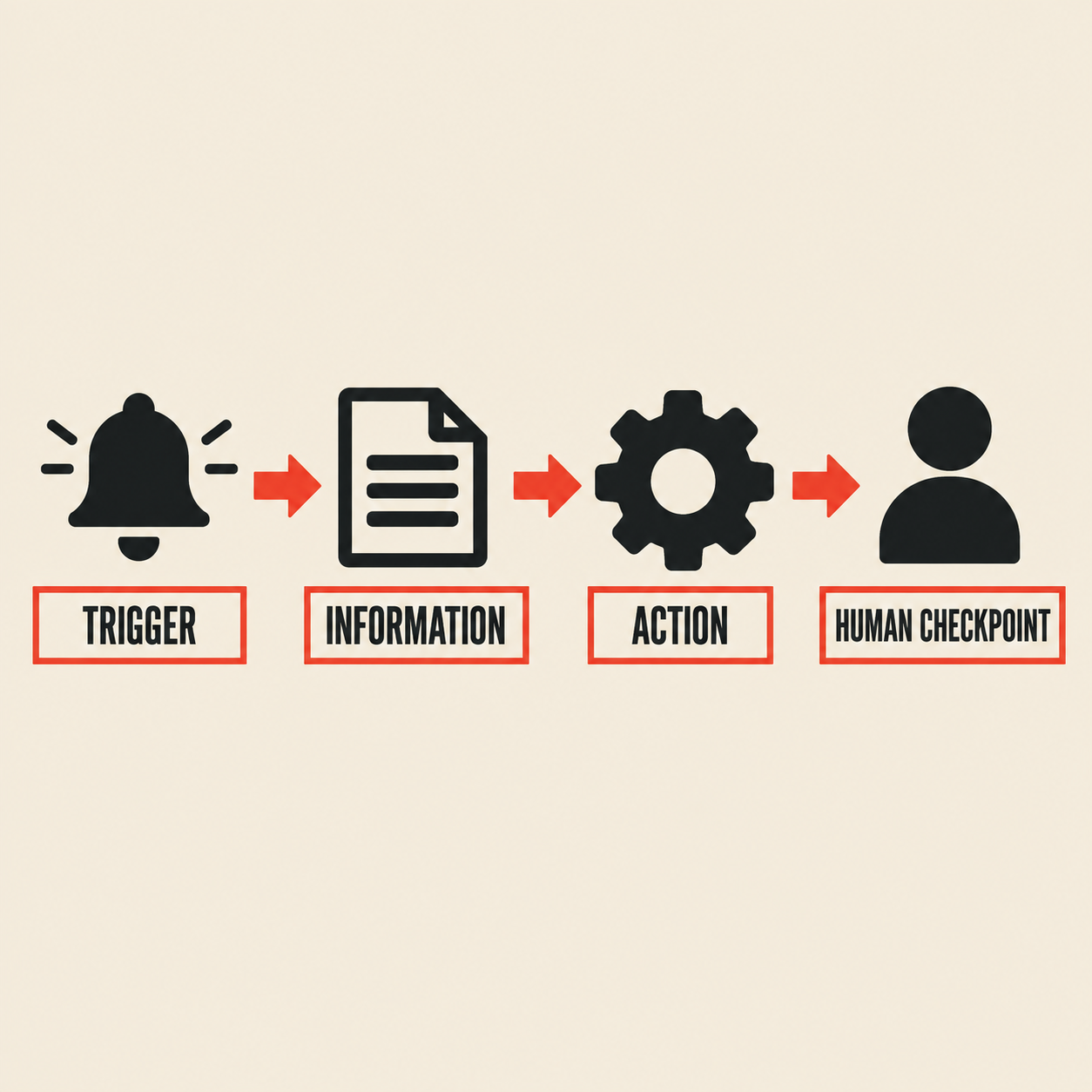
A workflow, however it is described, is built from the same four parts. A trigger starts it, such as a new website enquiry or an invoice being marked paid. The workflow then gathers the information it needs, from the message itself, your customer list, or a price list you have approved. It takes an action: creating a record, sending a message, booking a slot or drafting a reply. And for anything involving money, a promise to a customer or a sensitive situation, a human checkpoint holds the result for a person to approve before it goes out.
The AI part typically sits inside the information and action steps, reading an unstructured message such as an email or a form submission and turning it into something the rest of the workflow can use. An agency's real skill is not the AI model itself, since most agencies draw on similar underlying tools. It is the surrounding work: mapping your actual process accurately, connecting the right systems without breaking anything, writing clear rules for what the AI may and may not decide on its own, and testing with real examples from your business before anyone relies on it.
A reasonable engagement typically moves through a few stages. First, a conversation about your workflow and tools, sometimes structured as a paid discovery or audit rather than a free call. Second, a written scope describing exactly what will be built and, just as importantly, what it will not do. Third, the build and test phase, usually against real examples pulled from your own business rather than generic demos. Fourth, a handoff where you can see, and ideally access, the automation directly rather than only through the agency's own dashboard. And finally, an agreed plan for support and changes afterwards, since a workflow that is never touched again tends to drift out of date as your business changes.
What should you check before hiring one?
Use this as a working checklist during any sales conversation. A good agency should be comfortable answering every item directly, without vague reassurance.
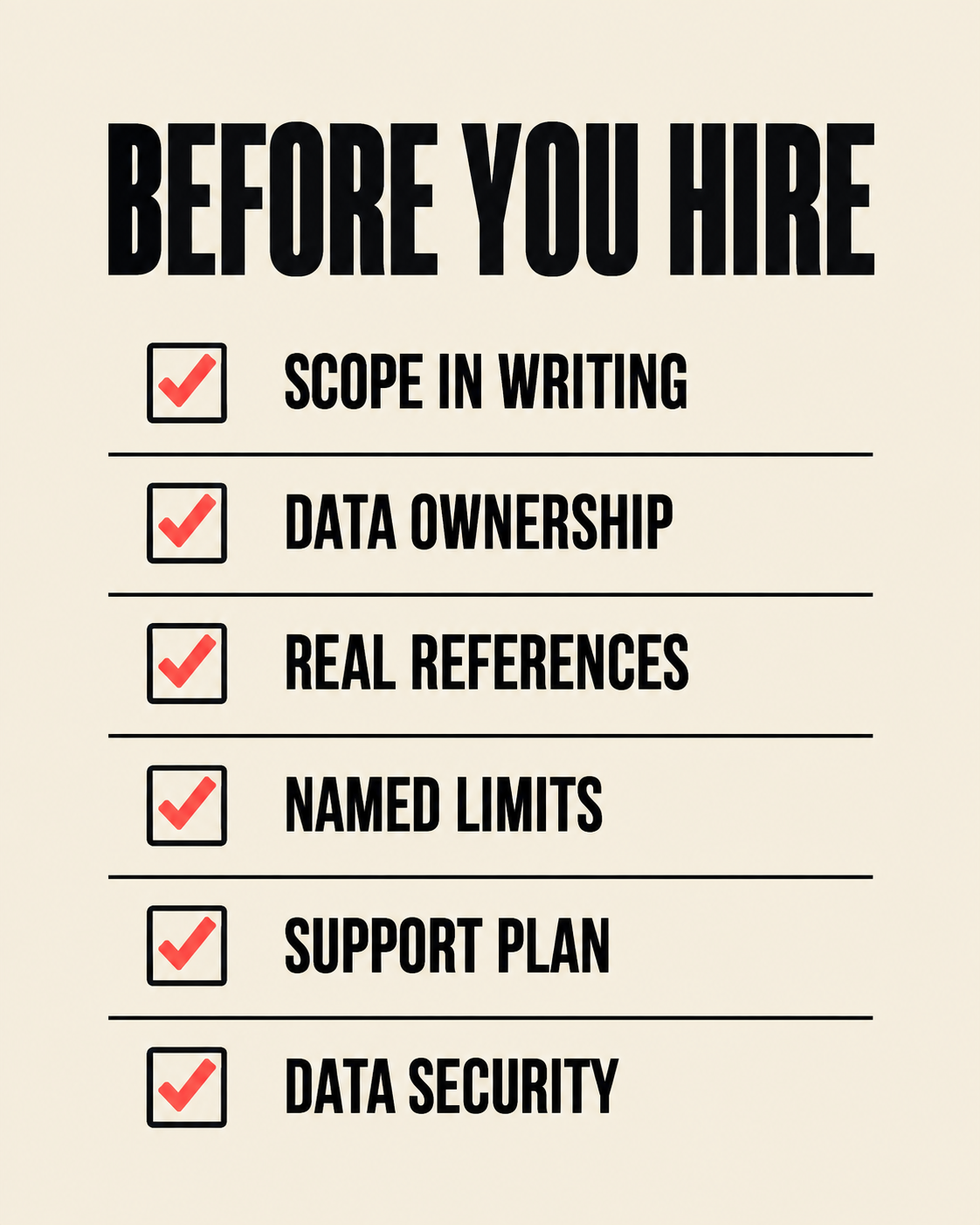
Can they describe your workflow back to you in plain language? If an agency cannot explain, in your own words, where your enquiries currently come from and where they get stuck, they have not understood your business yet, whatever they go on to propose.
Do you own and control where the automation lives? Some agencies build inside accounts and tools you already pay for and control. Others build inside their own platform, which can make switching providers later harder and more expensive. Ask directly who owns the automation once it is built, and what happens to it if you leave.
What do they say should not be automated yet? An agency that only ever talks about what can be automated, and never names a limit, is worth a second look. A credible one will usually flag at least one thing that should stay manual for now.
Can they point to work with businesses your size, doing something similar? Polished case studies from very large companies do not tell you much about how an agency handles a five person service business. Ask for an example closer to your own scale.
Is the scope, price and timeline written down before work starts? A short scope document, even an informal one, protects both sides. Be cautious of any agency that wants a signature before anything specific has been described in writing, including a realistic sense of how long the build will take.
Who maintains it after launch, and what does that cost? Automations need occasional adjustment as your business changes. Ask what ongoing support looks like, whether it is included, and what happens if you want to leave the arrangement later.
How do they handle customer information? Ask plainly where customer details are stored, who can see them, and how they are protected. In Canada, privacy law can apply to how customer information is collected and stored, so a provider who cannot answer this clearly is a real concern, not a technicality.
What does this look like in practice?
These are examples of the kind of engagement an AI automation agency might scope, to make the checklist above concrete. They are examples only, not a promise of what any specific engagement would include, since the right approach always depends on the tools and process already in place.
Example: an HVAC company drowning in dispatch calls. The agency's discovery call reveals that incoming service requests arrive by phone, text and a website form, and none of them land in one place. The scoped workflow logs every request into a single job list, drafts a same day or next day slot suggestion based on the technician's existing calendar, and sends a confirmation text. A person still confirms every booking and handles anything flagged as an emergency.
Example: a small online retailer buried in order questions. Most incoming messages are the same handful of questions about shipping times, sizing or returns. The agency builds a workflow that drafts an answer to routine questions for a staff member to send with one click, and automatically flags anything about a damaged order or a complaint for a person to handle directly, with no automated reply sent on those.
Example: a small accounting practice managing new client intake. New client paperwork arrives in a dozen formats and gets lost across email threads. The agency builds a workflow that sends a document checklist, tracks what has arrived against what is still needed, and reminds the client automatically. Every document is still reviewed by a person, and no financial advice or filing is automated.
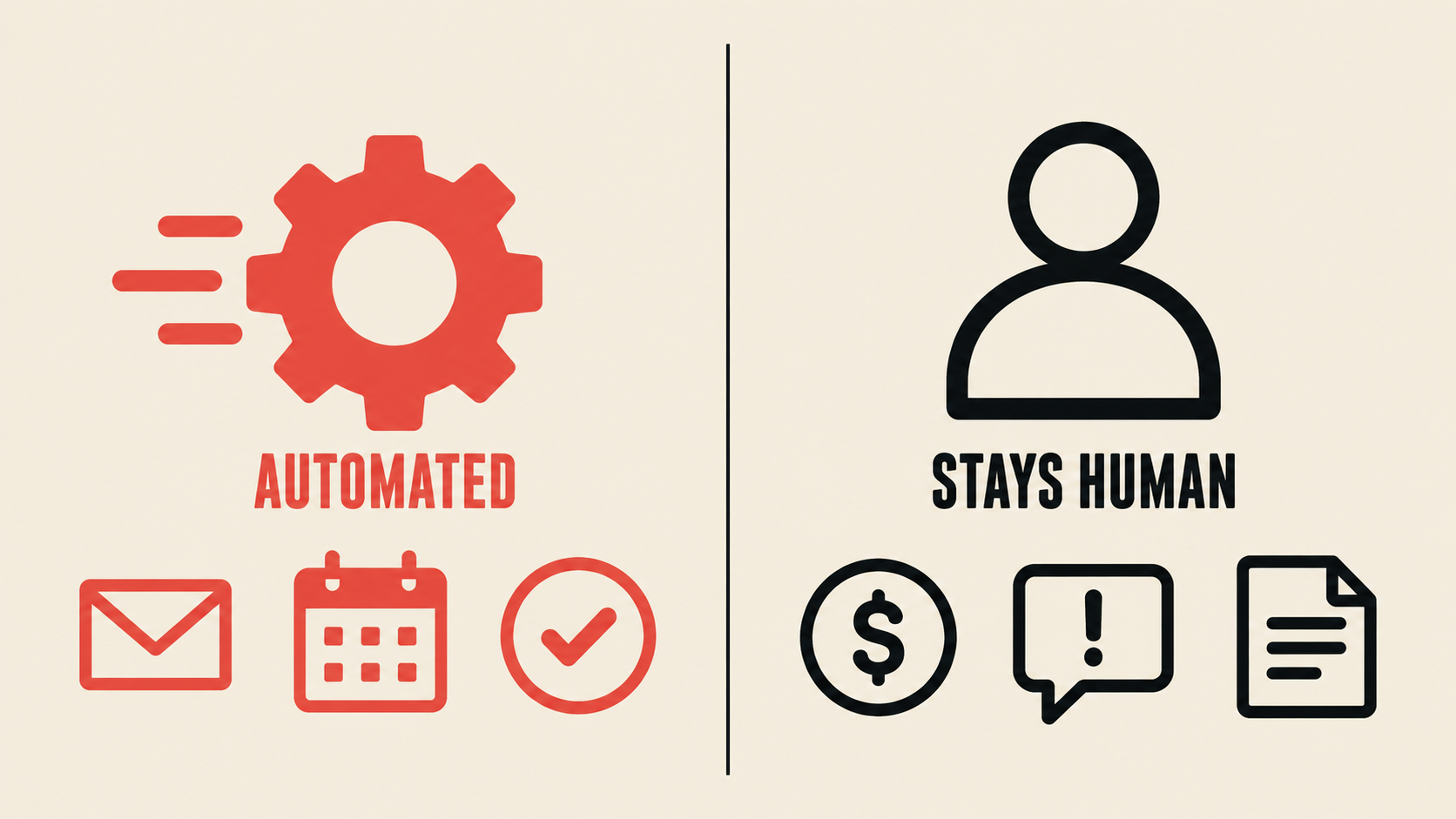
In each case, the pattern is the same: the agency automates the coordination and the chasing, and a person keeps the judgment calls.
What should stay a human decision, even after automation?
However good the agency, some decisions should never be fully handed to an automated system. Anything involving prices, contracts, discounts or refunds. Any promise made to a customer about timing, availability or outcomes. Complaints, upset customers and anything emotionally sensitive. Genuine emergencies, such as a safety issue or a service failure that needs an immediate human response. And any decision that would require sharing more personal information than the task actually needs.
A few patterns are worth treating as warning signs during the sales process itself, separate from judging the automation once it is running. Be cautious of an agency that promises a specific dollar figure in savings before it has looked at your actual process. Be cautious of pressure to sign a long contract before a scope has been written down. Be cautious if nobody can explain, in plain terms, what happens to your data or your automation if you decide to leave. And be cautious of an agency that cannot name a single task it would not automate for your business, since that usually means it has not thought carefully about your specific risk, only about closing the sale.
Who does hiring an agency suit, and who should wait?
Hiring an AI automation agency tends to suit businesses with a steady, real volume of repetitive enquiries, bookings or admin tasks spread across more than one tool, and an owner or manager who can describe roughly how the work happens today, even informally. It suits businesses that already use a calendar, a customer list or an accounting tool that do not talk to each other, since connecting existing tools is usually where an agency adds the most value. Good ai automation for small business tends to start with one clear task, not a full rebuild of how you operate.
It is probably too early if you are still deciding how the business should run day to day, since automating an unclear process usually just moves the confusion around faster. It may also be more than you need if your enquiry volume is small, a handful a week, where a simple checklist or an off the shelf tool you set up yourself could cover the same ground for less money and less commitment. And it is not the right fit for anyone hoping to remove all oversight, since that is not a realistic outcome from any provider, whatever the pitch says.
If you are unsure which category you fall into, spend a week writing down every repetitive task you or your team handle and roughly how long each one takes. That short list, brought to a first conversation with any agency, tells you quickly whether the idea is worth pursuing and gives the agency something concrete to respond to instead of a vague brief.
What a well chosen agency can add
- +A faster, tested build than doing it yourself
Agencies that do this daily can usually design and test a workflow faster than a business building its first one from scratch.
- +An outside view of what is actually worth automating
A good agency will tell you when a task is not worth automating yet, not just what it can build.
- +Fewer costly setup mistakes
Connecting business tools incorrectly can cause real problems, such as duplicate records or missed messages. Experience helps avoid the common ones.
- +Documentation you can hand to someone else
A properly scoped engagement leaves you with a written record of how the automation works, not something only the agency understands.
- +Room to start small
A single well chosen workflow can prove the idea before you commit to anything larger.
- +Ongoing support if you want it
Many agencies offer a maintenance arrangement so the automation gets adjusted as your business changes, rather than quietly breaking.
- +Time back for the parts of the job that need you
The point of a good automation is not removing people, it is freeing them for the work that actually needs judgment.
What does it cost, and what should you ask about pricing?
Cost depends on a handful of factors rather than a single number: how many workflows you want built, how many separate tools need to be connected, how consistent and complete your existing information already is, how much testing and review the work needs, and whether ongoing support after launch is included or billed separately. Because those factors vary so much between businesses, we do not publish a single figure here, and you should treat any agency that quotes a firm price before understanding your workflow with some caution.
What is worth asking directly: is this a fixed price for a defined scope, an ongoing retainer, or a paid discovery phase before a larger project is scoped? What exactly is included in that price, and what would trigger an additional cost? What is a realistic timeline for the work, given the scope described? Is support after launch included, and for how long? The clearest way to get an honest answer is to describe your actual busiest repetitive tasks and ask what is realistic for that specific work, rather than asking for a general price.
A sensible next step is a short, low pressure conversation. Message us on WhatsApp at +1 306-518-7811 or call +1 833-998-1234. You can also book a free 15-minute discovery call at underdogcreativesolutions.com/contact.
How Underdog approaches AI business automation
Underdog Creative Solutions is a Saskatoon based agency working with small and growing businesses across Canada and the United States. Our AI business automation work, including custom AI agents, CRM automation and AI integrations, is built inside the tools you already use wherever possible, rather than asking you to move your business onto a new platform.
We also build websites, create ongoing content and set up AI receptionists, and for many businesses the four connect naturally. A modern website that Google and AI tools such as ChatGPT can read gives customers a clear place to find you. Ongoing content builds visibility and trust over time. An AI receptionist answers calls and messages and captures the details. Automation then carries that information into your customer list, your calendar and your follow ups, so nothing gets typed in twice.
You do not need all four to start. Most businesses begin with the one causing the most day to day friction, and we would rather help you work out which that is than sell you a bundle you do not need yet.
Frequently asked questions
Talk to Underdog about your business
Have questions about your website, content, AI receptionist or business automation? Message us on WhatsApp at +1 306-518-7811 or call +1 833-998-1234. You can also email support@underdogcreativesolutions.com.
Follow Underdog Creative Solutions on Facebook, Instagram, LinkedIn, and YouTube for practical AI and marketing ideas for Canadian small businesses.