// SMALL BUSINESS
AI Implementation for Small Business: A Step by Step Guide for Canadian Owners
AI implementation means picking one real task in your business, building a working AI supported process for it, testing it against your own work until it is reliable, and then reviewing it every month so it keeps fitting how your business actually runs. It is not the same as buying a chatbot subscription or turning on a feature inside software you already use. Those are tools. Implementation is the job of making a tool actually work inside your business, and keeping it working. Most owners start the wrong way around. They read about an AI tool, try it on a slow Tuesday afternoon, get an impressive demo result, and then never touch it again because nobody owns it, nobody tested it against a real busy day, and nobody comes back to check whether it still fits three months later. That gap, between trying a tool and actually running a system, is what this guide walks through, in the order it should happen.
Why AI implementation usually stalls before it starts
Most of what gets written about AI implementation falls into one of two camps. Either it is a vendor explaining how their specific tool works, or it is a general framework, assess, pilot, scale, with no detail on what actually happens inside those steps. Neither tells you how long a first project realistically takes, who on a five or ten person team should own it, what a monthly check in should look like once something is live, or what should make you stop and wait instead of pushing ahead.
The result is that owners either do nothing, because the whole idea feels too abstract to start, or they buy a tool, try it once, and let it quietly go unused. Both outcomes trace back to the same missing piece: nobody wrote down who is responsible for the workflow after the demo ends.
What AI implementation actually means (and what it does not)
AI implementation is the work of taking one specific, repetitive part of your business and building a working, tested process around it that a named person owns, checks and adjusts over time. The AI part is usually the piece that reads or drafts something, such as sorting an incoming enquiry, summarizing a call, or writing a first draft reply. The implementation part is everything around that: deciding exactly what counts as a trigger, where the information comes from, what the AI is allowed to decide on its own, where a person has to check the result before it goes out, and what happens when it gets something wrong.
Buying a subscription to an AI tool is not implementation. Turning on an AI feature inside software you already pay for is not implementation either, not on its own. Both are a starting point. Implementation is what turns that starting point into something your business actually relies on: documented, tested against real examples from your own work, owned by a specific person, and reviewed on a schedule rather than left to decay quietly in the background.
This is also different from hiring an AI consultant or an AI automation agency, though the three overlap. A consultant often advises on strategy without building anything, which our guide on choosing an AI consultant covers in more depth. An agency usually builds one workflow for you, covered in our guide on choosing an AI automation agency. Implementation is the broader discipline that covers the whole cycle, whether you do it yourself, hire an agency to build it, or do some of each.
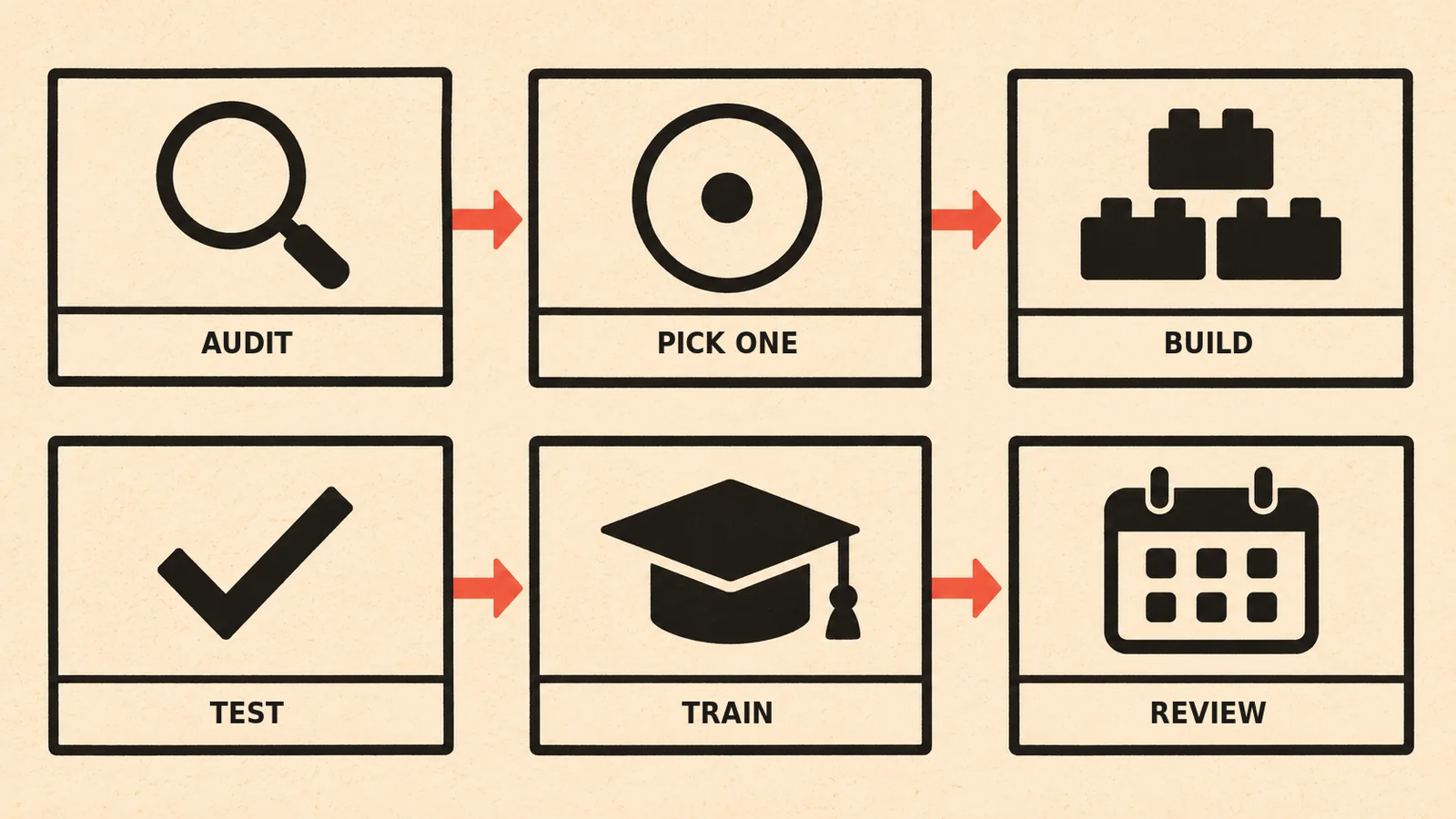
The steps: audit, pick one, build, test, train, review
These six steps are the same whether you do them yourself, with a consultant, or with an agency doing the build for you.
Audit what actually eats your time. For one week, write down every repetitive task that takes real time: answering the same questions, typing the same information into two places, chasing the same documents. Do not guess. A rough tally from memory usually misses the task that is actually costing the most time, because repetitive work tends to feel invisible once you are used to doing it.
Pick exactly one workflow. Choose the task that is both frequent and clearly defined, not the one that sounds most impressive. A task you do the same way almost every time is easier to build around than one that depends heavily on judgment. Resist the urge to automate three things at once. One working system beats three half finished ones.
Build around real inputs, not a demo. Whoever builds it, whether that is you with an off the shelf tool, a consultant, or an agency, needs real examples from your own business: actual enquiries, actual documents, actual call recordings if you have them. A system built only on hypothetical examples tends to fail on the messy real ones.
Test it against a real busy period, not a quiet one. A demo on a slow afternoon tells you almost nothing. Run the new process alongside your current one during a normal or busy week, and compare the two side by side before you switch over fully.
Train the person who will actually use it. The owner trying it once is not training. Whoever handles the task day to day needs to know what the system does well, what it gets wrong, and exactly when to step in and override it.
Review it on a fixed schedule, not when something breaks. Put a 30 minute review on the calendar once a month: has volume changed, has anything in the business changed that the system does not know about yet, is the person using it actually still using it. A system nobody revisits drifts out of date quietly, long before anyone notices it has stopped helping.
A worked example: a small bookkeeping office
This example is illustrative only, to make the six steps concrete. It is not a specific client, a promised outcome, or a typical result.
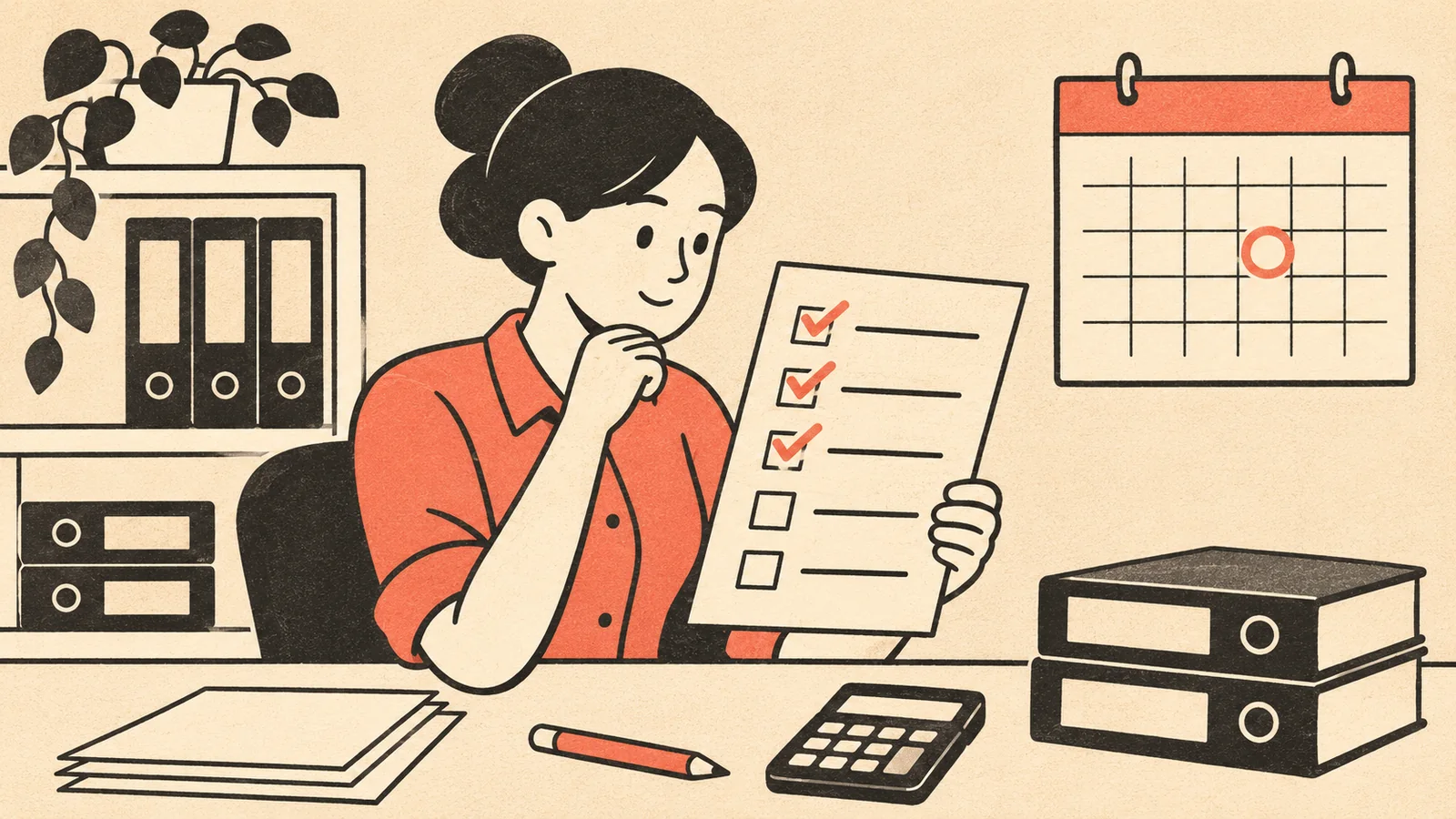
A five person bookkeeping office spends Week 1 tracking every repetitive task and finds that collecting documents from new clients eats the most hours: emails back and forth asking what is still missing, with no single place tracking it. In Week 2, the office picks that one workflow rather than also trying to automate client questions and invoicing reminders at the same time. In Weeks 3 and 4, a workflow is built that sends a document checklist to each new client, tracks what has arrived against what is still outstanding, and sends a polite automatic reminder for anything missing after a few days, using real checklists from the office's own recent clients rather than a generic template. In Week 5, it runs alongside the old manual process for every new client that month, with the office manager comparing how many reminder emails she still had to send herself. By Week 6, the manual chasing has dropped enough that the office switches over fully, the office manager becomes the named owner, and a 30 minute review is booked for the first of every month. No financial advice, filing or client judgment calls are automated at any point. A person still reviews every document.
The pattern to notice: six weeks from first tracking the problem to a working, owned system, not six days, and not six months either.
How long does AI implementation actually take?
For a single, well chosen workflow, a realistic range is four to eight weeks from the first week of tracking the problem to a system you are confident running without close supervision. A simple task with clean, consistent inputs can land at the shorter end. A task that depends on messy or inconsistent information, or that needs several rounds of testing against real examples, takes longer. Be cautious of anyone, whether a tool, a consultant or an agency, who promises a fully working system in a matter of days. That timeline is realistic for turning on a feature, not for building something tested and owned.
The timeline also depends on how much of the audit and testing work falls to you versus whoever is building it. Doing the audit and real world testing yourself, with an off the shelf tool, usually takes longer in owner hours but costs less. Handing the build to a consultant or agency can shorten the calendar time, but the audit, the real examples and the ongoing review still need someone on your side paying attention.
Who this suits now, and who should wait
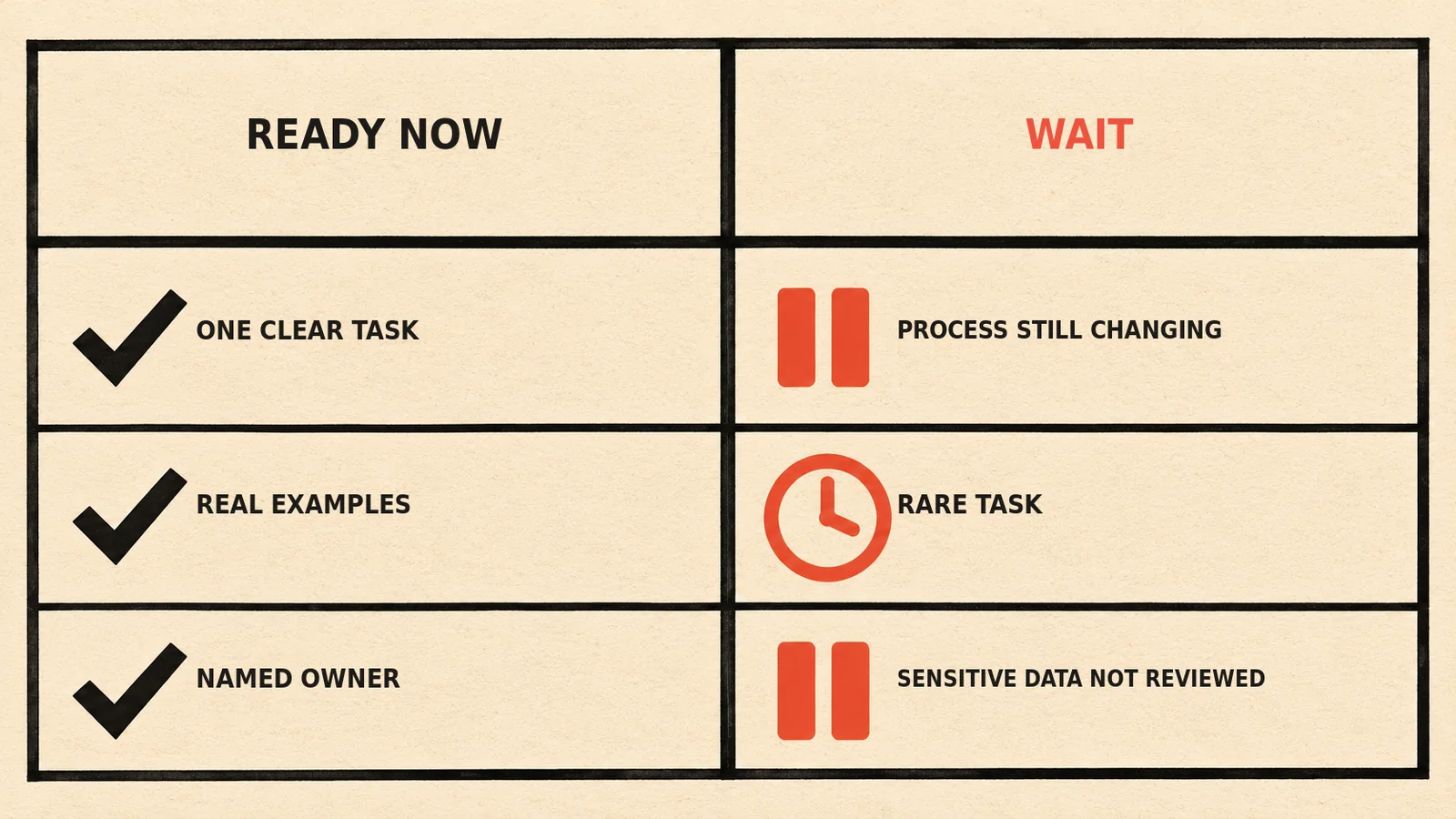
AI implementation is worth starting now if you can already name one specific, repetitive task that happens often enough to matter, you have, or can quickly collect, real examples of that task from your own business, and you can name one actual person, not a vague the team, who will own the result.
It is worth waiting if you are still deciding how the underlying process should work day to day, since implementing around an unsettled process usually just locks in the confusion. It is also worth waiting if the task you are considering happens only occasionally, since the time spent building and testing a system may cost more than the time it saves. And if your business handles sensitive personal information as part of the task, such as financial, health or identity documents, build in time to understand how that information will be stored and protected under Canadian privacy law, including PIPEDA and any applicable provincial equivalent, before anything goes live, not after.
If you are not sure which camp you are in, do the one week audit described above before deciding anything else. It costs nothing but a notebook, and it settles the question quickly.
What a properly implemented system gives back
- +A real task off your plate, not just a tool you tried
A named owner, a tested process and a monthly review mean the work actually stops landing back on you.
- +Fewer costly surprises
Testing against a real busy period before switching over catches problems while they are still easy to fix.
- +A system someone actually understands
Documenting the process means it survives staff changes instead of living only in one person's head.
- +Room to expand carefully
A first workflow that genuinely works gives you a template for deciding what to automate next, and what to leave alone.
- +A record you can hand to someone else
Written steps and a known owner mean a new hire or a different provider can pick the system up without starting over.
- +Time back for the judgment calls that need you
The point of implementation is not removing people, it is freeing them for the parts of the job that actually need judgment.
How Underdog approaches AI implementation
Underdog Creative Solutions is a Saskatoon based agency working with small and growing businesses across Canada and the United States. Where many providers stop at advice or at switching on a tool, our AI business automation work, including custom AI agents, CRM automation and AI integrations, covers the full implementation cycle: the audit, the build around your real examples, the testing, and an ongoing review arrangement so the system does not quietly go stale.
We also build websites, create ongoing content, and set up AI receptionists, and for many businesses the four connect naturally once one workflow is running well. You do not need all four to start. Most businesses begin with the single task causing the most day to day friction, and we would rather help you identify that one task than sell you a bundle you do not need yet.
What does AI implementation cost?
Cost depends on a handful of factors rather than one number: how much of the audit and real example gathering you can do yourself versus hiring it out, how many systems need to be connected, how consistent your existing information already is, how much testing a reliable result needs, and whether an ongoing monthly review is included or billed separately. Because those factors vary this much between businesses, we do not publish a single figure here, and you should be cautious of anyone who quotes a firm price before understanding your actual workflow.
Worth asking directly, whichever route you take: what is a realistic timeline for this specific task, given what you have described? What exactly is included, and what would trigger an extra cost? Is the monthly review included, or a separate ongoing arrangement? And how is customer or client information handled and protected along the way?
A sensible next step is a short, low pressure conversation. Message us on WhatsApp at +1 (306) 518-7811 or call +1 (306) 518-7811. You can also book a free 15-minute discovery call.
Frequently Asked Questions
Talk to Underdog about your business
Have questions about your website, content, AI receptionist or business automation? Message us on WhatsApp at +1 (306) 518-7811 or call +1 (306) 518-7811. You can also email support@underdogcreativesolutions.com.
Follow Underdog Creative Solutions on Facebook, Instagram, LinkedIn, and YouTube for practical AI and marketing ideas for Canadian small businesses.