// SMALL BUSINESS
Business Process Automation for Small Business: A Plain Language Explainer

Business process automation is using software, often including AI, to carry a repetitive, multi-step task in your business from start to finish, with a person stepping in only to approve the result or handle anything unusual. For a small business, this usually starts with one specific, recurring piece of work, such as how a new enquiry gets logged and answered, and connects the tools you already use so that work happens the same way every time, instead of someone retyping the same details into two or three places. Most of what ranks for this search explains the idea through enterprise examples: robotic process automation platforms, business process management software, and consultants pitching hyperautomation to companies with dedicated IT departments. None of that is built, or priced, for a business with a handful of staff. This guide explains business process automation in plain terms, with no RPA jargon, and focuses on what a small business can realistically start with, what should stay a manual, human step, and how to tell whether this is worth doing yet.
Why does most business process automation content not apply to a small business?
Searching for an explanation of business process automation turns up three recurring problems for a small business owner.
The first is vocabulary. Terms such as robotic process automation, business process management, workflow orchestration and hyperautomation get used by different providers to mean overlapping but not identical things, and some content treats them as interchangeable. None of that vocabulary is required to understand or start using the idea.
The second is scale. Much of what ranks uses examples built around large organizations: multiple departments, dedicated IT staff, and processes spanning several internal systems most small businesses do not have. A business with five staff and one shared inbox does not need, and usually cannot use, the same approach as a five hundred person company.
The third is unverifiable numbers. Several guides quote broad percentage figures for cost savings or hours recovered without explaining where those figures came from or what business they were measured on. Treat a number like that with real caution. Your own result, if any, depends entirely on which task you automate and how much time it currently takes, not on a percentage borrowed from someone else's business.
What is business process automation, in plain terms?
Business process automation means using software, usually including some AI, to carry out a repetitive, multi-step task consistently, without a person manually doing each step every time. The word process is doing real work here. This is not about automating a single click. It is about automating a short sequence, such as everything that happens between a new enquiry arriving and a reply going out, or between a job finishing and an invoice being sent.
It helps to separate this from two related ideas you may also see mentioned. Robotic process automation, often shortened to RPA, usually refers to older style tools that mimic clicking through a specific piece of software exactly the way a person would. It tends to break if that software's screens change, and it is rarely the right starting point for a small team. A simple automation tool, such as a basic email filter or an if this then that style app, can be enough on its own for automating one small, single step task, with no need to call it business process automation at all. What this article covers sits between those two: a short, defined process built to handle real variation in the information coming in, such as a messy enquiry or a missing detail, usually with some AI involved in reading or sorting that information, and a clear point where a person reviews or approves the result.
In short, it is not one tool. It is a way of describing a recurring piece of work, whatever software ends up running it, and it is one of the more approachable ways for a small business to automate repetitive tasks without hiring a full technical team.
How does a small business process automation actually work?
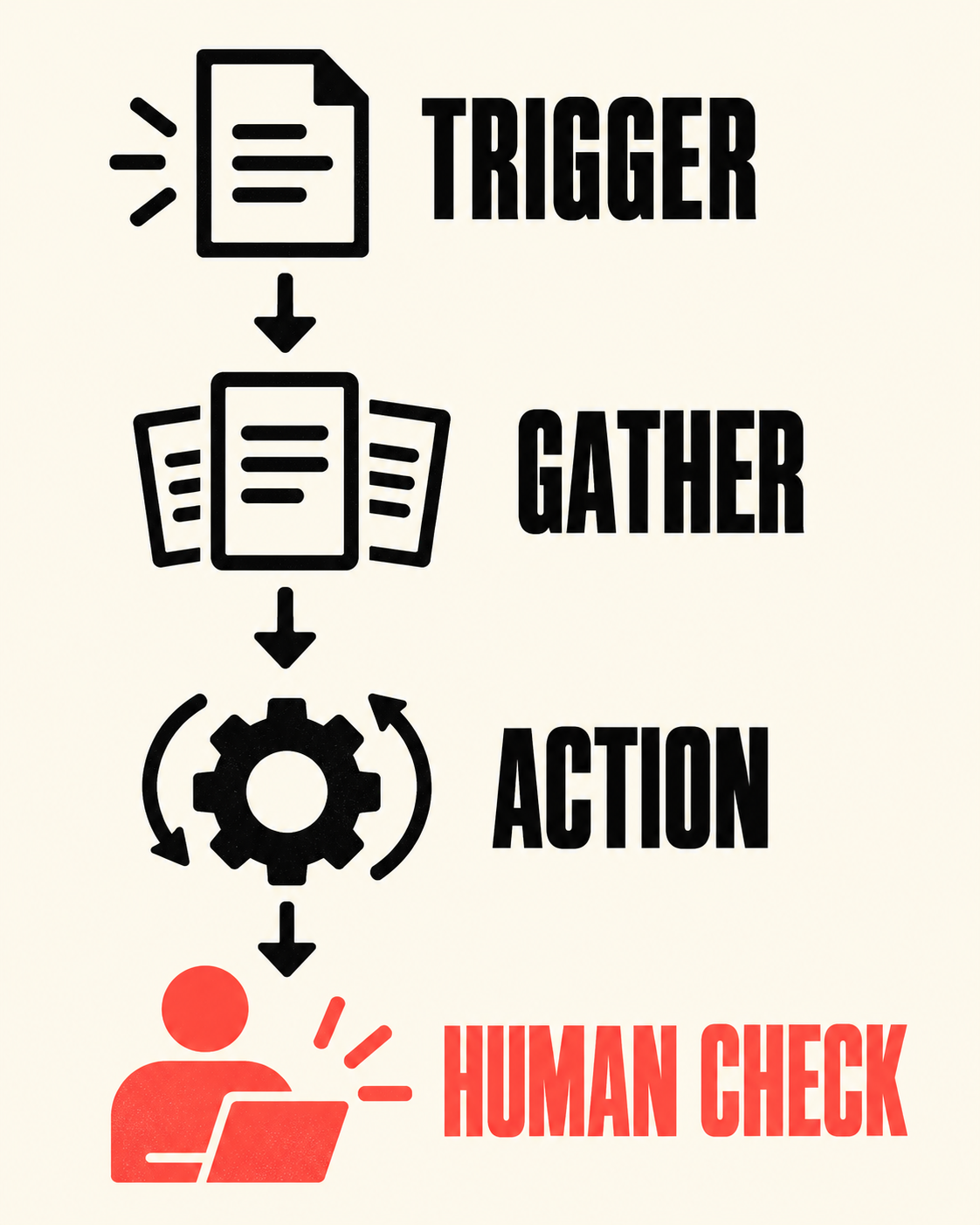
Most business process automation, including what some providers call ai workflow automation, is built from the same four parts, regardless of the specific tools involved.
A trigger starts the process: a new form submission on your website, an email arriving at a shared inbox, an invoice being marked paid, or a calendar booking being confirmed.
The process then gathers what it needs: details from the trigger itself, information already stored about that customer, or a price list or availability calendar you have already approved.
It takes an action: creating a record, sending a reply, updating a spreadsheet or your accounting software, or booking a slot.
And for anything involving money, a commitment to a customer, or a judgment call, a human checkpoint holds the result for a person to review before it goes out, rather than sending it automatically.
The AI part, where it is used, usually sits in the gathering step: reading an unstructured message, such as a typed enquiry or a scanned form, and turning it into the structured information the rest of the process needs. That is usually the part that feels the most impressive, and it is also the part most worth testing carefully before you trust it with real customers.
What is a good first process to automate?
The marketing answer to this question is usually vague. The practical answer is: whichever repetitive task currently takes the most time for the least judgment. A simple way to find it is to track, for one week, every task you or your team repeat more than a few times that does not involve a real decision.
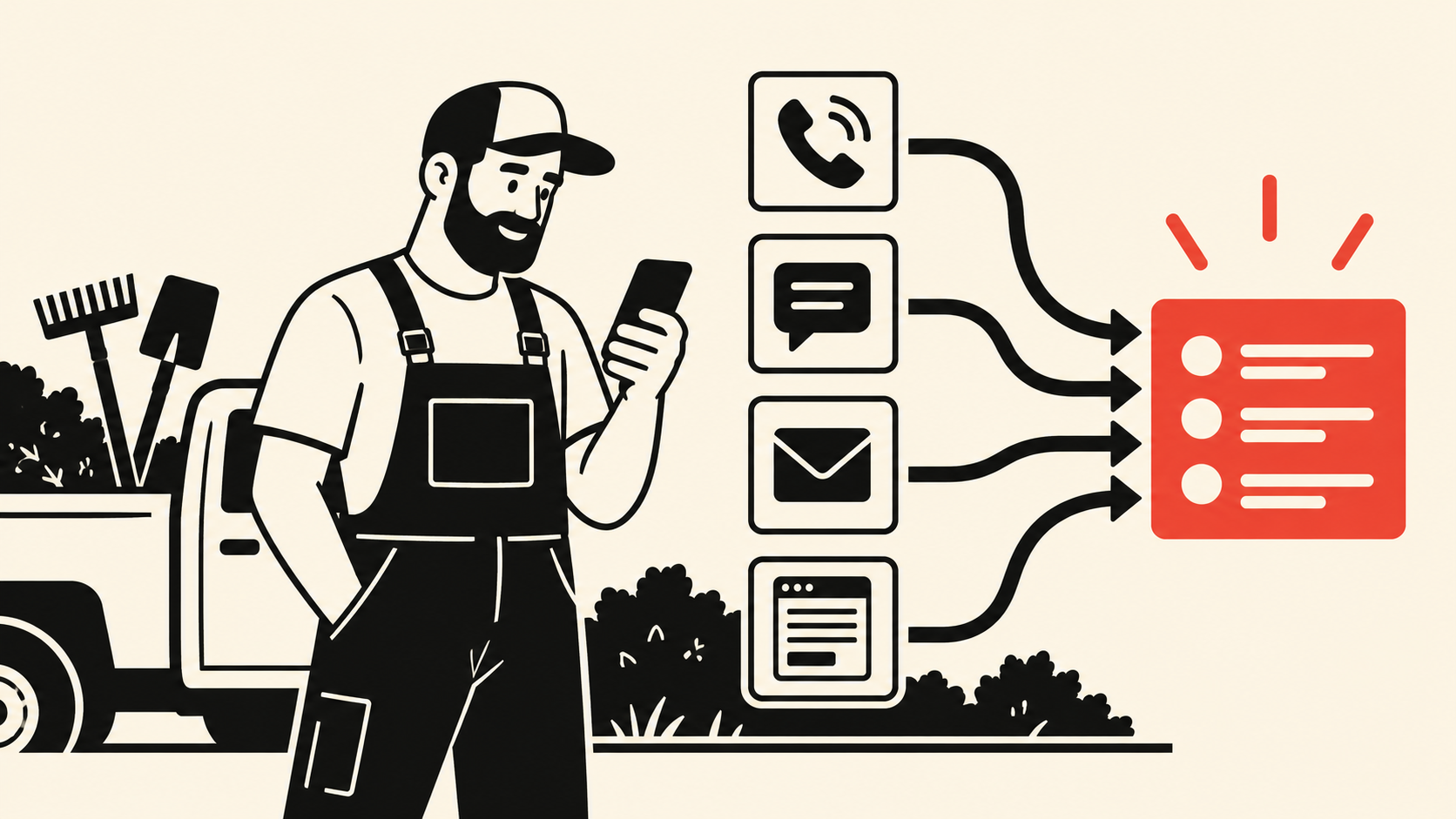
Example: a small landscaping company gets quote requests by phone, text, email and a website form, and every one currently gets copied by hand into a shared spreadsheet before anyone follows up. A first automation might simply log every incoming request into one place automatically and send the customer a short confirmation, with a person still writing and sending the actual quote. That alone removes the copying step without touching the part of the job that needs a person's judgment.
This is an example only, meant to show the size and shape of a reasonable first step, not a specific business or a promise of what any automation would include for your situation. A good first process is usually narrow enough to describe in one sentence, happens often enough to be worth setting up, and does not require a judgment call at the exact point the automation takes over.
What is the difference between automation and AI?
The two overlap but are not the same thing. Automation on its own means a computer reliably repeating a defined set of steps: if a specific thing happens, do a specific thing in response, every time, without a person needing to notice and act. That kind of automation has existed for years and does not need any AI at all. A simple email filter that moves messages from one sender into a folder is automation with zero AI involved.
AI adds the ability to handle information that is not already sorted into a clean rule. Reading a customer's typed message and working out what they are actually asking for, summarizing a long document, or drafting a reply in plain language are things a fixed rule struggles with but an AI model can do reasonably well. In most small business process automation, AI is doing one specific job inside a larger automated process: making sense of messy input well enough that the rest of the process, which is often still simple rule based automation, knows what to do next.
Put plainly, automation is the plumbing and AI is sometimes the part that reads the label on what is flowing through it. You can have automation with no AI. Useful AI in a business process is rare without automation around it to actually act on what the AI worked out.
What should stay a manual, human step?
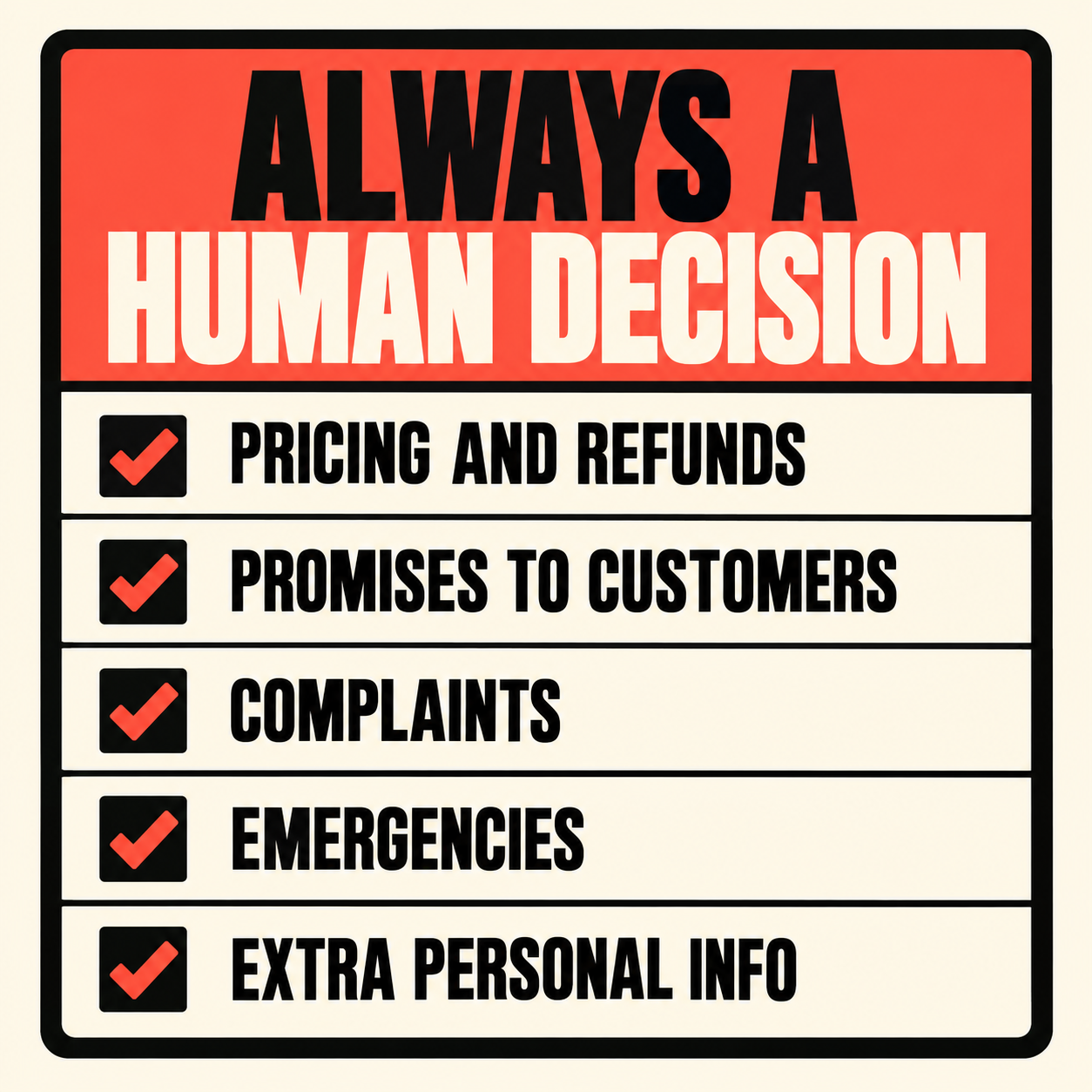
Some parts of a process are worth automating. Others should stay with a person regardless of how capable the tools become. Anything involving a price, a discount, a contract or a refund. Any firm promise made to a customer about timing or availability. Complaints, upset customers, or anything that sounds urgent or unusual. Genuine emergencies that need an immediate human response. And any step that would need collecting more personal information than the task actually requires.
A simple test holds up well here: if getting a step wrong would upset a customer, cost real money, or create a legal or privacy problem, it belongs in front of a person, even if an automated draft or suggestion speeds up getting there. The point of a sensible first automation is removing the repetitive, low judgment parts of a process, not removing the person from it.
Is this only for large companies, or does it work for a small team?
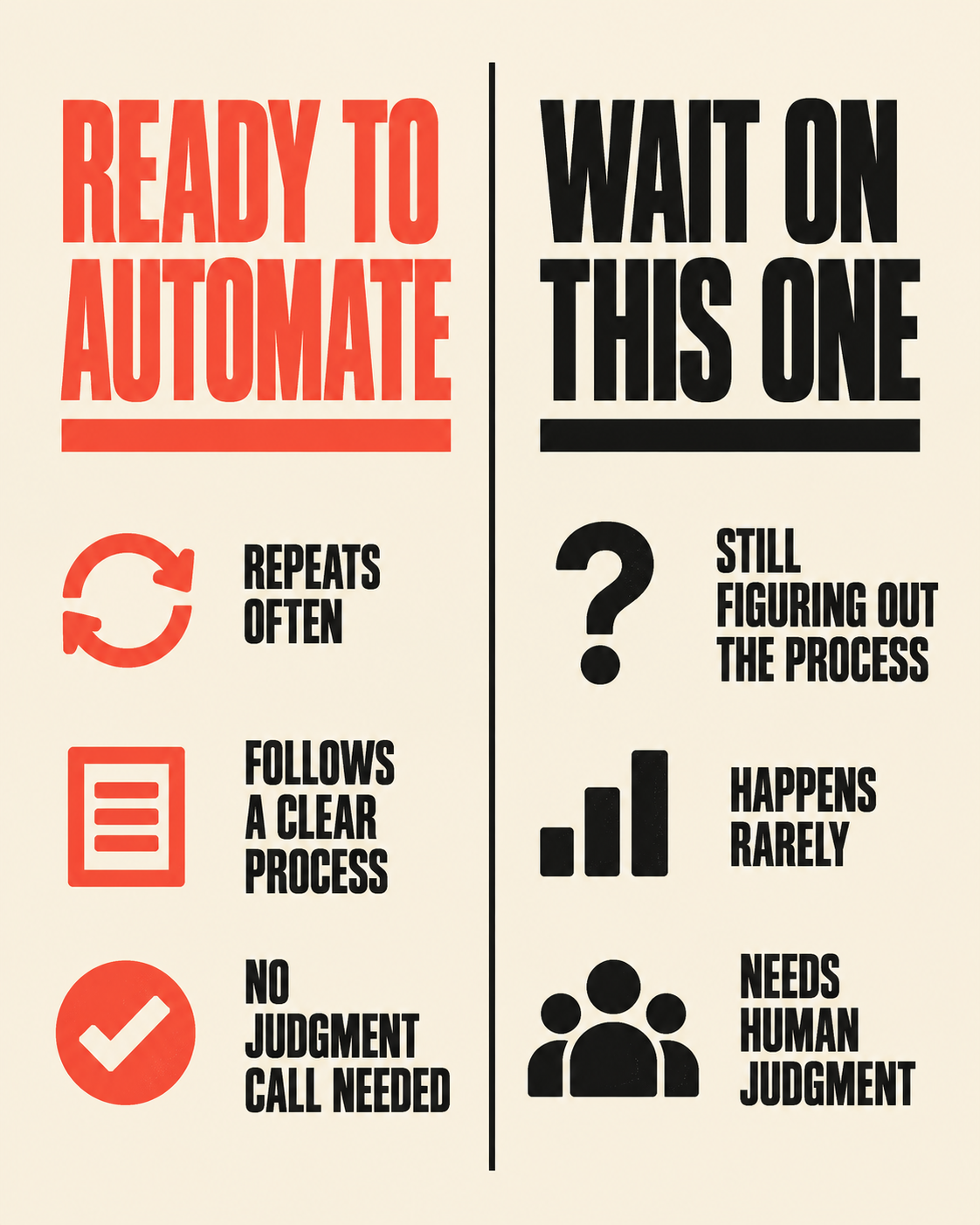
Business process automation is often explained using large company examples, but the underlying idea scales down fine. Small business automation like this tends to work well when a specific task repeats often enough to notice, involves copying or re-entering the same information across more than one place, and does not require a judgment call at the exact point the automation takes over.
It is probably not worth the effort yet if a task happens rarely, if your current process already works and nobody is losing real time to it, or if the business itself is still figuring out how a process should run day to day, since automating an unclear process usually just repeats the confusion faster. A good general rule: automate a process you understand well, not one you are still inventing.
Good ai automation for small business, whether you build it yourself or bring in help, tends to start with one clear task rather than a full rebuild of how you operate. If you are unsure where you fall, spend a week noting every task you or your team repeat that does not need real judgment, and roughly how long each one takes. That short list tells you quickly whether there is a reasonable first project here, and gives any provider you talk to something concrete to respond to instead of a vague idea.
What a well chosen first automation can add
- +A clear time saving on one specific task
Once a single repetitive task is automated well, the time it used to take mostly disappears, since nobody is manually repeating it anymore.
- +Fewer copy and retype errors
Information typed once and reused automatically is less likely to be mistyped or missed than the same details copied by hand into a second or third system.
- +A process that keeps running when you are busy
A well built automation keeps handling its one task even during your busiest days, when manual steps are most likely to get missed.
- +Something you can explain to someone else
A clearly scoped automation, documented properly, is something a new staff member or a future hire can understand quickly, unlike an informal habit that only lives in one person's head.
- +A real basis for deciding what comes next
A first automation that works well gives you solid evidence for deciding whether a second process is worth automating, instead of guessing.
How much does business process automation cost for a small business?
Cost depends on a handful of concrete factors rather than a single number: how many systems need to be connected, how messy or inconsistent the information coming in currently is, how much testing the process needs before anyone trusts it with real customers, whether any AI reading or drafting step is involved, and whether ongoing support and adjustment after launch is included. Because those factors vary this much between businesses, we do not publish a single figure here, and a flat price quoted before anyone has asked about your actual process is a guess, not an estimate.
What is worth asking directly, whether you are talking to Underdog or anyone else: what exactly is included in the price, what would trigger an extra cost, how long the build realistically takes for a process this size, and what happens if you want changes or need support after launch. The clearest way to get a useful answer is to describe your actual repetitive task and ask what is realistic for that specific piece of work, rather than asking for a general price.
A sensible next step is a short, low pressure conversation about your business. Message us on WhatsApp at +1 306-518-7811 or call +1 833-998-1234. You can also book a free 15-minute discovery call.
How Underdog approaches business process automation
Underdog Creative Solutions is a Saskatoon based agency working with small and growing businesses across Canada and the United States. Our AI business automation work, including custom AI agents, CRM automation and AI integrations, starts with one clearly defined process rather than a full rebuild of how you operate, and is built inside the tools you already use wherever that is possible.
For many businesses, automation connects naturally to the rest of what we do. A modern website that Google and AI tools such as ChatGPT can read brings enquiries in. An AI receptionist answers calls and messages and captures the details. Ongoing content keeps bringing people back. Business process automation is often the piece that carries information between all of those, so nothing has to be typed in twice.
You do not need all of that to start. Most businesses begin with automating the one task causing the most day to day friction, and we would rather help identify that task than sell a bundle you do not need yet. If you have already decided you want to bring in outside help rather than figure this out alone, our companion guide on choosing an AI automation agency covers what to ask before you hire anyone.
Frequently asked questions
Talk to Underdog about automating your business
Have questions about business process automation, your website, content, or an AI receptionist? Message us on WhatsApp at +1 306-518-7811 or call +1 833-998-1234. You can also email support@underdogcreativesolutions.com.
Follow Underdog Creative Solutions on Facebook, Instagram, LinkedIn, and YouTube for practical AI and marketing ideas for Canadian small businesses.