// SMALL BUSINESS
AI Consultant for Small Business in Canada: What They Do and How to Choose One
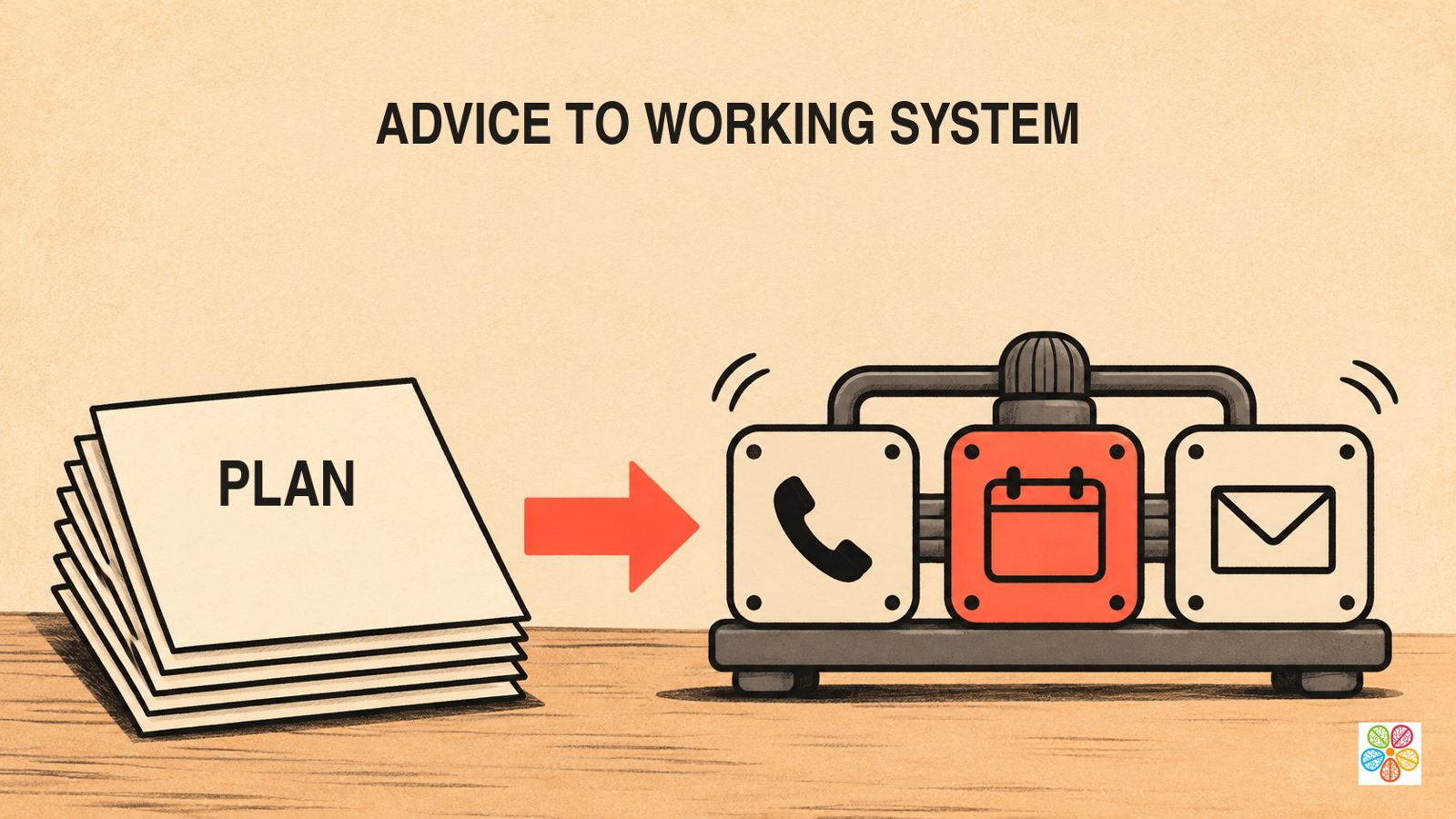
If you are searching for an AI consultant, you are probably past the question of whether AI matters and stuck on a harder one: who do I trust to tell me what to do with it, and what am I actually paying for? Here is the direct answer. An AI consultant looks at how your business runs, finds the few places where AI would save real time or stop work from being dropped, and gives you a plan to act on. A good one for a small business works on a small, defined scope, shows you something working within about a month, and is clear about who builds the system and who keeps it running afterward. That last part is where most engagements go wrong. Advice is the easy half. Implementation, meaning someone builds the thing, connects it to your tools and looks after it, is the half many consultants leave to you. This guide covers what an AI consultant does for a small business in Canada, what the first 30 days should look like, how to choose one, the red flags, what drives the cost, and when the right move is to wait.
Why is hiring an AI consultant so confusing for a small business?
More Canadian businesses are using AI every year. Statistics Canada reported that 19.2% of businesses used AI to produce goods or deliver services in the 12 months before its second quarter 2026 survey, up from 12.2% a year earlier and 6.1% in 2024. (Source: Statistics Canada, Analysis on artificial intelligence use by businesses in Canada, second quarter of 2026.) That growth has pulled a lot of new people into selling AI help, and a small business owner now has to sort through them.
Three things make that hard.
First, almost every guide to hiring an AI consultant is written by someone selling AI consulting. The advice is not always wrong, but it is shaped around the seller's own offer.
Second, the title tells you very little. The person using it might be a former enterprise strategist, a software developer, or a marketing freelancer who learned a few tools last year.
Third, the published prices do not line up. When we reviewed the top search results for this topic in November 2026, the project prices quoted by different sellers were far apart for work described in similar words, and most did not say which currency they meant. That does not mean anyone is being misleading. It means the words AI consulting cover very different amounts of work.
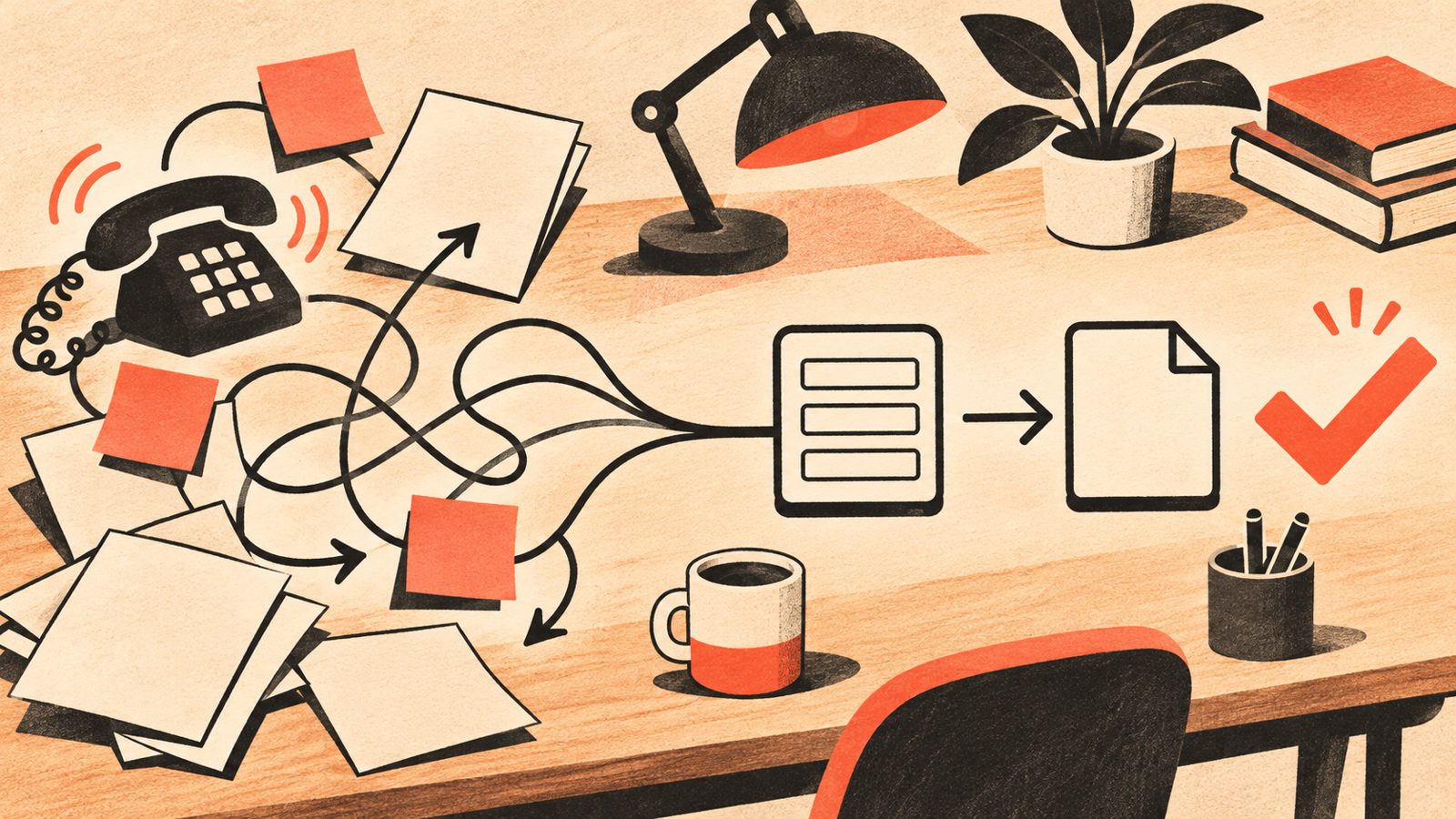
Underneath all of this sits the problem owners feel most: paying for a report. A slide deck that says you should automate your follow up is not the same as follow up that happens automatically. If nobody builds it, nothing changes.
What does an AI consultant actually do for a small business?
Strip away the titles and the work falls into four jobs.
Finding the work worth fixing. The consultant learns how enquiries arrive, how jobs get booked, how quotes and invoices go out, and where things get retyped or forgotten. The output is a short list of specific tasks, ranked by how much time they cost and how safe they are to hand to software.
Matching tools to tasks. For each task on the list, they recommend an approach: a setting in software you already pay for, an off the shelf AI tool, a connection between two systems, or something built for you. A good consultant often recommends the boring option.
Planning the rollout. They decide what goes first, what data it needs, who on your team owns it, and how you will know whether it worked.
Guarding against the risks. They decide where a person must review the output, what customer information may and may not be shared with an AI tool, and what happens when the AI gets something wrong.
What is missing from that list is building. Some consultants build what they recommend. Many do not, and hand you a plan to take to a developer, an agency or your own staff. Neither model is wrong, but you need to know which one you are buying before you sign, because a small business rarely has a spare person to turn a plan into a working system.
What should the first 30 days with an AI consultant look like?
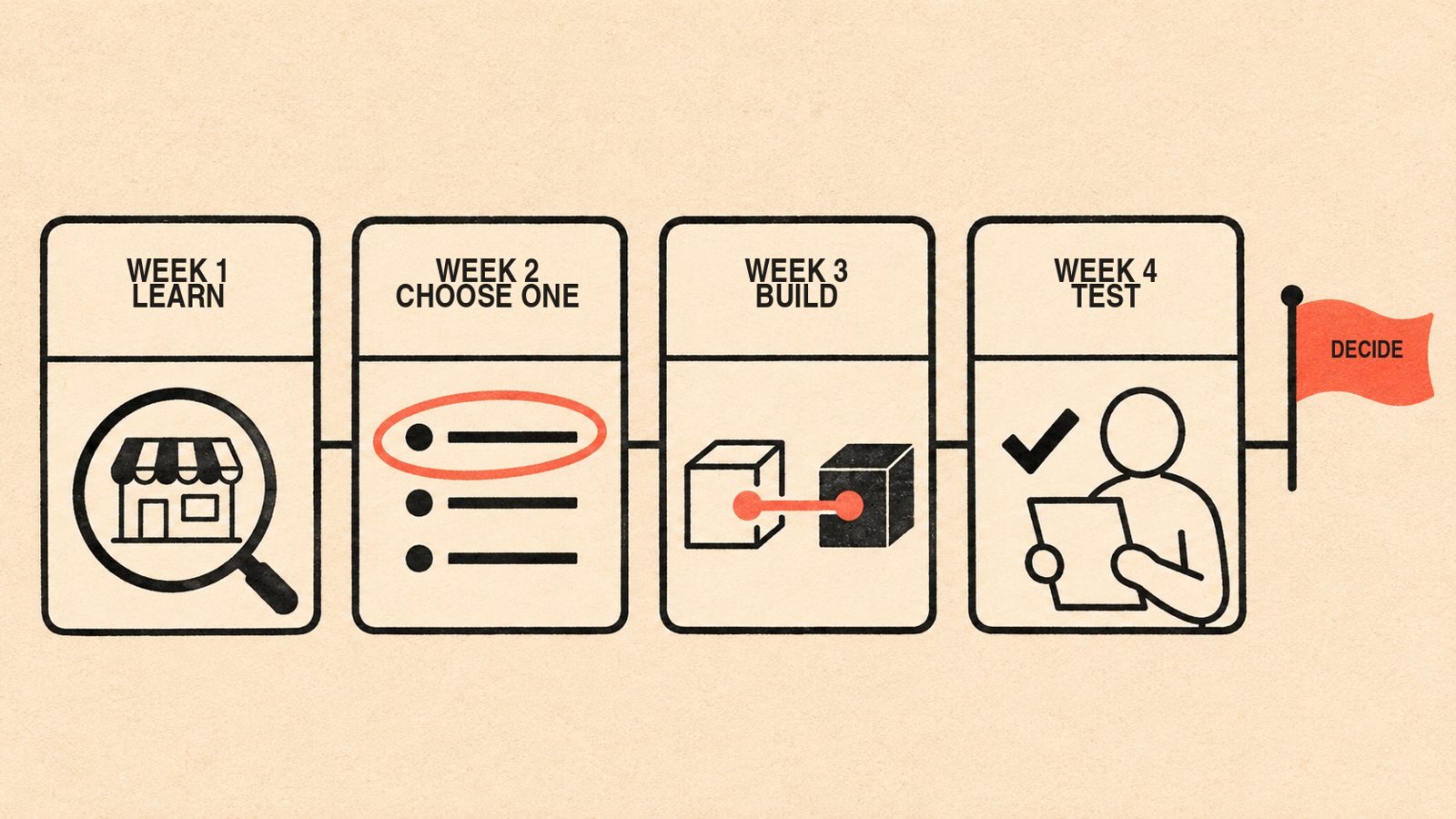
The exact schedule varies, but a small business engagement that is going well tends to follow this shape. Treat it as a yardstick, not a contract.
Week 1: learning your business. The consultant talks to you and to the people who do the daily work, and looks at real examples: recent enquiries, a week of calls, a few quotes, the spreadsheet everyone complains about. You should be asked for numbers, even rough ones, such as how many calls go unanswered or how long a quote takes.
Week 2: a short list and a choice. You receive a ranked list of opportunities in plain language, each with the expected effort, the risk, and what it depends on. Together you pick one workflow to do first. One, not five.
Week 3: a working first version. Whoever is building it, the consultant or a partner, shows you a first version running on real examples from your business. It will be imperfect. That is the point of seeing it early.
Week 4: testing with real work, then a decision. The first version runs alongside your normal process, with a person checking its output. At the end of the month you should be able to answer three questions. Does it work on our real cases? Who looks after it from here? Is the next workflow worth doing?
What the consultant needs from you. This part is rarely mentioned up front. Expect to provide access to the systems involved, one named person on your team who can answer questions, and a couple of hours a week of your own time. If you cannot spare that for a month, the engagement will stall no matter who you hire.
If 30 days pass and all you have is a document, ask why. Sometimes there is a good reason, such as a system that turned out to be hard to connect. Often there is not.
Do you need an AI consultant, an AI agency, or neither?
These labels overlap, so look at what each one delivers.
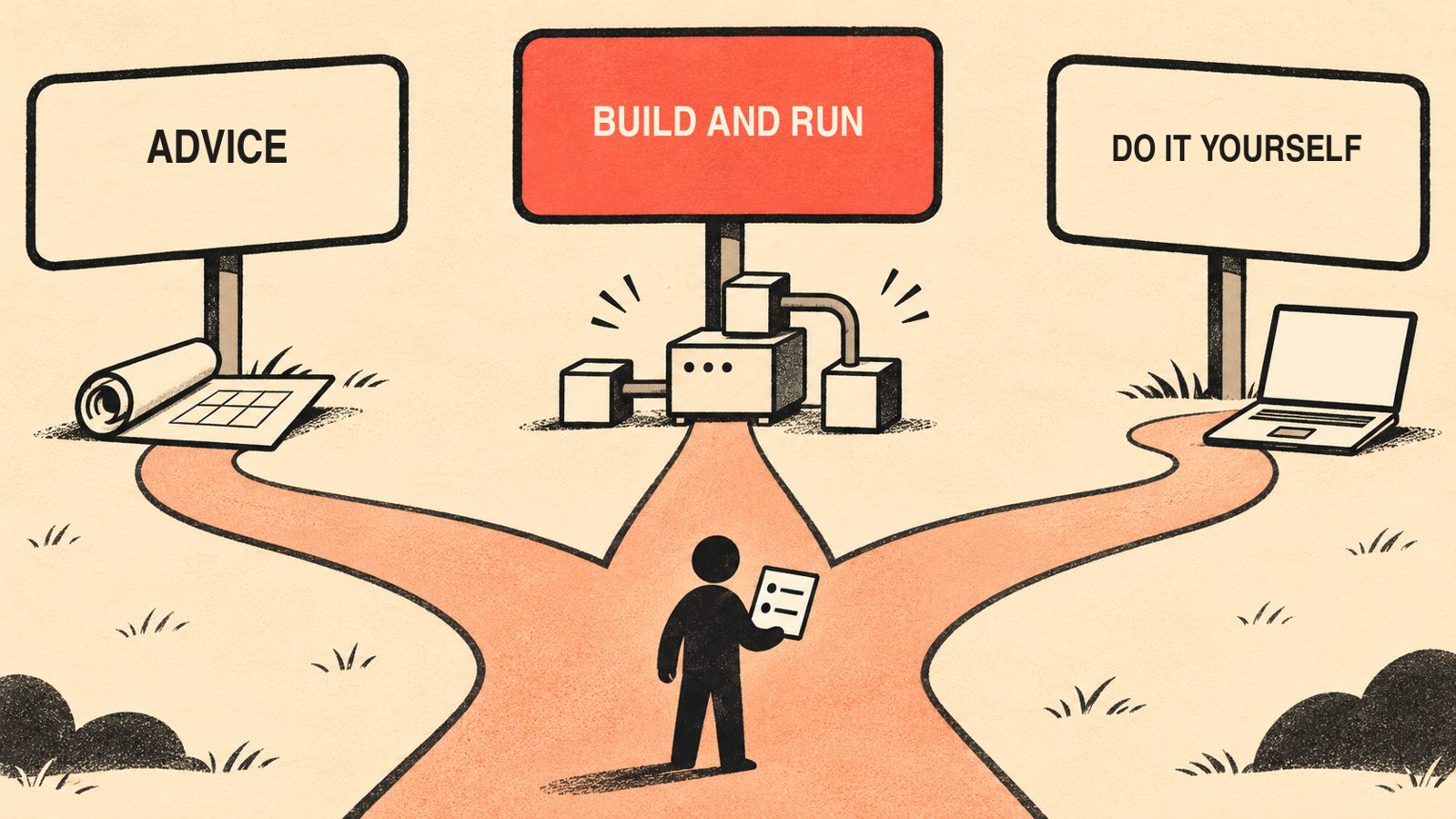
An AI consultant mainly sells judgment: what to do, in what order, and what to avoid. This suits a business that has someone capable of building, or one facing a decision large enough that a second opinion is worth paying for. Large AI consulting firms are generally set up for enterprise projects, so a small business is usually better served by an independent consultant or a small team.
An AI agency or implementation partner mainly sells a finished, working system and usually the upkeep that follows. This suits a business that knows roughly what hurts (missed calls, slow follow up, repeated data entry) and has nobody in house to build the fix.
Neither is the right answer more often than sellers admit. If your need is one or two simple tasks, such as drafting emails faster or summarizing meeting notes, a general AI assistant and an afternoon of practice will likely cover it. If the software you already use has an automation feature you have never switched on, start there.
A quick way to decide. If you can already name the task and you need it built, look for someone who implements. If you cannot name the task and the stakes are high, pay for advice first, but keep the scope small. If the task is small and the stakes are low, try it yourself.
How do you choose an AI consultant in Canada?
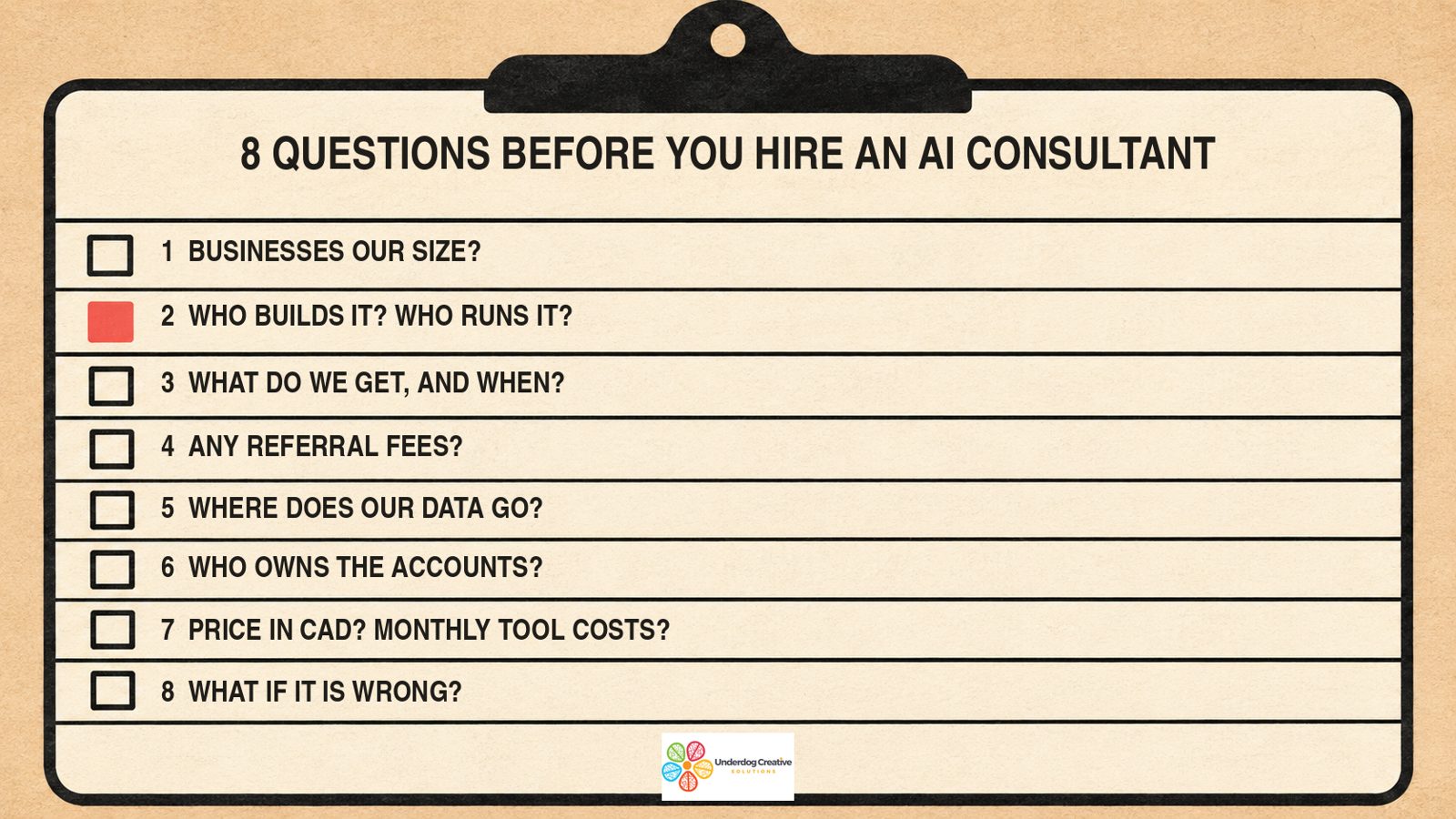
Ask the same questions of everyone you speak to and compare the answers side by side.
1. What have you done for a business our size? Enterprise experience does not transfer cleanly. A plan that assumes a data team and a large budget is no use to a ten person company.
2. Who builds it, and who runs it afterward? Get names. If the answer is that you will need to find a developer, add that cost and delay to the quote in your head.
3. What exactly will we have at the end, and by when? Look for a working thing described in plain words, with a date.
4. Do you earn anything from the tools you recommend? Referral fees are common. They are not disqualifying, but you should know about them.
5. Where will our customer data go? Ask which AI services will see customer names, calls, messages or documents, what those services do with the data, and where it is stored. Canada's federal privacy regulator, together with its provincial and territorial counterparts, has published principles for generative AI which say that accountability rests with the organization using the tool, not with the automated system. (Source: Office of the Privacy Commissioner of Canada, Principles for responsible, trustworthy and privacy-protective generative AI technologies.) In practice the responsibility stays with you, so the person advising you should be able to explain the data flow clearly. This is general information, not legal advice. For anything sensitive, speak to a privacy professional.
6. Who owns the accounts, the prompts and the automations? They should sit in accounts your business controls, so that you can change providers without starting over.
7. Is the quote in Canadian dollars, and what will the tools cost each month? Many AI tools bill in US dollars, so ask for the ongoing subscription costs separately from the consulting fee.
8. What happens when it gets something wrong? There should be a clear answer about human review, how errors get reported, and who fixes them.
You do not need perfect answers to all eight. You do need clear ones.
What are the red flags when hiring an AI consultant?
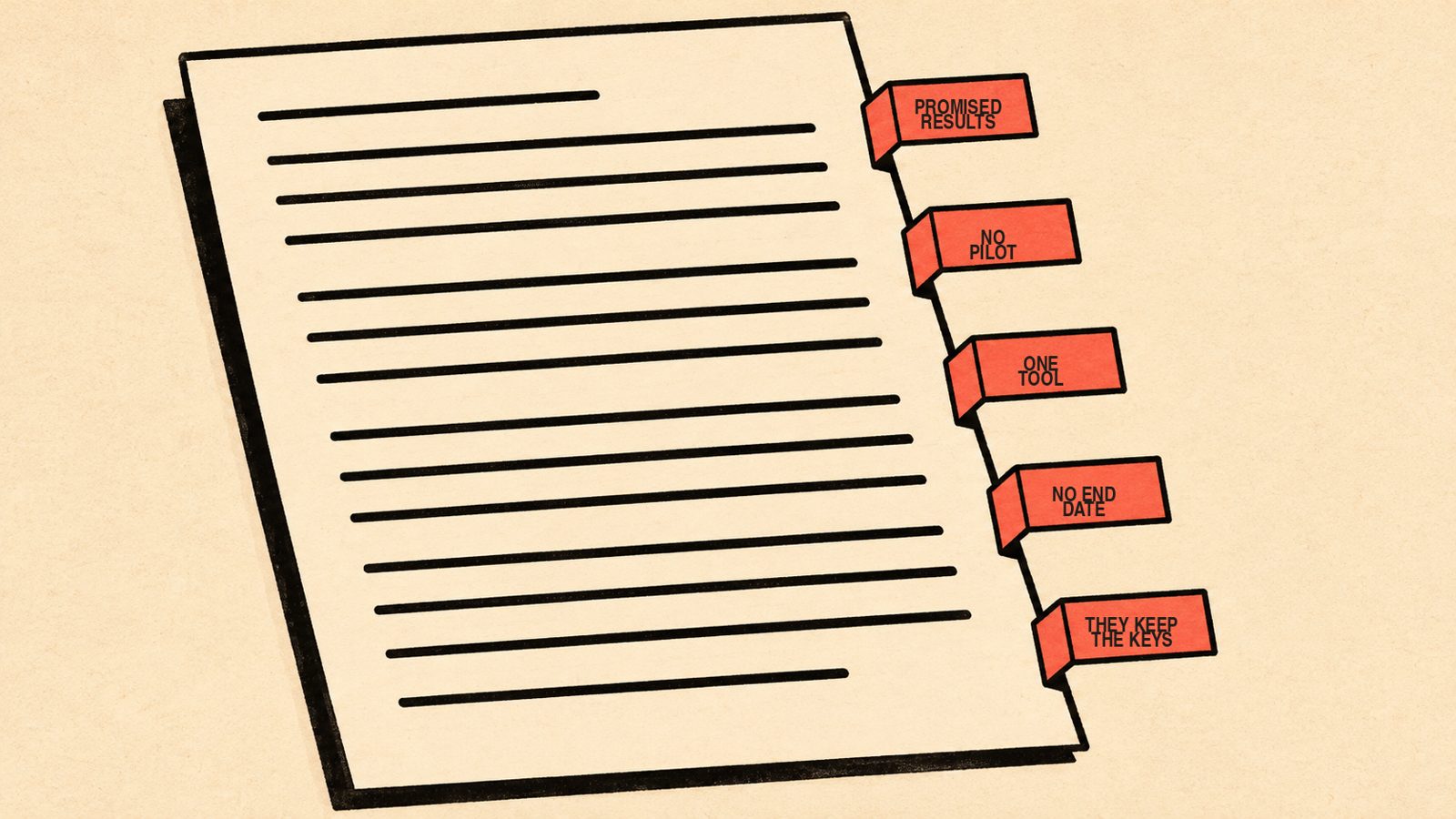
Promised results. Nobody can promise a specific amount of revenue, leads or hours saved before they have seen how your business runs.
A big plan and no pilot. If the first step is a long strategy phase with nothing working at the end, the risk is all yours.
One tool for every problem. If the answer to every question is the same product, you are talking to a reseller.
No questions about your data. Someone who never asks what customer information is involved has not thought about the risk.
No end date. An open ended monthly retainer with no defined deliverables is hard to judge and hard to leave.
They keep the keys. If the automations live in the consultant's accounts and you cannot export them, you are renting your own process.
Vague answers about building. If implementation is something to figure out later, it usually becomes your problem.
When should a small business wait before hiring an AI consultant?
Waiting is sometimes the smart choice. Hold off if any of these describe you.
Your process is not settled yet. If the way you quote or book jobs changes every month, automating it locks in a moving target. Fix the process on paper first.
Your information is scattered. If customer details live in three inboxes, a notebook and someone's memory, the first job is getting them into one place. That is groundwork, and it does not need an AI consultant.
Nobody has time to take part. An engagement needs a named person and a few hours a week. Without that it will drift.
The problem is small. If the pain is a few minutes a day, the fee will outweigh the saving. Try a general AI assistant yourself first.
You are buying because of pressure. Feeling behind is not a reason. A specific, repeated, costly task is.
None of this means doing nothing. Writing down your five most repeated tasks and roughly how long each takes costs an hour, and it makes any later conversation with a consultant shorter and cheaper.
What does a good first engagement look like? A worked example
This is an illustrative example, not a client story. The details are invented to show the shape of a sensible first project.
Picture a six person home renovation company. The owner is on job sites most of the day. Enquiries arrive by phone, by a website form and by text, and many callers who reach voicemail hang up without leaving a message. Quotes go out days late because the details from the first call have to be chased again.
In week one, the consultant listens to how calls are handled and reads a month of enquiries. In week two, the short list has three items: answer and log every call, send a same day acknowledgement with next steps, and draft quotes from site notes. The owner picks the first, because nothing else matters if the enquiry is lost.
In week three, an AI receptionist is set up to answer the calls the team cannot take, collect the job details, and send a summary to the owner's phone. In week four it runs alongside the normal process. The office manager reviews every summary, corrects the questions it asks, and flags two call types that should always ring through to a person: existing customers with a problem on an active job, and anything involving safety.
At the end of the month the owner knows what the system handles well, what it should never handle alone, who maintains it, and what the second project should be. No promise about revenue was needed to make that a useful month.
What should a good AI consulting engagement leave behind?
- +One working workflow
Something that runs on your real work, not a description of what could run.
- +A ranked list of what comes next
The remaining opportunities in order, so the second project does not need a second discovery.
- +Clear ownership
Accounts, automations and documentation held by your business, with a named person responsible for upkeep.
- +Rules for human review
A written list of what the AI may do alone, what a person checks, and what always goes to a person.
- +A known running cost
The monthly tool subscriptions and support, stated separately from the one time work.
- +A team that understands it
The people who use the system know what it does, how to correct it and how to switch it off.
What does an AI consultant cost, and what should you ask?
We do not publish a typical price here, because there is no reliable one. Figures published by sellers vary widely and are often in unstated currencies. What you can do is understand what moves the number.
Scope. Advice alone costs less than advice plus building, and one workflow costs less than five.
How messy the starting point is. Connecting two modern tools is quick. Working around old software, paper records or scattered spreadsheets takes longer.
Who does the building. If the consultant only advises, you will pay someone else to build. Ask for the total.
Ongoing costs. AI tools usually carry monthly subscriptions, some based on usage, and many bill in US dollars. Upkeep and changes after launch are a separate line too.
How it is billed. AI consulting services are typically billed hourly, by project, or by monthly retainer. A defined project with a defined deliverable is the easiest for a small business to judge.
Questions worth asking before you agree to anything. What is the total cost to get one workflow live, including the build? What will we pay each month after that, and to whom? What is not included? What happens if we stop after the first project?
If you would like to talk through your situation without pressure, message us on WhatsApp at +1 306-518-7811 (https://wa.me/13065187811) or call +1 (306) 518-7811. You can also book a free 15-minute discovery call at underdogcreativesolutions.com/contact.
How is Underdog different from an AI consultant who only advises?
Underdog Creative Solutions is a Saskatoon based AI implementation and marketing agency working with small and growing businesses across Canada and the United States. We do the advising, and then we do the part that usually gets left out: we build the system, connect it to the tools you already use, test it on your real work, and keep running it after launch.
In practice that work falls into a few areas. AI business automation covers follow up, CRM updates, intake and the repeated admin that eats an owner's evenings. An AI receptionist answers the calls your team cannot take and passes on the details. A modern website gives Google and AI tools such as ChatGPT clear information to read about your business. Content keeps that information current. Where no existing product fits, we build custom AI powered internal tools for a specific job.
We start small on purpose: one workflow, built and proven, before a second. We will also tell you when you do not need us yet. If your process is not settled, or a general AI assistant would cover the need, we would rather say so than sell you a project that will not pay off.
Frequently asked questions
Talk to Underdog about your business
Thinking about AI for your business and not sure whether you need advice, a build, or neither yet? Message us on WhatsApp at +1 306-518-7811 (https://wa.me/13065187811) or call +1 (306) 518-7811. You can also email support@underdogcreativesolutions.com or book a free 15-minute discovery call at underdogcreativesolutions.com/contact.
Follow Underdog Creative Solutions on Facebook, Instagram, LinkedIn, and YouTube for practical AI and marketing ideas for Canadian small businesses.