// SMALL BUSINESS
Social Media Management for Small Business: DIY, In House, or Outsource

Somewhere between running the business and answering the phone, social media becomes the thing that happens when there is time left over, which in practice means it often does not happen at all. A few posts go up in a burst of good intentions in January, then two months pass with nothing, then a customer mentions that the Instagram looks abandoned. Here is a direct answer: there is no single right choice between managing it yourself, handing it to someone already on your payroll, or outsourcing it to a freelancer or agency. The right choice depends on how much time you can actually spare each week, how visual your business is, and what you can afford to pay for consistency. What matters is treating this as a staffing decision rather than a marketing decision, because that is what it actually is, and making the choice on purpose instead of by default.
Why this decision keeps getting put off
Most owners default to doing it themselves, not because it is the best option, but because hiring for it feels like a bigger commitment than a few posts a week seems to justify. So it sits on the owner's plate indefinitely, squeezed in between quotes, orders, and everything else that has a deadline attached to it.
The cost of that default is not dramatic. It shows up as inconsistency: strong weeks followed by silence, a profile that looks active in July and dead by September. Inconsistency is the actual problem, more than any single missed post. A page that posts three times a week for a month and then goes quiet for six weeks reads as unreliable, and unreliability is a strange thing to project when the content is supposed to be building trust.
The second cost is less visible: the opportunity cost of the owner's own time. An hour spent writing captions and resizing photos is an hour not spent quoting a job, following up with a client, or closing a sale. For some businesses that trade is worth it. For others it is not, and the only way to know is to be honest about what an hour of the owner's time is actually worth to the business right now.

What social media management actually involves week to week
Before deciding who should do this work, it helps to know what the work actually is, because "social media management" hides several distinct jobs inside one phrase.
Content planning means deciding what to post and when, ideally a week or two ahead rather than the morning of. Content creation means producing the actual photos, graphics, or short videos, which takes longer than writing the caption that goes with them. Scheduling and posting is the mechanical part, usually the fastest once content exists. Community management means replying to comments and messages, which needs to happen within a reasonable window or it defeats the purpose of being reachable. Reporting means occasionally checking what is working and what is not, so effort does not keep going toward posts nobody engages with.
A business posting lightly on one platform, a few times a week with simple photos, might spend somewhere in the range of three to six hours a month once a rhythm is established. A business posting daily across two or three platforms, responding to comments promptly, and producing original photo or video content is a different job entirely, closer to several hours a week. The gap between those two scenarios is exactly why "how long does this take" has no single honest answer, and why vague online estimates often contradict each other.
Three realistic paths, and what each one actually looks like
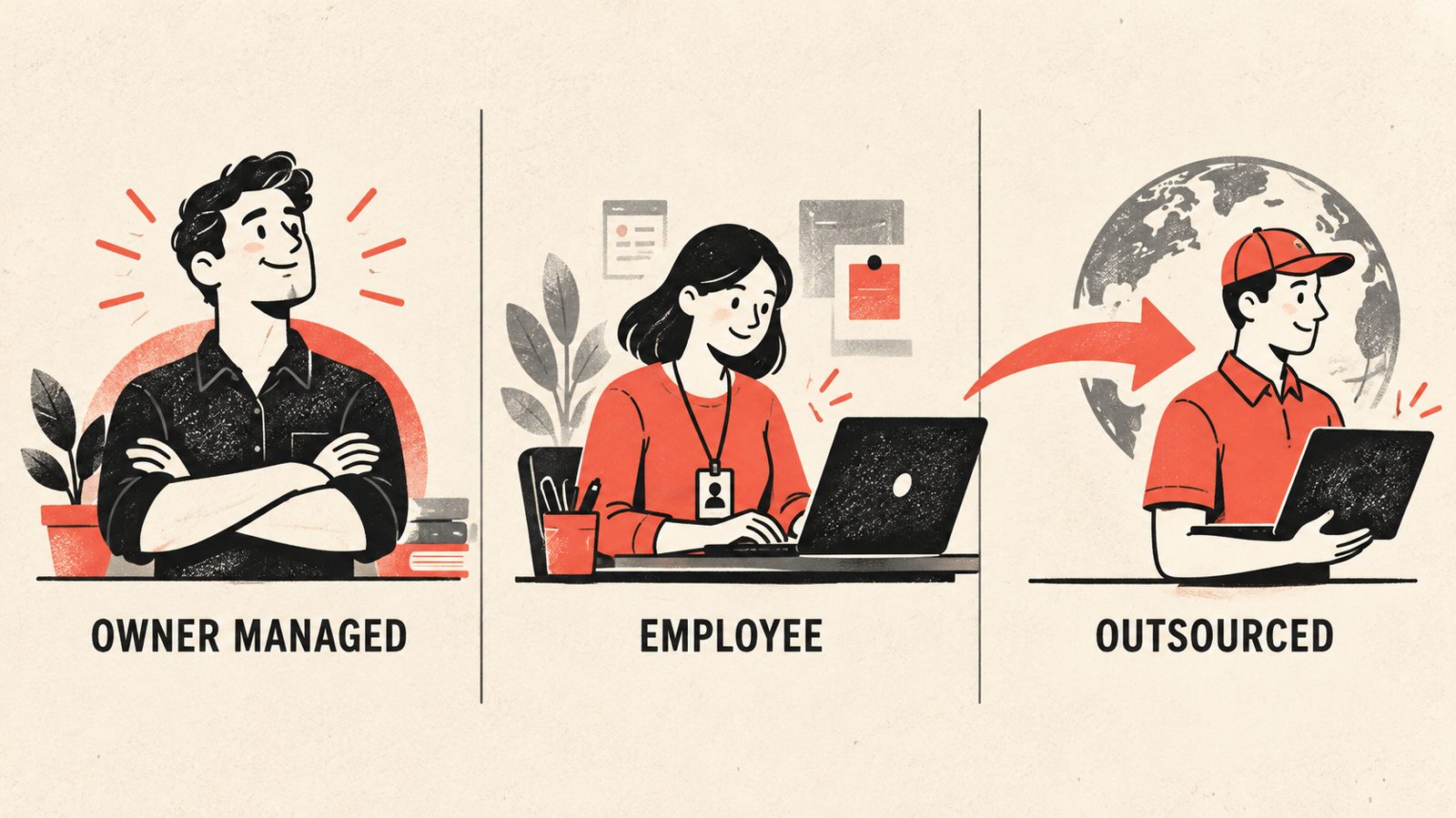
Owner managed. The owner, or an existing team member, fits social media in around other work. This costs no new money directly, but it costs time, and it depends entirely on someone staying consistent without a job description forcing them to. It tends to work well for a business with a simple, low volume posting cadence and an owner or staff member who does not mind the work. It tends to fail when the business gets busy, because social media is usually the first thing dropped when something urgent comes up.
An employee's added responsibility. An existing employee, often someone in an admin or marketing adjacent role, takes on social media as part of their job. This keeps the work inside the business and close to day to day knowledge of customers and jobs, which can make the content feel more authentic. The risk is scope creep: a task that was meant to take an hour a week quietly grows, or gets dropped whenever that employee's main responsibilities get busy, since nobody wants to tell their boss that the social posts have to wait.
Outsourced to a freelancer or agency. An outside person or company handles planning, content, and posting, usually against a monthly retainer. This buys consistency and, often, a level of content polish that is hard to produce internally without dedicated skills. It also introduces a real cost every month regardless of how the business is doing, and it requires someone on the inside who still reviews what goes out, since nobody outside the business knows it as well as the people running it.
None of these paths is inherently better. A roofing company with three trucks and a simple Facebook page has very different needs from a boutique with a strong visual product and a following that expects frequent posts. The right path is the one that matches the business's actual capacity and the role social media plays in bringing in work.
How to decide which path fits your business
A few honest questions do most of the work in this decision.
How visual is the business. A cafe, a salon, or a retailer has constant visual material (food, finished work, product) and social media tends to matter more to how customers find and trust them. A business that sells mainly through quotes, referrals, and repeat work, like most trades and professional services, usually needs a steady, simple presence rather than a heavy content operation.
How much time can realistically be protected every week. Not how much time exists in theory, but how much time has actually been protected for this in the last three months. If the honest answer is none, the owner managed path is unlikely to change that pattern just because the intention is good.
What the budget can absorb every month without strain. Outsourcing turns a flexible task into a fixed monthly cost. That is a reasonable trade for a business with the margin to support it, and a difficult one for a business where cash flow is already tight.
Who on the team already knows the brand and the customers. An employee who already understands the business can often represent it more naturally than an outside freelancer starting from zero, even if that freelancer is more skilled at content creation on day one.
There is no need to pick a path forever. Many businesses start with the owner posting a few times a month, move the task to an employee once there is bandwidth, and outsource later once consistency and volume actually require it. Starting small and adjusting is a reasonable strategy, not a failure to commit.
If outsourcing is the right call, questions to ask before signing anything
Not every agency or freelancer offering social media management operates the same way, and the difference matters more than the price on the invoice.
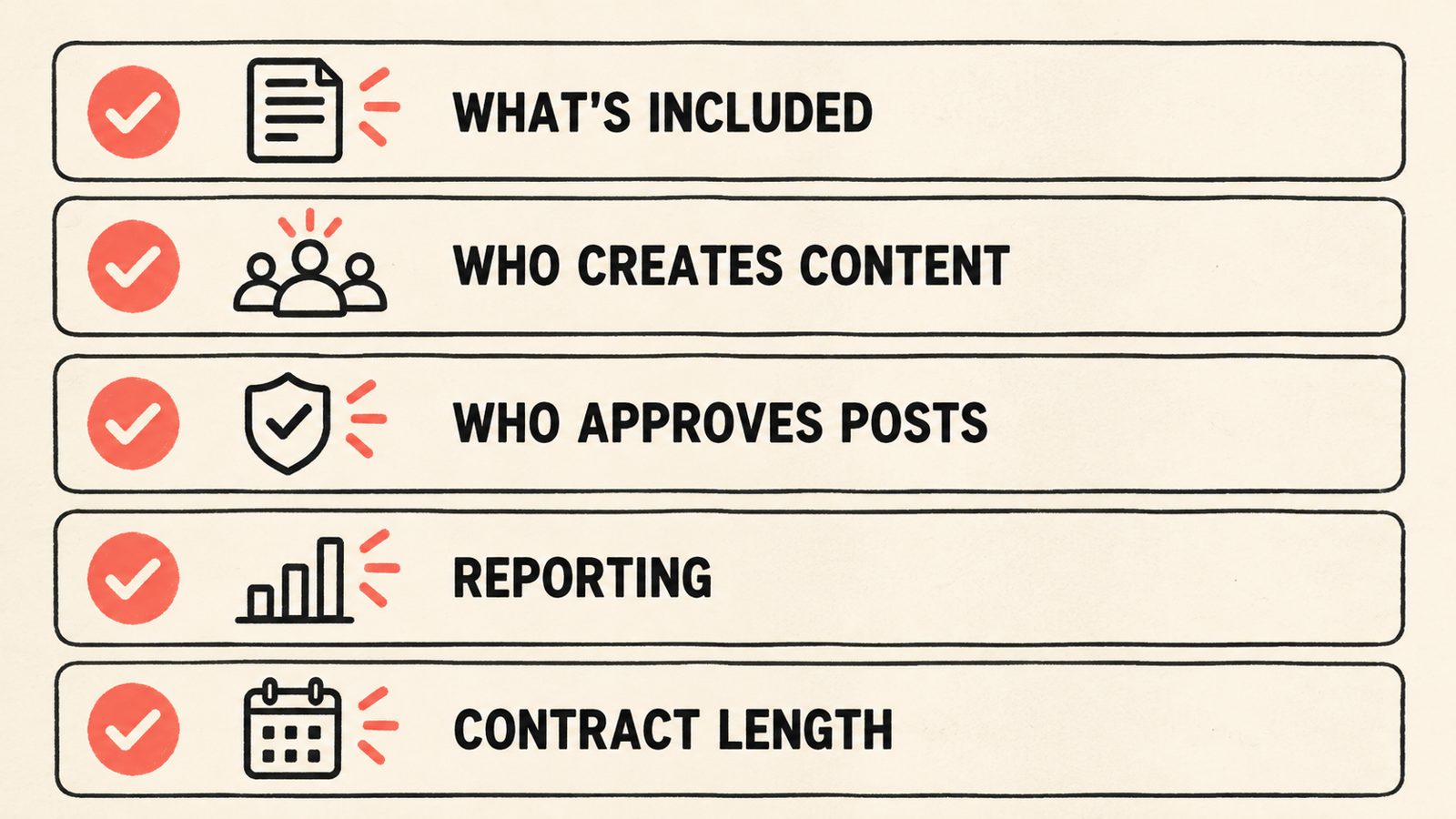
What exactly is included each month. Ask for the specific number of posts, which platforms, and whether that includes stories, short video, or only static posts. "Social media management" means very different things from one provider to the next.
Who creates the content, and from what. Some providers need the business to supply photos and raw material every month; others produce original content themselves. Knowing which one you are hiring matters before the first invoice arrives.
Who approves posts before they go out. A review step before anything is published protects the business from a provider misrepresenting a product, a price, or a promotion. If a provider resists a review step, that is worth asking about directly.
What reporting looks like, and how often. A plain monthly summary of what was posted and how it performed is reasonable to expect. Reporting that is vague or arrives rarely is a sign the relationship may need closer attention.
What the contract length and exit terms are. A short initial term, or a clear cancellation window, lets a business test the relationship without a long commitment if the fit turns out to be wrong.
A provider that cannot answer these plainly, or that leans on promises about guaranteed growth or follower counts, is worth being cautious about. Real social media management is steady, unglamorous work. Anyone promising rapid, guaranteed results is selling something other than the service itself.
What tends to go wrong with each path
Owner managed social media tends to fail quietly through inconsistency rather than any single mistake. The posts simply stop during a busy stretch and never quite restart, until the account looks neglected.
An employee's added responsibility tends to fail through scope creep in the other direction: the task grows past what was agreed, or starts competing with the employee's actual job, and either the social media or the original role suffers.
Outsourcing tends to fail in two specific ways. The first is content that technically posts on schedule but does not sound like the business, because the provider never really learned who the customers are or how the owner actually talks to them. The second is a provider that disappears between posts, offering no real strategy or reporting, so the business is paying for activity rather than results. Both are reasons to review work in the first month or two rather than assuming it is fine because something is appearing on the feed.
Where Underdog Creative Solutions fits in, whichever path you choose
- +Content built around what you already do well
[Underdog's content solutions](/services/content) start from the work a business already does, the jobs completed, the products made, the questions customers actually ask, rather than generic templates repeated across every client.
- +Content that connects to a website built to be found
Posts work better when they point somewhere worth visiting. Pairing content with a modern, fast website that both Google and AI tools like ChatGPT can read properly means social traffic lands somewhere that can actually convert a visitor into an enquiry.
- +An AI receptionist to catch what social media sends your way
Social media sometimes generates calls and messages at odd hours. An AI receptionist means those enquiries get a response immediately instead of waiting until the next business day, whichever path you choose for the posting itself.
- +Automation for the follow up, not just the posting
AI business automation can handle the repetitive parts around content, like routing a comment or message to the right person, without replacing the judgment a person still needs to apply to what gets said publicly.
How Underdog approaches this differently
Underdog does not treat content, the website, the AI receptionist, and automation as separate purchases that happen to be sold by the same company. They are built to work together: content that reflects how a business actually operates, delivered through a site built to be read by both people and AI search tools, backed by a receptionist and automation that make sure none of the attention that content generates gets lost.
That said, this article's job is to help a business owner make a sound staffing decision, not to argue that outsourcing to Underdog or anyone else is automatically the right answer. For some businesses, owner managed or employee managed social media is simply the better fit, at least for now, and a plain conversation should say so.
What this actually costs, and a reasonable next step
Costs for outsourced social media management vary widely based on how many platforms are covered, how much original content is produced, whether paid advertising is included, and how much strategy and reporting comes with it. Rather than quoting a figure that would not hold up across different businesses, the more useful approach is asking any provider, including Underdog, to break down exactly what is included for the price quoted, and comparing that against what an employee's time or your own time is actually worth to the business.
If you want a second opinion on which of these three paths fits your business, or want to see what a content plan built around your actual work would look like, the Underdog team is reachable without any pressure to commit. Call us at +1 833-998-1234, message us on WhatsApp at +1 306-518-7811, or email support@underdogcreativesolutions.com. You can also book a free 15 minute discovery call at underdogcreativesolutions.com/contact. We reply within four business hours.