// SMALL BUSINESS
Can AI Find Your Business? What Local Owners in Canada Need to Know
The short answer: Yes, AI can find your business, but only if it can read clear, consistent and recent information about you. If your details are thin, out of date or different from one website to the next, AI tools will skip you and recommend someone else. The good news is that most of the fix is basic housekeeping you can start this week.
Why this question matters right now
Customers used to ask Google, scroll a list and pick. Now a growing number of them ask an AI tool, get a short list of names, and call the first one that sounds right.
Here is what the research shows:
- In BrightLocal's 2026 Local Consumer Review Survey, 45% of consumers said they had used AI tools such as ChatGPT, Gemini or Perplexity to find local business recommendations. A year earlier that number was 6%. AI is now the third most used source for local recommendations, behind Google and Facebook [1].
- In the same survey, 40% of consumers said they trust AI platforms to recommend businesses, and 42% trust them about as much as traditional reviews [1].
- Closer to home, a March 2026 survey of 1,230 Canadian adults found that about two thirds of Canadians use at least one AI tool, most often for information, research and work tasks [4].
- Canadian businesses are catching up. Statistics Canada reports that 19.2% of businesses used AI in the last 12 months (second quarter of 2026), and 25.2% plan to use it over the next 12 months [2][3].
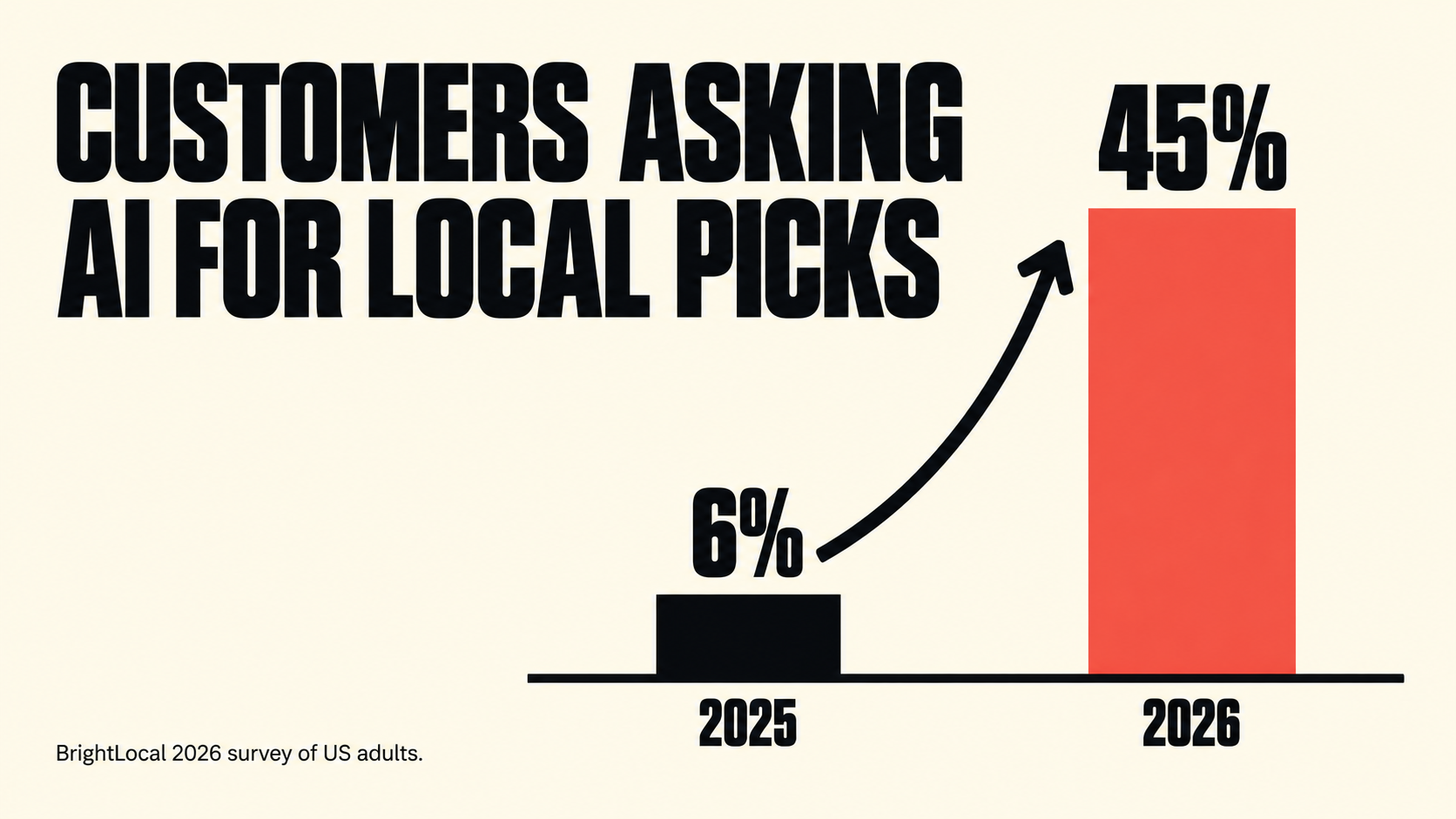
One honest note: the BrightLocal survey sampled 1,002 adults in the United States [1]. We could not find an equivalent Canadian survey on AI and local search, so treat the 45% as a signal of direction, not a Canadian measurement. Still, if two thirds of Canadians already use AI tools, it would be risky to assume your customers are the exception.
There is also a gap between customers and businesses. SOCi's 2026 Local Visibility Index looked at more than 350,000 business locations belonging to 2,751 brands and found that ChatGPT recommended only 1.2% of them [11]. That study covers multi location brands, not corner shops, but it shows how few businesses make the cut.
How does AI actually "find" a business?
Think of an AI assistant as a very fast researcher with two sources of knowledge.
- What it learned during training. This is a large snapshot of the internet, and it goes out of date.
- What it looks up live. When you ask for "the best bakery near me," tools like ChatGPT search the web in real time, read the pages they find, and write an answer with sources.
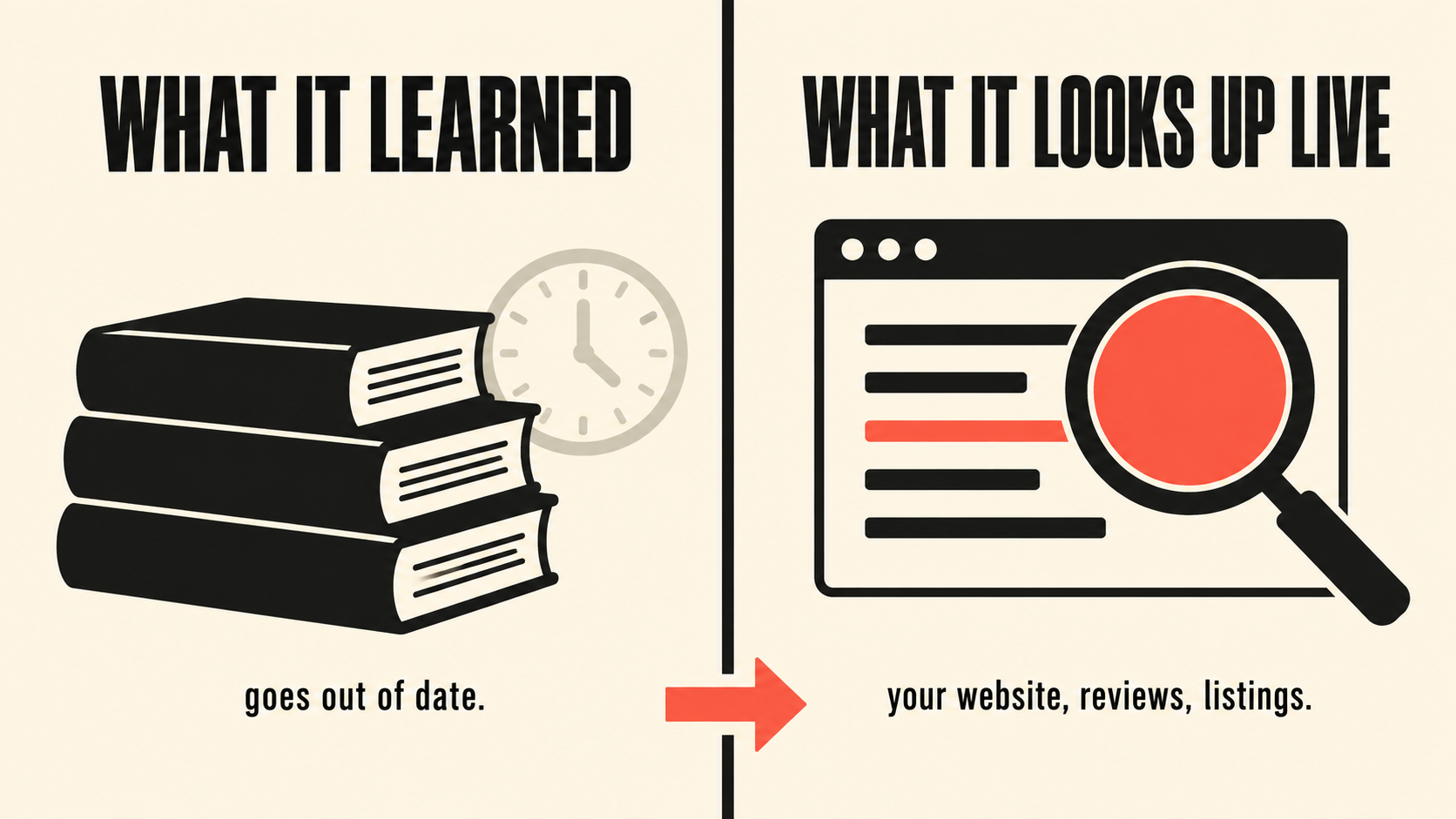
For local questions, the second part matters most, because your hours, prices and reviews change. In a BrightLocal study of 800 local searches in ChatGPT (run in November 2024 across 20 US cities and 20 business types), 58% of the sources ChatGPT showed were business websites, 27% were articles and pages that mention businesses, and 15% were directories [5]. Directory and review sites like Yelp, Facebook and Google Maps did not appear as directory sources in that study [5].
That tells you something useful: your own website is one of the most important things AI reads about you. Not just your Google listing.
Keep in mind that this study is a snapshot from late 2024 and these tools change fast [5]. Other research disagrees on which listing sites matter most. One example is Bing Places: some local SEO firms call it a direct pipeline into ChatGPT, while Search Engine Land's testing found ChatGPT draws on Bing's regular web results and does not see the profile details businesses enter in Bing Places [6]. When the experts disagree, the safe move is the simple one: keep your information correct and identical everywhere, instead of betting everything on a single directory.
What about Google's AI answers?
Google also shows AI summaries (called AI Overviews) and has a separate AI Mode. Google's own guidance for site owners is refreshingly plain: there are no additional requirements to appear in these features, and no special optimizations are necessary. A page needs to be indexed and eligible to show in regular Google Search with a snippet, and normal good practice applies [8].
Google also tells owners to keep their Business Profile information up to date [8]. That is the part many local owners skip.
How often do AI summaries show up for local searches? It depends heavily on the type of question:
- One 2026 analysis found AI Overviews on about 68% of local related searches overall, but only about 15% of simple searches like "tacos San Francisco," where the familiar map results still dominated. For informational questions like "how long does an eye exam take near me," they appeared 92% of the time [10].
- Another industry tracker put AI Overviews on only around 8% of searches with clear local intent [13].
The studies disagree on the exact number, but the pattern is consistent: when someone searches "plumber near me," the map results still do most of the work. When someone asks a longer, more detailed question, the AI answer takes over. Customers do both, so you need to be ready for both.
What AI looks at when it decides who to recommend
Nobody outside the AI companies knows the exact formula, and anyone who claims they do is guessing. What we do have is expert opinion and testing. Whitespark, a Canadian local search firm, surveyed 47 local search practitioners for its 2026 ranking factors report, and for the first time it included a section on AI search visibility [9]. As summarized by one marketing agency, those experts put roughly 24% of the weight on the content and quality of your own website, around 16% on reviews, and about 12% on your Google Business Profile for AI visibility [12]. Treat these as informed opinions, not measured facts.
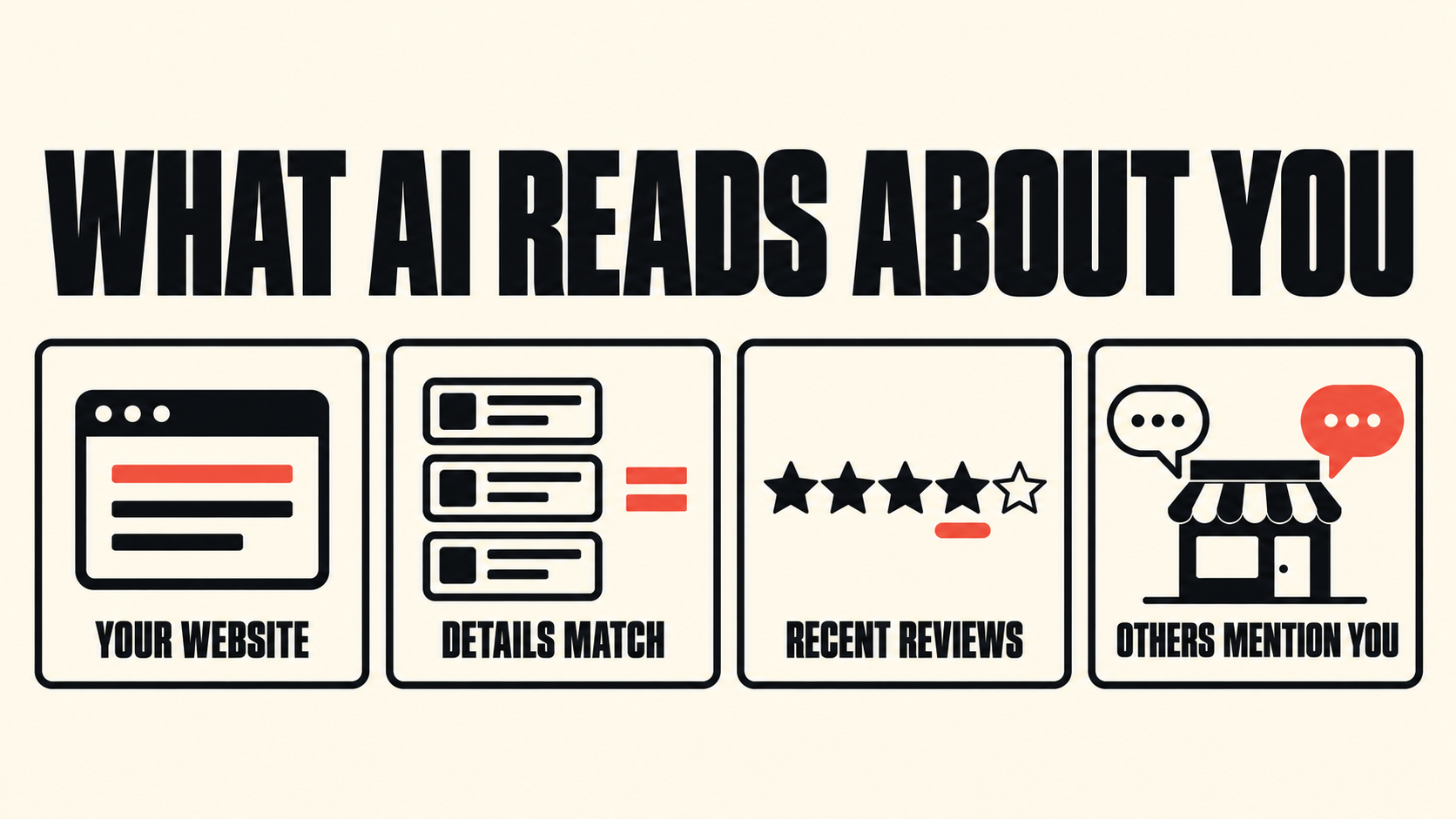
Across the sources, the same four things come up again and again.
1. Your website says clearly what you do and where.
Plain sentences beat clever slogans. "We repair residential furnaces in Saskatoon and surrounding areas" is something an AI can lift straight into an answer. "Comfort, delivered" is not.
2. Your details match everywhere.
Name, address, phone number, hours and services should be identical on your website, Google, Facebook, Apple Maps, and any directory you appear on. Whitespark's report highlights clean, consistent business information as a core signal [9].
3. You have plenty of recent, positive reviews.
BrightLocal found that 47% of consumers will not use a business with fewer than 20 reviews, 74% only care about reviews from the last three months, and 31% will only use a business rated 4.5 stars or higher [1]. Reviews also shape the AI summaries customers read: 82% of consumers read AI generated review summaries [1].
4. Other websites mention you.
Local news, community groups, industry associations and "best of" articles all count as mentions. In BrightLocal's ChatGPT study, mentions made up more than a quarter of the sources shown [5].
There is one more reason to take your website seriously. After reading positive reviews, 54% of consumers go and look at the business's website [1]. Yet in BrightLocal's research, only about 40% of local businesses have a dedicated website and only 35% have a Google Business Profile [1]. (Those figures are quoted in the survey from BrightLocal's earlier small business research and, like the rest of its data, are not specific to Canada.)
The 10 minute test: does AI know you?
Do this today. It costs nothing.
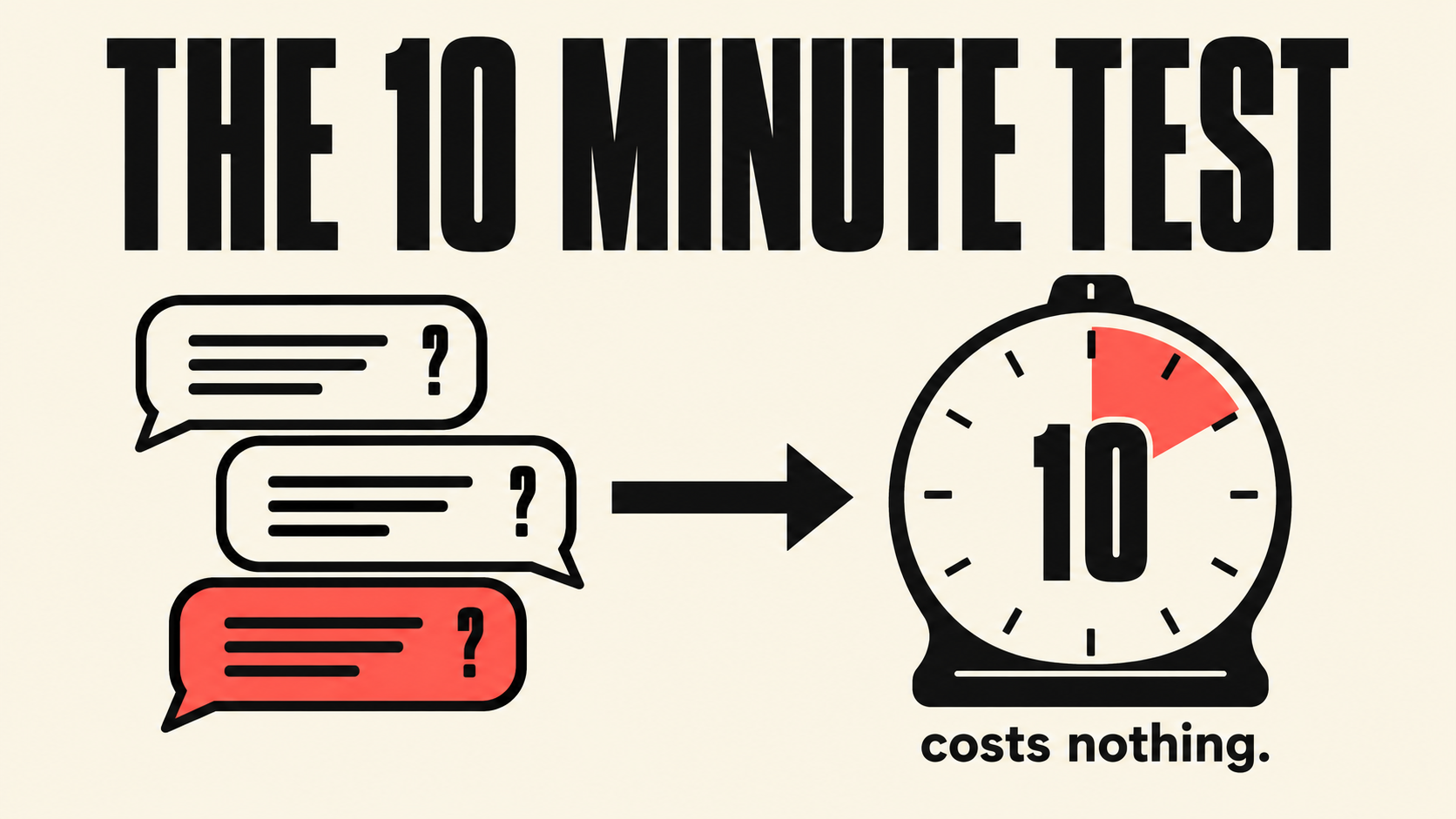
- Open ChatGPT, Gemini and Google (try its AI Mode if you see it).
- Ask each one the questions your customers would ask. For example: "Who is the best [your service] in [your city]?" and "Which [your business type] in [your neighbourhood] is open on Sundays?"
- Ask a third question using your business name: "What do you know about [Your Business Name] in [Your City]?"
- Write down or screenshot who gets recommended, and what the AI says about you, including any wrong hours, old phone numbers or services you no longer offer.
Because answers can differ from one try to the next, repeat the test once a month and compare. If the AI names three of your competitors and not you, or gets your details wrong, that is your to do list.
What to fix first (in order)
- Claim and complete your Google Business Profile. Correct category, services, hours, phone, photos. Google specifically says to keep this current [8].
- Make one master copy of your business details and match every listing to it: Google, Facebook, Apple Maps, Bing, Yelp, industry directories and your own website. Fix old addresses and phone numbers.
- Rewrite your website's key pages in plain language. One page per main service, with the city or area you serve, your hours, your phone number and answers to the five questions customers ask most. Put it in real text, not only in images or PDFs. Google asks that important content be available in textual form [8].
- Ask for reviews on a schedule. BrightLocal found 78% of consumers were asked to leave a review in the past year, and 83% of those asked went on to leave one [1]. Reply to every review, and make the replies personal. Half of consumers are put off by templated replies [1].
- Earn mentions. Sponsor a local team, join your chamber of commerce or business association, offer an expert quote to a local publication, get listed on community and industry sites.
- Do not block the robots. Some websites accidentally tell AI search tools to stay out. (See the technical card below.)
What not to believe
- "We can guarantee you will rank in ChatGPT." Nobody can. These tools change constantly, answers vary from one try to the next, and the companies do not publish their formulas. Google itself says there is no special trick to appear in its AI features [8].
- "You need a brand new kind of marketing." Whitespark's 2026 findings point the other way: AI search leans on many of the same signals as local search, namely accurate information, reviews and a quality website [9]. If you already do the basics well, you are most of the way there.
- "Ignore it, it's a fad." Maybe the exact tools change. The behaviour of customers asking a machine for a short list is not going away.
So, can AI find your business?
Right now, the honest answer for most small businesses is "partly." AI can find you if you have a clear website, matching details across the internet, recent reviews and a few mentions. It struggles if you are missing from the places it reads, or if what it reads is out of date.
Start with the 10 minute test. If the results surprise you, you now know where to begin.
And if you would rather have someone who does this every day look at it for you, that is what we are here for.
Ready to talk? Call us at +1 833-998-1234, message us on WhatsApp at +1 306-518-7811, or email support@underdogcreativesolutions.com. You can also book a free 15 minute discovery call. We reply within four business hours.
Follow Underdog Creative Solutions on Facebook, Instagram, LinkedIn, and YouTube for practical AI and marketing ideas for Canadian small businesses.
References
Sources were accessed on October 7, 2026.
- BrightLocal. (2026, February 11; updated September 14, 2026). Local Consumer Review Survey 2026: Star ratings keep rising, old reviews don't cut it. https://www.brightlocal.com/research/local-consumer-review-survey/
- Statistics Canada. (2026). Analysis on artificial intelligence use by businesses in Canada, second quarter of 2026 (Catalogue no. 11-621-M). https://www150.statcan.gc.ca/n1/pub/11-621-m/11-621-m2026010-eng.htm
- Statistics Canada. (2026). Analysis on planned use of artificial intelligence by businesses in Canada, third quarter of 2026 (Catalogue no. 11-621-M). https://www150.statcan.gc.ca/n1/pub/11-621-m/11-621-m2026013-eng.htm
- Logit Group and Narrative Research. (2026). AI usage in Canada: Most see AI as a tool, not a companion (online survey of 1,230 Canadian adults, March 12 to 16, 2026). https://logitgroup.com/ai-usage-in-canada/
- Paget, S. (2024, December 12; updated November 14, 2025). Uncovering ChatGPT Search sources. BrightLocal. https://www.brightlocal.com/research/uncovering-chatgpt-search-sources/
- Search Engine Land. (n.d.). How does ChatGPT conduct local searches? https://searchengineland.com/how-does-chatgpt-conduct-local-searches-454894
- OpenAI. (n.d.). Overview of OpenAI crawlers. OpenAI Developers. https://developers.openai.com/docs/gptbot
- Google. (2025, December 10). AI features and your website. Google Search Central. https://developers.google.com/search/docs/appearance/ai-features
- Whitespark. (2026). Local Search Ranking Factors 2026 (survey of 47 local search practitioners). https://whitespark.ca/local-search-ranking-factors/
- ALM Corp. (n.d.). How AI is impacting local search. https://almcorp.com/blog/how-ai-is-impacting-local-search/
- SOCi. (2026). 2026 Local Visibility Index. As reported in Aspen Daily News, "45% of consumers now use AI to find local businesses." https://www.aspendailynews.com/features/article_b921b781-a6fd-5051-b5e2-af787dd56850-47ab237f
- Emulent Digital Marketing. (n.d.). Local SEO ranking factors and projected weight, 2026 to 2028 (summary of the Whitespark 2026 survey). https://emulent.com/?p=20138
- ThinkProfits. (2026). Why the Maps Pack still wins local: AI Overviews hit only about 8% of local searches. https://thinkprofits.com/digital-news/maps-pack-still-wins-local-ai-overviews-8-percent/