// SMALL BUSINESS
Answer Engine Optimization: A Plain Guide for Small Business Owners

Ask ChatGPT or Google's AI Overview a question about a product or service, and increasingly you get a short, direct answer instead of a list of links to click through. For a small business owner, that raises a question alongside the familiar one. Showing up in search results used to be the whole game. Now showing up inside an AI generated answer is becoming part of it too, and almost everything written about how to do that is aimed at marketers and agencies, not at the owner who just wants to know what, if anything, needs to change on their own website. This guide is written for that owner. It explains what answer engine optimization actually means, how it builds on the search engine optimization basics a business may already have in place, and a short, practical list of what to check on a website. It is honest about the parts nobody, including Underdog, can promise: no AI tool guarantees a mention, a citation, or a recommendation for any business, no matter what is done to a website.
Why is it hard to find a plain answer about this?
Search "answer engine optimization" or "AEO" and most of what comes back is written by marketing agencies, for other marketers. The language leans on acronyms, AEO, GEO, LLM visibility, stacked on top of each other, the checklists assume a content team and a developer are already on staff, and several pages exist mainly to sell an AEO audit or a monthly retainer.
None of that is wrong, exactly. It is just written for the wrong reader. A small business owner does not need a framework for a generative engine optimization strategy. They need to know, in plain terms, whether this is something worth acting on now, and if so, what actually changes on a website that already has reasonable content and a working SEO setup.
That is the gap this guide tries to fill: the owner facing version, without the jargon, and without pretending that any of this comes with a guarantee.
What is answer engine optimization, in plain terms?
Answer engine optimization, usually shortened to AEO, means organizing a website so that AI tools such as ChatGPT, Google's AI Overviews, and Perplexity can read the content, understand what the business actually does, and sometimes use a piece of it directly in an answer to someone's question.
Classic search engine optimization is about ranking high enough in a list of links that someone clicks through to a site. AEO is about something slightly different: being the source an AI system pulls from when it writes its own direct answer, whether or not that answer includes a link back. The two overlap heavily. A page that is clear, accurate, and well organized tends to help with both at once, which is part of why this is less of a separate project than most marketing content makes it sound.
The important honest point is this: no business, including ours, can guarantee that an AI tool will mention, cite, or recommend it. Nobody controls what these systems choose to say, and anyone who promises otherwise is promising something they cannot deliver. What a business can do is make its own information easy to find, accurate, and hard to misread, which is the same work that has always supported good search performance.
How do AI tools like ChatGPT and AI Overviews actually find and use your content?
These systems generally work from two places: a general knowledge base built by crawling large amounts of the web in advance, and, for tools connected to live search, whatever a search engine returns for a specific question at the moment someone asks it. In both cases, a website only has a chance of being used if it has already been crawled, is written clearly enough to extract a clean answer from, and says something that is not contradicted elsewhere.
A few practical details follow from that. If a page buries the actual answer three paragraphs into a wall of text, an AI summarizer has to guess which sentence to use, and it may guess wrong or skip the page entirely. If a page states something that conflicts with a Google Business Profile, a directory listing, or another page on the same site, for example a different phone number or a service no longer offered, that inconsistency makes the business a less reliable source to pull from. And if a site has no clear, labelled answer to a question at all, there is nothing for a tool to use even if it would otherwise want to.
None of this is mysterious or unique to AI. It is largely the same discipline that has always mattered for being quoted in a featured snippet or a voice assistant answer: say the thing plainly, say it once clearly rather than three times vaguely, and keep it consistent everywhere the business is listed.
What should your website have so AI tools can read it well?
A short, practical list, roughly in order of effort versus impact for most small business sites.
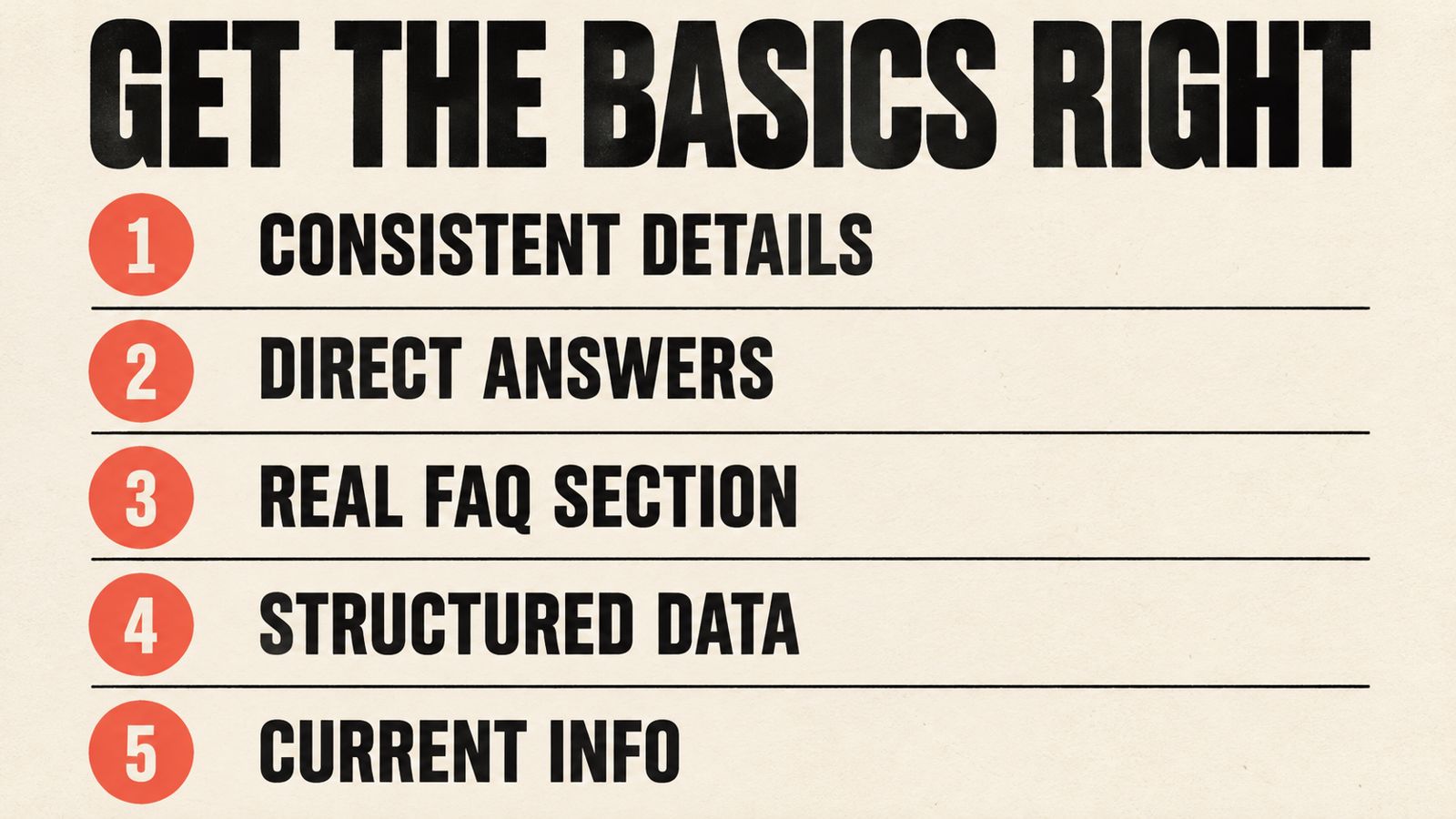
Keep business details identical everywhere. The business name, address, phone number, hours, and the services actually offered should read the same way on the website, the Google Business Profile, and any directory listing it appears in. A mismatch anywhere is one of the simplest ways to confuse a system trying to describe the business accurately.
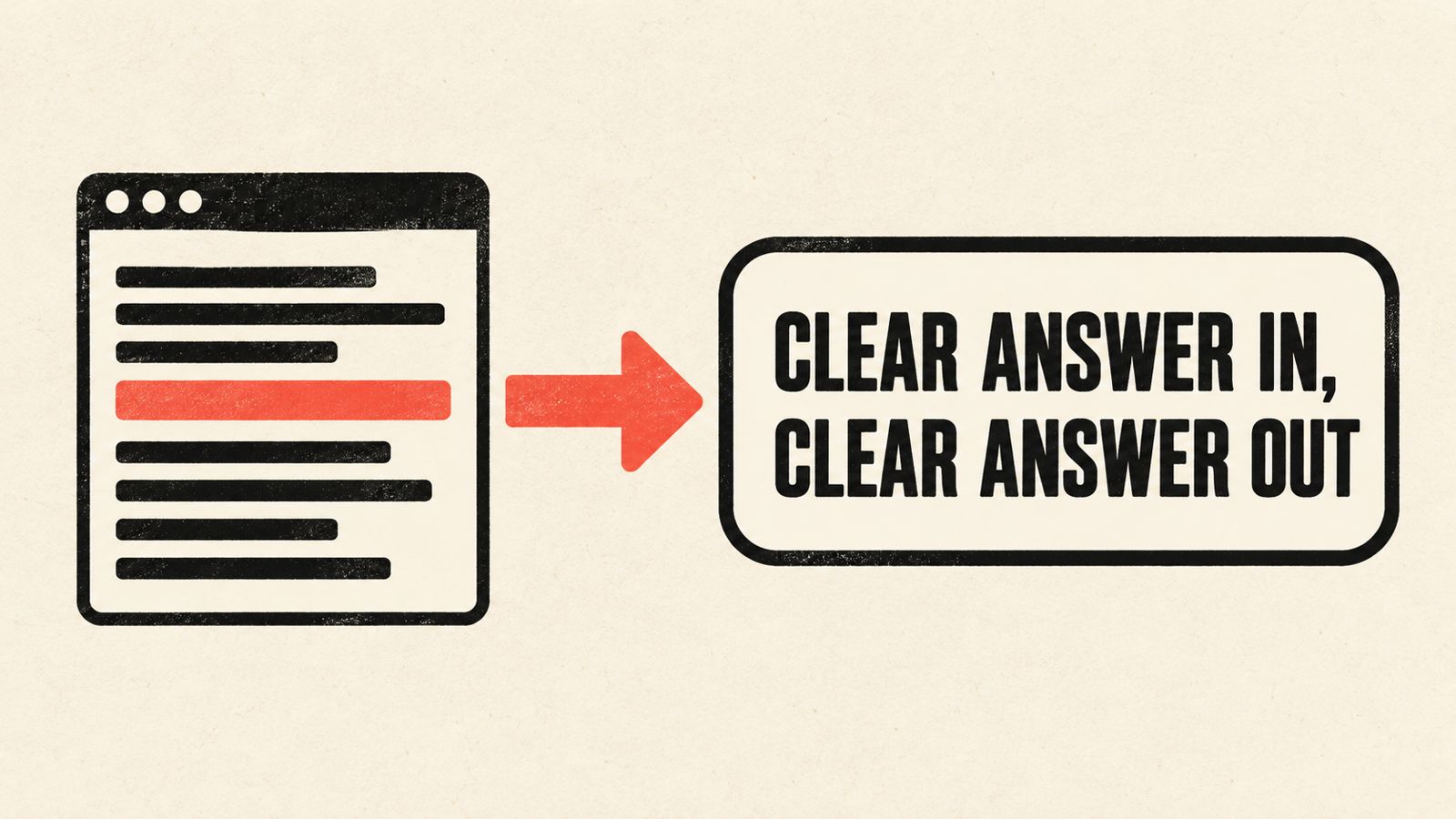
Answer real questions directly, near the top of the page. If customers commonly ask whether a business serves a certain area, what a service includes, or how booking works, put that question as a heading and answer it in the first sentence or two, before adding more detail. This is also simply good writing for a human visitor in a hurry.
Keep a clear FAQ section with real questions and complete answers. Write each answer so it stands on its own, naming the business or service directly rather than relying on "we" or "it" the way the rest of a page might. AI tools often extract a single question and answer in isolation, so an answer that only makes sense in the context of surrounding paragraphs loses its meaning when pulled out.
Use structured data where it fits, without treating it as a shortcut. Adding FAQ, organization, and article markup to a page is a reasonable technical step that makes a page's structure explicit to a machine. It does not guarantee a citation and is not, on its own, a ranking factor. Google has said directly that no special markup is required for its AI Overviews to use a page. Structured data simply removes some of the guesswork, nothing more.
Keep information current. A page that lists an old price, a discontinued service, or last year's hours will eventually feed a wrong answer to someone asking an AI tool a question, and there is no way to catch that after the fact except checking the pages regularly.
Collect genuine reviews on Google and any platform relevant to the industry. Many AI tools draw on review platforms for local recommendations, and reviews are one of the few signals that are hard to fake convincingly at scale.
Does your business need to act on this yet?
For most small businesses, the honest answer is: get the basics right, and do not treat this as an urgent separate project.
This is a reasonable next step if a website already has clear service pages, a working contact method, and decent organic traffic, and the owner wants to tighten things up without a big rebuild. Checking that business details match everywhere, adding a proper FAQ section, and making sure key pages answer the obvious question near the top are all a few hours of work, not a redesign.
This can probably wait if the website itself is the bigger problem: thin content, no clear service pages, inconsistent contact information, or a site that has not been touched in years. AI tools reading a weak site will simply reflect that weakness back. Fixing the underlying site comes first, and AEO style changes on top of it will matter very little until it does.
What to do first, in order: confirm business information is consistent everywhere it appears online, make sure every core service page answers its own obvious question in the opening lines, add or tidy up an FAQ section using the questions customers actually ask, and only then look at structured data and the more technical pieces. Skipping ahead to markup on a site that does not yet say anything clearly tends to waste the effort.
What this looks like in practice
These are examples of how the ideas above tend to play out, not a promise of a specific outcome for any business, since results always depend on the starting point and the questions people are actually asking.
Example: a home services company with a single service area page. The page listed services in a bulleted list with no explanation. After rewriting the top of the page to directly answer whether the company serves the area and what is included in a standard visit, and adding a short FAQ with five real customer questions, the page became easier for a human visitor to scan quickly, and gave any AI tool a clean, quotable answer to pull from instead of a list fragment.
Example: a professional services firm whose Google Business Profile listed slightly different hours than the website. Fixing that mismatch did not change anything dramatic overnight, but it removed one clear source of an AI tool describing the business inaccurately to someone asking when it was open.
Example: a retailer whose product pages buried return and shipping policy details inside a long paragraph near the bottom. Pulling that information into its own short, clearly headed section made it something a customer, or an AI summarizer, could find and quote directly instead of having to infer it from context.
In each case, nothing about the business changed. What changed is that the same accurate information became easier for both people and machines to find and use without guessing.

What getting the basics right actually gives you
- +Clearer answers for real visitors, not just AI tools
Writing a direct answer near the top of a page and keeping a real FAQ helps the human visitor in a hurry just as much as it helps any AI system.
- +Fewer embarrassing inconsistencies
Checking business details across the website, Google Business Profile, and directories catches the kind of small mismatch that quietly erodes trust wherever it is noticed.
- +A head start if AI search keeps growing
Nobody can say for certain how much weight AI generated answers will carry in two or three years, but the work involved, clear content and consistent information, holds its value either way.
- +No wasted spend on a guaranteed outcome
Because no legitimate source can promise an AI citation, focusing on the concrete, checkable steps avoids paying for a guarantee that was never real to begin with.
- +A reason to finally tidy up thin or outdated pages
AEO is often a useful excuse to fix pages that needed attention anyway, rather than a wholly new category of work.
What does this cost, and what should you ask?
Most of what is described in this guide, consistent business details, a clear FAQ, a direct answer near the top of key pages, is writing and editing work rather than a software purchase, so the cost is mainly time, either the owner's own or whoever maintains the website. Adding structured data correctly takes a bit more technical care, particularly on a site not built on a platform with a plugin that handles it, but it is a one time setup per page type rather than an ongoing cost.
For a business considering paying someone for this work, it is worth asking a few direct questions before agreeing to anything: what specifically will be delivered, for example a list of pages with new FAQ sections and structured data, rather than a vague AI optimization package; whether any part of the service claims to guarantee a citation, a mention, or a ranking in an AI answer, since a straight answer should be no; how the work will be checked afterward, since there is no official report that shows whether a specific AI tool is using the content; and whether this is being sold as a wholly separate service from existing SEO work, when in practice the two overlap enough that a competent SEO provider should already be covering most of it.
We do not publish a flat price here because the right amount of work varies enormously between a five page service site and a larger catalogue of products or locations. A short, honest conversation about what a site currently has is a more useful starting point than a number pulled from a general price list. Message us on WhatsApp at +1 306-518-7811 or call +1 833-998-1234. You can also book a free 15 minute discovery call at underdogcreativesolutions.com/contact.
How Underdog approaches AI findability
Underdog Creative Solutions is a Saskatoon based agency working with small and growing businesses across Canada and the United States. When we build or update a website, making it properly readable, for people and for the AI tools now summarizing the web, is treated as part of ordinary website solutions work rather than a separate add on package with its own pitch.
In practice that means service pages that answer their own obvious questions near the top, FAQ sections built from the questions customers actually ask rather than generic filler, consistent business details across the site and listings, and structured data added where it actually fits the content, not sprinkled on every page for its own sake.
We also build AI receptionists and handle AI business automation and ongoing content work, and for some businesses those connect naturally: an AI receptionist captures the enquiry that a well written, easy to find page generates, and ongoing content keeps a site from going stale in exactly the way that makes it less trustworthy to both readers and AI tools. None of that is required to benefit from the basics in this guide. Most businesses can start with the website changes alone.
Frequently asked questions
Talk to Underdog about your website
Have questions about your website, content, AI receptionist, or business automation? Message us on WhatsApp at +1 306-518-7811 or call +1 833-998-1234. You can also email support@underdogcreativesolutions.com.
Follow Underdog Creative Solutions on Facebook, Instagram, LinkedIn, and YouTube for practical AI and marketing ideas for Canadian small businesses.