// SMALL BUSINESS
AI Content Creation for Small Business: What It's Good For and What Still Needs a Person

Ask any small business owner who has tried ChatGPT or another AI writing tool, and the reaction is usually the same two things in the same breath: this is impressively fast, and I am not sure I can trust it enough to just hit publish. Both reactions are fair. The direct answer is this: AI content tools are genuinely useful for first drafts, repurposing existing material and routine posts, but anything that touches brand voice, accuracy, or a claim made to a customer still needs a person to check it before it goes out. That is not a disclaimer added to make everyone feel better about using AI. It is the practical line that separates small businesses getting real value out of these tools from the ones quietly publishing content that sounds a little off, states something incorrect, or reads exactly like every other AI written page on the internet.
Why does this feel more confusing than it should?
Search for guidance on AI content creation and almost everything written for a small business owner turns out to be a tool roundup: a ranked list of Jasper, Copy.ai, HubSpot's free generator, Buffer's AI assistant and a dozen others, each with a short pitch for why it is the best pick. A different slice of what comes up leans the other way, promising that AI content is an easy way to make money online, with little honesty about what that content actually needs before it is good enough to represent a real business in front of real customers.
Neither kind of page answers the question a business owner actually has. That question is less about which tool to choose and more about judgment: what is safe to let AI write with a light edit, what needs a careful human pass before it goes anywhere near a customer, and whether using AI at all creates any risk to search rankings or reputation. That decision, not a tool comparison, is the real starting point.
What does AI content creation actually mean for a small business?
In practice, AI content creation covers a wide range of tasks that tend to get lumped together under one label. At the simple end, it means asking a tool such as ChatGPT, Claude, or a marketing platform's built in assistant to draft a social media caption, turn a blog post into a handful of shorter posts, summarize a longer document, or suggest a few headline options to react to. At the more involved end, it means asking the same kind of tool to write a full blog post, a product description, or an email newsletter from a short prompt.
The tools themselves are not the risk. The risk is treating every one of those tasks the same way: publishing whatever comes out without checking it against what the business actually knows to be true, how it actually talks to customers, and whether the result says anything genuinely useful. A caption that reads a little generic is a minor problem. A blog post that states an incorrect price, an outdated policy, or a claim the business cannot support is a real one.
What is AI actually good at for content work?
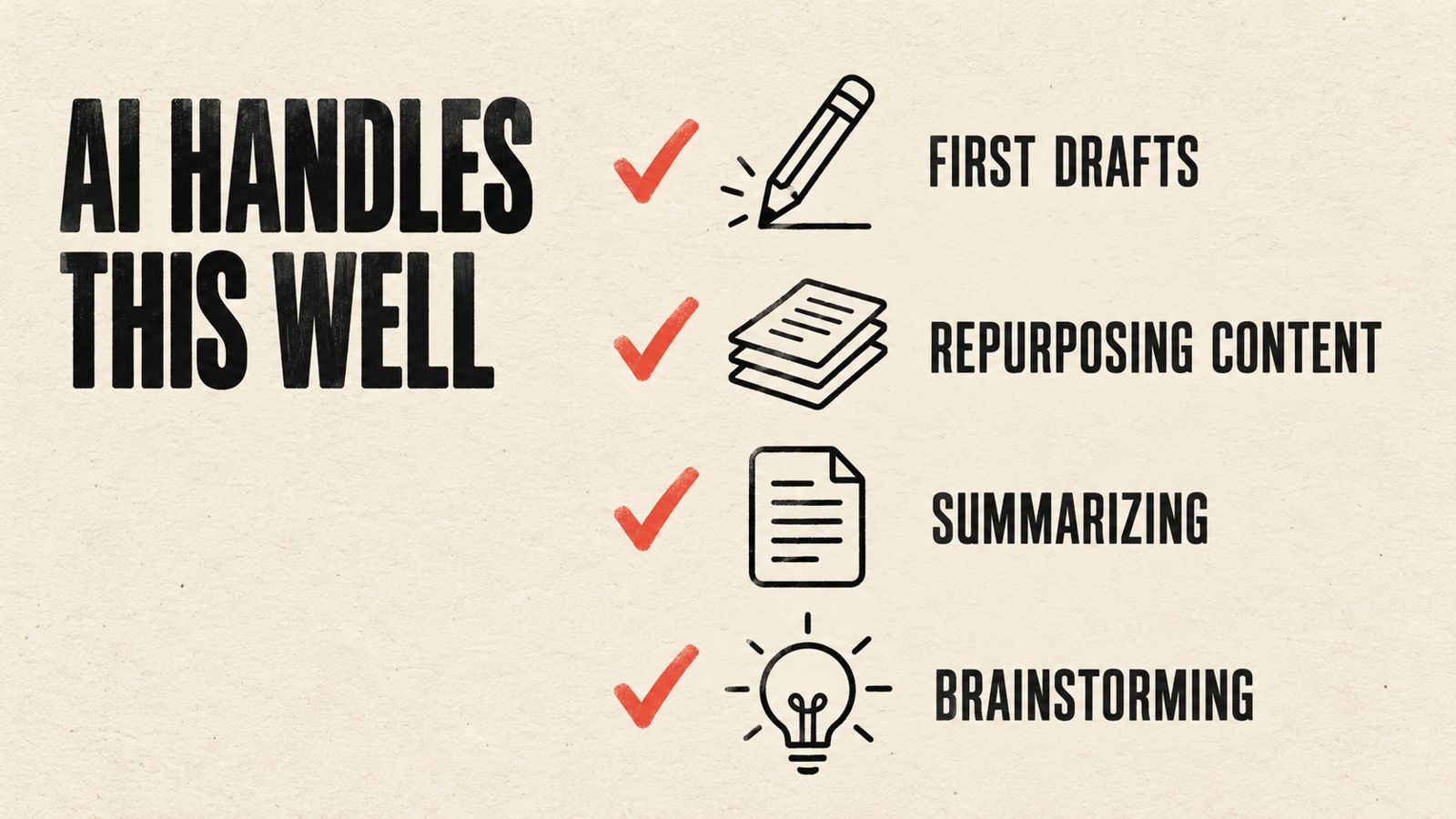
A few tasks consistently work in AI's favour when a small business uses these tools well.
First drafts of routine content. A first pass at a social caption, a short product description, or an email subject line gives a starting point that is usually faster to edit than to write from nothing, especially for a business posting often.
Repurposing material that already exists. Turning one piece of content, a blog post, a video transcript, a longer newsletter, into several shorter pieces for different platforms is one of the clearest wins. The underlying facts and voice already exist; the tool is mostly restructuring and shortening them.
Summarizing and organizing. Condensing a long document, a batch of customer reviews, or a set of meeting notes into a short, readable summary is a task AI tools handle reliably, because the goal is compression, not invention.
Brainstorming past a blank page. Generating ten headline options, five different angles for the same announcement, or a rough outline for a longer piece gives a person something to react to and improve, rather than staring at an empty page.
In every one of these cases, a person is still making the decisions that matter: which draft to use, what to cut, and whether it actually sounds like the business. AI is doing a useful first pass, never the final one.
What still needs a person, every single time?
A shorter list, but a more important one, because getting these wrong costs more than a mediocre caption.
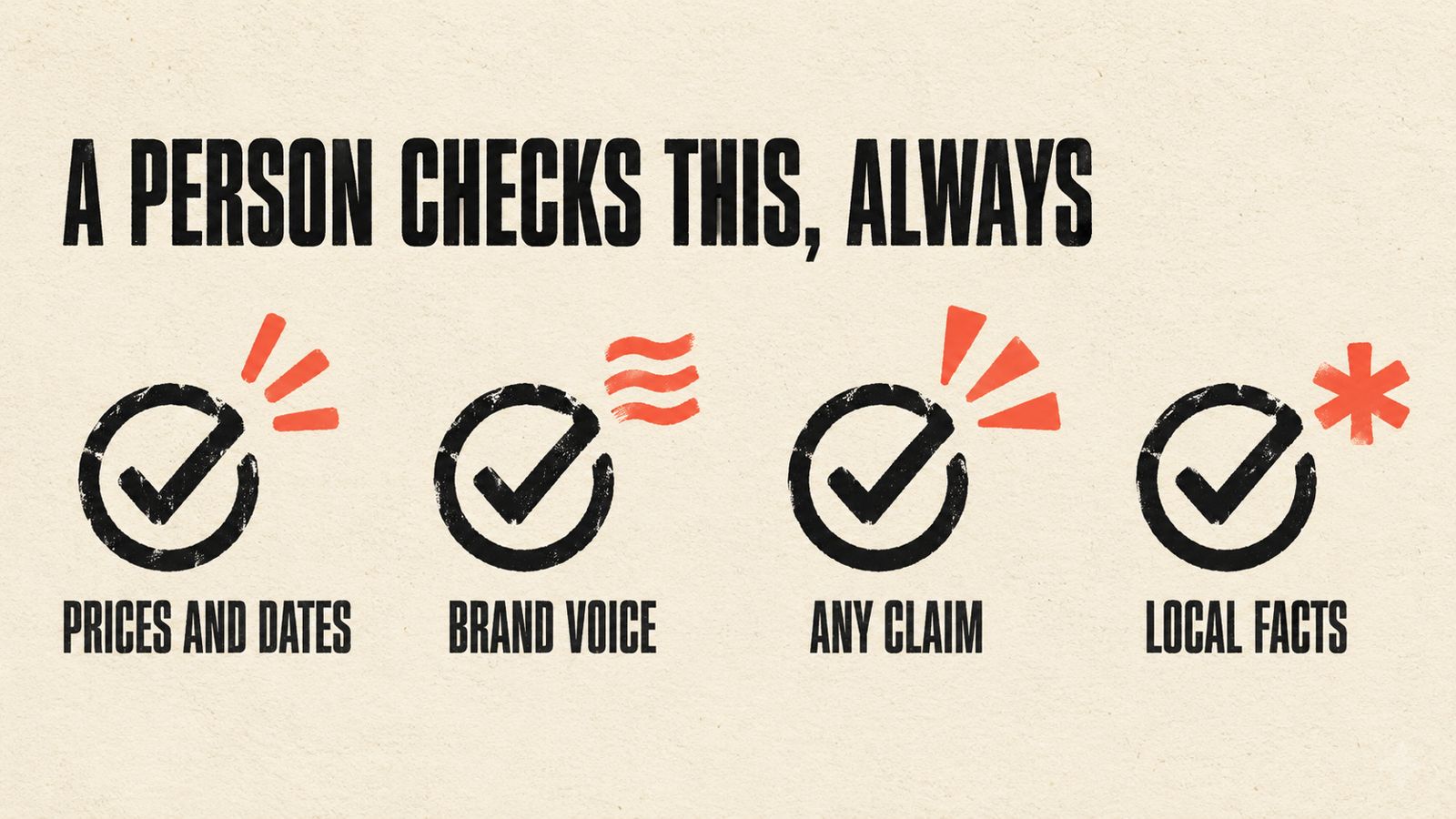
Anything with a number, a price, a date, or a policy. AI tools do not know a business's current prices, inventory, hours, or terms unless those are given to it directly, and even then a tool can restate a figure incorrectly. Any number or policy claim needs to be checked against the actual source before it is published, every time, with no exceptions.
Anything that is supposed to sound like the business, not like every other AI written page. Left unedited, AI tools default to a smooth, slightly generic tone, and that tone is often the first thing a regular customer notices, even if they cannot say exactly why a post feels a little off.
Anything customer facing that makes a claim. A statement about results, a guarantee, a comparison to a competitor, or anything that could be read as a promise needs a person who understands what the business can and cannot actually deliver. An AI tool has no way to know what is true; it only knows what sounds plausible.
Local or specific facts. A mention of a neighbourhood, an event, a regulation, or anything tied to a particular place or time should be verified the same way any other published fact would be, since AI tools can state a confident sounding detail that is simply wrong.
The simplest version of this rule: the more a piece of content could embarrass, mislead, or create a liability for the business if it turned out to be wrong, the more a person needs to read it before it goes out, no matter how good the AI draft looked on first read.
Will using AI content hurt your SEO?
This question comes up constantly, and the honest answer is more specific than a plain yes or no. Google's own guidance on AI generated content states that content is not penalized simply for being produced with AI assistance. What its systems look at is whether a page is genuinely helpful to the person reading it, regardless of how it was written.
Where AI content does run into trouble with search performance is the same place low quality content of any origin runs into trouble: pages published at scale with little real value, content that exists mainly to attract clicks rather than inform, and material that contradicts other information about the business elsewhere online. Google's policies on this kind of content apply whether a person, an AI tool, or some mix of both produced the page.
The practical takeaway is that the tool used to write something matters far less than whether the result is accurate, useful, and specific to the business. A thoughtfully edited, AI assisted post that answers a real customer question will generally perform fine. A pile of unedited, generic AI output posted purely to fill a content calendar is a problem, and it would still be a problem if a person had written it the same way.
How do you make AI content sound like your business instead of generic?
This is usually the difference between AI content that quietly works and AI content that quietly undermines a brand.
Give the tool real examples. Paste in a few pieces the business has actually published, an email that got a good response, a caption that sounded right, and ask the tool to match that voice rather than starting from nothing. A generic prompt produces a generic result.
Name the specific audience and purpose every time. A prompt such as describing exactly who the post is for and what it needs to say produces something far more usable than a vague request for "something for social media," because the tool has less room to default to filler.
Edit for voice before editing for grammar. Read the draft out loud, or imagine saying it to a regular customer. If it does not sound like something the business would actually say, rewrite the sentence rather than simply polishing it.
Keep a short style note on hand. A few lines on words the business avoids, a preferred tone, and a couple of phrases it actually uses saves time on every future draft and keeps AI assisted content consistent across whoever is using the tool.
What this looks like in practice
These are examples of how the ideas above tend to play out, not a promise of a specific result for any business, since outcomes depend on the starting point and how carefully a draft is reviewed.
Example: a retailer using AI to turn one blog post into a week of social captions. The owner wrote the original post herself, then asked an AI tool to split it into five short captions for different days. She still read and adjusted each one before scheduling, catching one caption that used a discount percentage the store was no longer offering.
Example: a service business using AI for first drafts of email replies to common questions. A tradesperson used an AI tool to draft replies to frequently asked questions about scheduling and service areas, then edited each draft before sending, keeping the specific details and tone accurate for that particular customer.
Example: a professional services firm catching a voice problem early. A consultant asked an AI tool to draft a newsletter introduction and found the result read as overly enthusiastic and generic compared to how the firm actually communicates. Rather than publishing it with a light edit, the draft was rewritten using the firm's usual, more measured tone, with the AI version kept only as a starting structure.

What getting this balance right actually gives you
- +Faster first drafts without losing your voice
Using AI for the first pass and a person for the final pass keeps the speed benefit without handing over judgment the tool does not have.
- +Fewer embarrassing mistakes reaching a live page
A clear rule about what always needs a human check, prices, policies, claims, local facts, catches the errors that matter most before customers see them.
- +A realistic use of a content person's time
Freeing up time spent on first drafts and repurposing lets a person spend more of their attention on the review and judgment work AI cannot do.
- +A simple standard anyone on the team can follow
A short, written rule for what needs review is easier to apply consistently than relying on everyone's individual sense of what AI content is safe to publish.
- +No wasted spend chasing a fully automated outcome
Expecting AI content to run itself without review tends to produce content that needs redoing later; building the review step in from the start avoids that cost.
What does this cost, and what should you ask?
Most AI content tools charge a monthly subscription, and the range varies by tool and by how much use is included, so there is no single figure that applies to every business. The bigger cost for most small businesses is not the subscription, it is the time someone spends reviewing, editing and fact checking what the tool produces, which is real work even when it is faster than writing from a blank page.
For a business considering paying someone to help with content that uses AI tools as part of the process, a few direct questions are worth asking before agreeing to anything: who reviews AI drafts before they are published, and what specifically are they checking; how the provider keeps content sounding like the business rather than generic; whether pricing is based on volume of content or on time spent, since those create different incentives; and what happens if an AI drafted piece contains an error, meaning who catches it and when.
We do not publish a flat price here because the right amount of AI assisted content, and the right amount of human review time, varies by business and by how much content is actually needed. A short, honest conversation about what a business currently publishes and what it actually needs is a more useful starting point than a number pulled from a general price list. Message us on WhatsApp at +1 306-518-7811 or call +1 833-998-1234. You can also book a free 15 minute discovery call at underdogcreativesolutions.com/contact.
How Underdog approaches AI assisted content
Underdog Creative Solutions is a Saskatoon based agency working with small and growing businesses across Canada and the United States. When content work for a client uses AI tools as part of the process, that use is treated as a drafting aid, not a replacement for a person who knows the business, and every piece that reaches a customer or a published page is reviewed before it goes out.
In practice that means AI assisted first drafts where they genuinely save time, a written style reference built from how a specific business actually talks to its customers, and a simple rule about what always gets a careful human pass: prices, policies, claims, and anything tied to a specific place or date.
We also build websites that are easy for people and AI tools to read, handle AI receptionists, and work on AI business automation, and for some businesses those connect naturally: a well organized website gives an AI receptionist and any AI assisted content the same accurate information to work from. None of that is required to benefit from the approach in this guide. Most businesses can start with better habits around their existing content tools alone.
Frequently asked questions
Talk to Underdog about your content
Have questions about your content, website, AI receptionist, or business automation? Message us on WhatsApp at +1 306-518-7811 or call +1 833-998-1234. You can also email support@underdogcreativesolutions.com.
Follow Underdog Creative Solutions on Facebook, Instagram, LinkedIn, and YouTube for practical AI and marketing ideas for Canadian small businesses.