// SMALL BUSINESS
How Much Does AI Business Automation Cost for a Saskatoon Small Business

There is no single, honest number for AI business automation cost in Saskatoon, and any provider who quotes you one before understanding your business is guessing. What actually sets the price is the scope of what gets connected, how much custom logic the project needs, how much ongoing support you want, and whether you start small or try to automate everything at once. This guide walks through each of those factors in plain language, gives you a practical checklist for comparing quotes, and is upfront about who should wait before spending anything at all.
Why do automation cost estimates for Saskatoon businesses swing so wildly?
Search for AI business automation cost and you will find numbers that do not agree with each other at all. One page says a project starts around a couple of thousand dollars. Another quotes tens of thousands for a "comprehensive implementation." A third prices everything by the hour, with rates that vary just as widely. None of these figures are wrong exactly. They are answering a different question than the one most Saskatoon business owners are actually asking.
The reason the numbers scatter so much is that AI business automation is not one product with one price tag. It covers everything from a single form that automatically creates a task in your scheduling tool, to a full rebuild of how invoices, customer records and follow ups move between systems. Those two projects have almost nothing in common except the word automation.
This guide will not add another invented number to that pile. Instead, it walks through the factors that actually move the price up or down, so you can look at any quote, including one from Underdog, and tell whether it reflects your business or someone else's.
What actually counts as AI business automation?
AI business automation, in practical terms, means software that handles a repeatable task without a person doing it by hand each time, using some combination of rules and AI to decide what to do with the information it receives. It is a different thing from an AI receptionist, which specifically answers phone calls, and different again from simply buying a piece of off the shelf software and using its built in features.
A few common examples of what falls under this umbrella for a small business: a new website enquiry automatically creating a record in a customer system instead of someone copying it over by hand, an overdue invoice triggering a polite reminder on a schedule instead of depending on someone remembering, or a finished job automatically prompting a review request a day or two later. For more worked examples like these built around a Saskatoon service business, see our guide to AI workflow automation examples for Saskatoon service businesses.
What it is not: a chatbot widget on your website by itself, a single automation already built into software you pay for (many tools include basic automation for free), or a vague promise to "add AI" without a specific task named. If a conversation about automation never gets specific about which task, which systems, and which person checks the outcome, it is not far enough along to be priced fairly yet.
What actually drives the cost of an automation project?
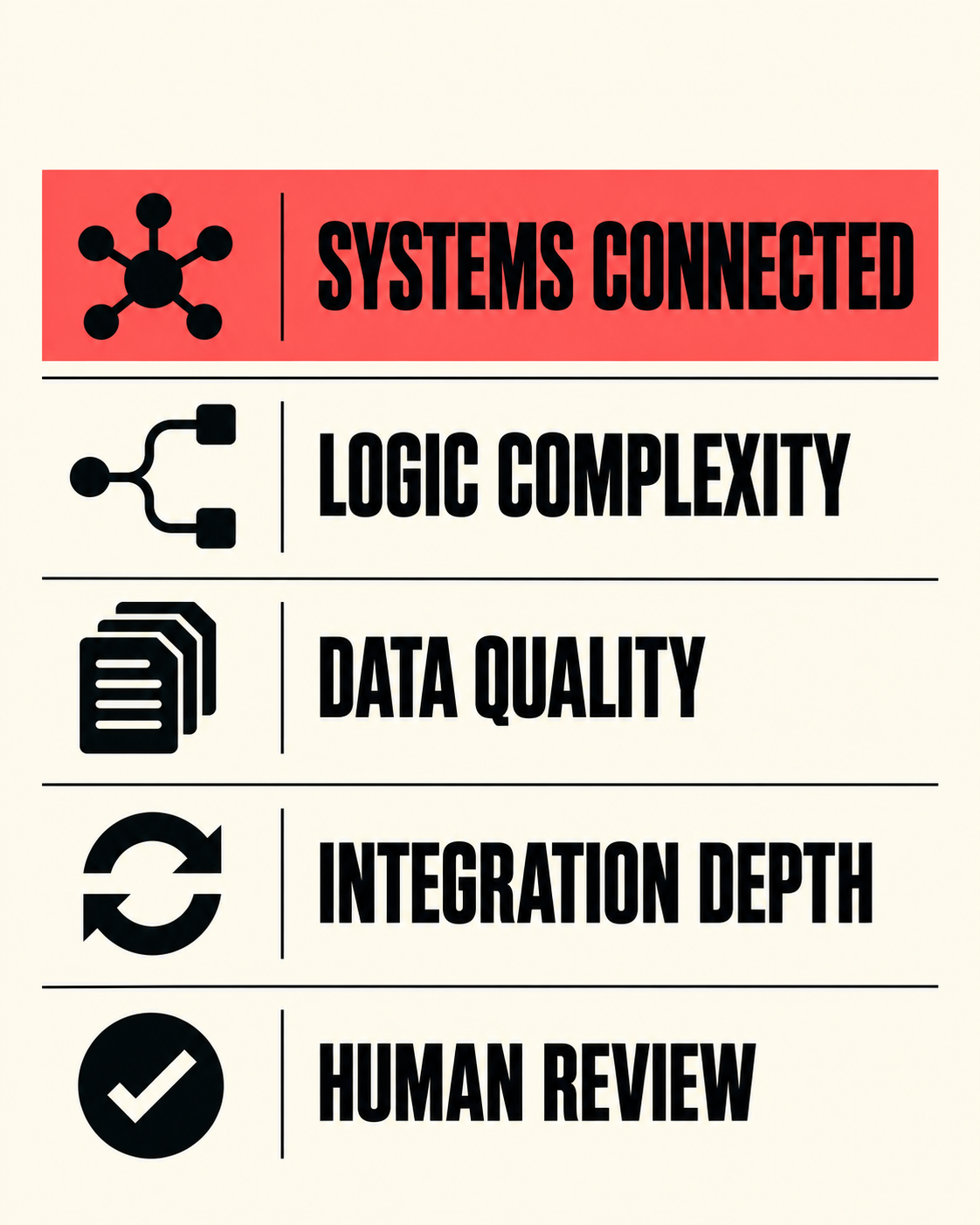
Once a project is specific enough to price, a handful of factors do almost all of the work in moving that price up or down.
The number of systems being connected matters most. A project that only touches one tool, for example drafting a message inside the scheduling software you already use, is simpler than a project that has to move information between your website form, your customer database, your invoicing software and your calendar, keeping all of them in sync.
The complexity of the logic matters nearly as much. "If a form is submitted, create a task" is a simple rule. "If a form is submitted, check which service was requested, look up whether that customer has an open invoice, and route the message differently depending on both answers" is a different scale of work, even though it still sounds like one automation to a business owner describing it.
Data quality affects cost in a way that is easy to miss. If your customer records are clean and consistently formatted, connecting them to something new is relatively quick. If the same customer appears three different ways across two spreadsheets and an old piece of software, cleaning that up often costs more time than building the automation itself.
Volume plays a role, though usually a smaller one than people expect. A workflow that runs five times a day and one that runs five hundred times a day often cost about the same to build. Volume mainly affects whether a human review step adds noticeable time, and whether the underlying software's own pricing scales with usage.
How deep the integration goes changes the cost directly. A one way notification, where one system simply tells another that something happened, is cheaper to build and far easier to fix than a two way sync, where information has to stay consistent in both directions and conflicts need a clear rule for which side wins.
Finally, how much human review the business wants built in affects both the build and the ongoing cost. A chain that drafts something for a person to approve every time is usually simpler to build than one that is trusted to send automatically, but it also means someone's time is still part of the process every time it runs. For a longer list of specific tasks worth automating first, see our guide on repetitive tasks Saskatoon businesses can automate with AI.
Are automation costs one time, or do they keep going?
It helps to separate what you pay once from what you pay every month, because competing pages often blur the two together.
The one time cost covers mapping the current manual process, building the automation itself, connecting the relevant systems, and testing it against real examples before it goes live. This is the part most quotes focus on, and it is also the part that varies most with the factors above.
The ongoing cost usually has two pieces. The first is whatever the software you are automating on top of already charges, since automation tools typically run as a layer above your existing systems rather than replacing them, and that underlying subscription keeps billing whether or not you automated anything. The second is support: monitoring that the automation is still working correctly, adjusting it when one of the connected systems changes something on its own end, and making small changes as your process evolves.
A business evaluating a quote should ask about both pieces separately. A low one time price paired with vague or open ended ongoing support terms is not automatically a better deal than a higher one time price with clearly defined support included.
How does scope change the cost? A worked example
Two examples make the scope difference concrete. Both are illustrative examples, not real client projects or quotes.
Example one: a Saskatoon landscaping company wants new website enquiries to automatically create a job lead in the scheduling software they already use, tagged by service type, so nobody has to retype it. This touches one system on the receiving end, follows one clear rule, and does not need to reconcile conflicting data anywhere. It sits at the simpler end of the scale.
Example two: a multi crew service business wants its customer database, invoicing software and calendar to stay in sync automatically, with overdue invoices triggering reminders, completed jobs triggering review requests, and anything unusual flagged for a person before it goes out. This touches three systems with two way data flow, several distinct rules running in parallel, and a defined human checkpoint built into more than one step. It sits toward the more involved end of the scale, and should cost more to build and support, for reasons that are visible in the scope itself rather than because a provider is charging more for the same work.
Neither example comes with a number attached here, because a fair number depends on which specific tools are involved, how clean the existing data already is, and how much support is wanted afterward. That is exactly the conversation worth having with any provider before agreeing to anything.
What should you ask before you sign a quote?
Whether you are talking to Underdog or anyone else, the same handful of questions separate a clear quote from a vague one.
What exactly is included at the quoted price. Ask for the specific systems being connected and the specific rules being built, not a general description like "automate your workflow."
What would trigger an additional charge. Scope tends to grow once a project starts, so ask in advance what counts as a change request versus what is already covered.
Who owns the finished automation if you switch providers later. Some automations live inside a platform you control directly, and some live inside a provider's own account, which matters if the relationship ever ends.
What happens if a connected tool changes its own features, pricing, or how it works. Automation depends on other software behaving consistently, and a good provider should have a plan for when it does not.
What ongoing support actually includes, in writing. "We're here if you need us" is not a support plan. A real one names what is covered, how quickly issues are addressed, and what counts as a separate paid change.
How you will know it is working. Ask what gets checked after launch, and by whom, rather than assuming the automation will quietly flag its own mistakes. For a broader checklist on evaluating any automation provider, not just on cost, see our guide on how to choose an AI automation agency.

Who does AI business automation suit, and who should wait?
AI business automation tends to suit a Saskatoon business that already has a repeatable manual process, running often enough that the time spent on it adds up over a month, where the steps rarely change from one instance to the next. A service business sending the same kind of follow up message dozens of times a week is a good candidate.
It suits a business less well when the process in question happens rarely enough that a person can comfortably keep up with it by hand, or when every instance is different enough that there is no real pattern to automate, only individual judgment calls. It is also a poor fit when the underlying data is still a mess. In that case, cleaning up records and settling on one system of record is worth doing before paying anyone to automate on top of it, since automation on messy data tends to automate the mess as well.
What to do first, before requesting a quote from anyone: write down the manual version of the process causing the most friction, roughly how often it happens, and who currently does it. That one page is worth more to a fair quote than any amount of back and forth about budget, because it is the thing an automation project actually prices against.
What does a well scoped first automation project typically include?
- +A single clear trigger and outcome
Not five problems solved in one build. One event, one defined result, so you can judge it clearly before going further.
- +A defined human checkpoint
A point where a person reviews or approves before anything reaches a customer, especially in the first weeks after launch.
- +A plain way to check the results
A simple method for confirming, after launch, whether the automation is actually doing what it was built to do.
- +A realistic timeline agreed upfront
A timeline set before work starts, rather than an open ended one that drifts as scope creeps.
- +A way to pause or adjust it
The ability to pause, tweak, or turn off the automation without having to start the whole project over.
How much should AI business automation actually cost for your business?
The fair answer to "how much does AI business automation cost" is that it depends on your own scope, not on a number published somewhere else. The factors in this guide, number of systems, complexity of the logic, data quality, integration depth, and the support you want afterward, are what any fair quote should be built around.
The most useful next step is not comparing prices from different websites. It is describing your own process, in the kind of detail outlined in the quote checklist above, and asking a provider to price that specific situation. See our pricing page for how Underdog structures its own quotes around a project's actual scope. A provider who can price your actual process clearly is worth more than one who can quote you a number before asking a single question about your business.
If you want to talk through where your Saskatoon business might start, message Underdog Creative Solutions on WhatsApp at +1 306-518-7811 or call +1 833-998-1234. You can also book a free 15-minute discovery call at underdogcreativesolutions.com/contact.
Where Underdog Creative Solutions fits, in plain terms
AI business automation is one of four pillars we work across for small businesses in Saskatoon and beyond, alongside website solutions, content, and an AI receptionist for handling calls specifically. We mention this because the four connect in practice, not because every business needs all of them at once.
A workflow that automatically creates a job lead is only useful if the enquiry reaches you to begin with, which is where a website that Google and AI tools can actually read comes in. An AI receptionist answers the call itself, while the kind of automation described in this guide usually handles what happens after an enquiry or a job already exists in your systems. Most Saskatoon businesses we talk to start with whichever single problem is causing the most friction right now, often the one described in the worked examples above, and only add a second piece once the first one is working the way they expected.
Frequently asked questions
Talk to Underdog about your automation project
If one part of your business, quoting, invoicing, follow ups, or anything else that repeats the same way every time, is currently held together by memory and spare time, that is usually the sign it is ready to be scoped and priced properly rather than guessed at.
Message Underdog Creative Solutions on WhatsApp at +1 306-518-7811, call +1 833-998-1234, email support@underdogcreativesolutions.com, or book a free 15-minute discovery call at underdogcreativesolutions.com/contact.
Follow Underdog Creative Solutions on Facebook, Instagram, LinkedIn, and YouTube for practical AI and marketing ideas for Canadian small businesses.