// SMALL BUSINESS
How to Choose a Web Designer in Vancouver: A Small Business Buyer's Guide

If you search for a web designer in [Vancouver](/locations/british-columbia/vancouver) right now, you will find a wall of nearly identical agency homepages and freelancer profiles, most of them telling you they are the best choice without saying why. Choosing between them is hard precisely because they all sound the same. The short answer: a good web designer for your business is someone whose past work you can actually test on your own phone, whose quote spells out exactly what is and is not included, and who hands you full ownership of your site once the work is done. This guide walks through how to tell that apart from the rest, what a fair quote should contain, and when it makes sense to wait before you spend anything at all.
The problem: a crowded market with no easy way to compare
Vancouver has one of the more competitive web design markets in Canada. A search for a web designer here turns up a local pack of three agencies, a long list of organic agency and freelancer results, a couple of best web design company listicles, and little else. Almost every result is a business pitching itself, which makes sense, but it leaves an owner with no neutral way to compare one shop against another.
Most of these pages look similar: a portfolio grid, a list of services, a contact form. Few explain what their price actually covers, who will touch your project day to day, or what happens after the site goes live. People searching this topic commonly ask what a website actually costs and whether web design is still worth paying for, both signs that the information they need is not showing up on the page.
What you are actually buying from a web designer
A website build is really three things bundled together: the design and build itself, the technical setup that lets your site be found (basic search engine optimization and, increasingly, a structure that AI tools such as ChatGPT or Google's AI Overviews can read), and an ongoing relationship for updates, fixes and hosting.
A good web designer quote should cover more than a one time build. It should say plainly what is included for search visibility, who owns the site once it is finished, and what support looks like in month two and month twelve, not just launch day. If a quote is silent on any of those three parts, ask about it before you sign anything.
How to choose a web designer in Vancouver, step by step
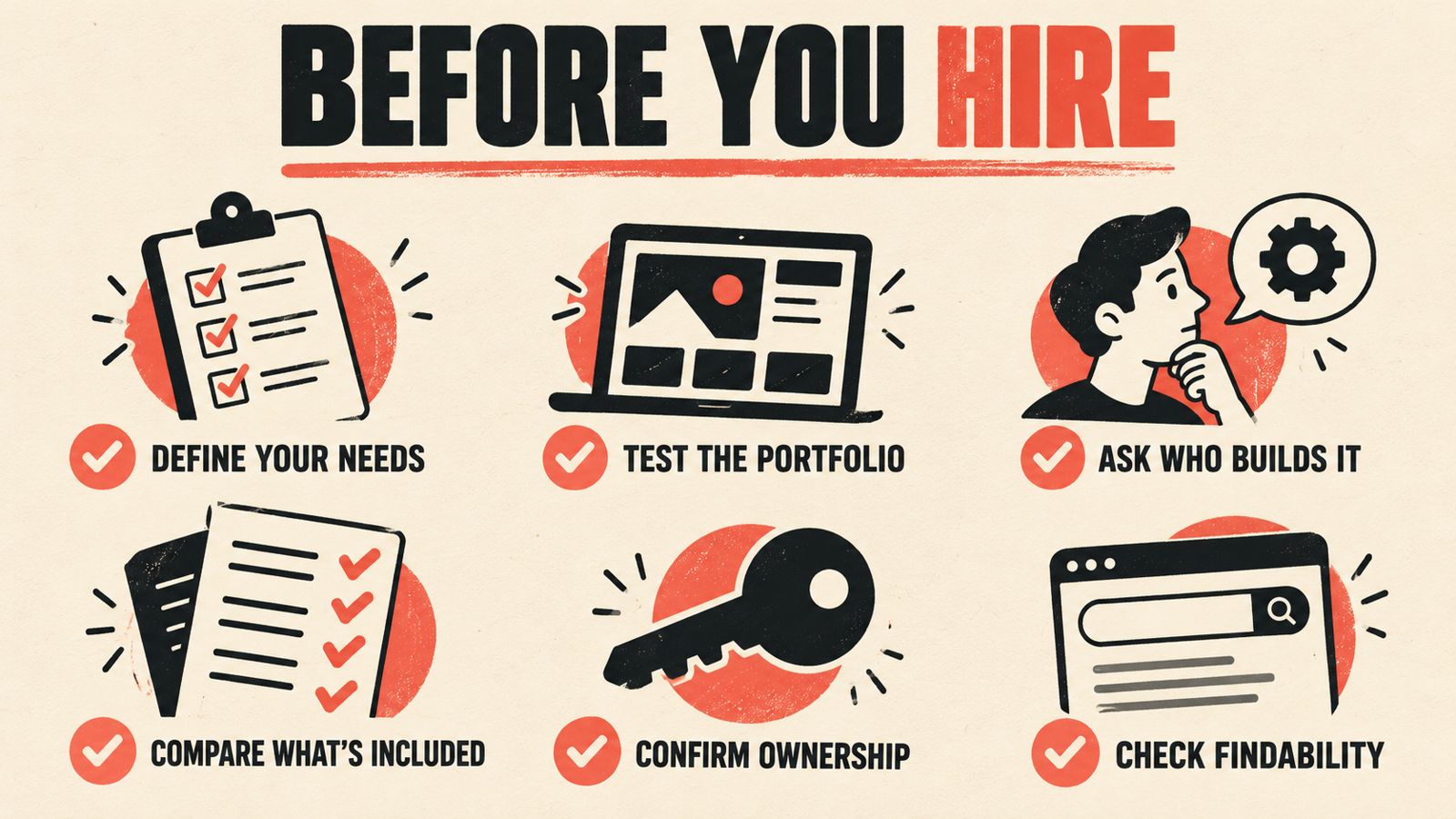
Write down what the site needs to do before you talk to anyone. A five page brochure site, a site that takes bookings, and a site that sells products online are three different projects with different costs and different skills required. Knowing which one you need stops a designer from either overselling you or underbuilding what you actually require.
Build a short list, then look at the work on your own phone. Do not judge a designer by their own homepage. Open two or three sites from their portfolio on your phone, the way a customer would. Try the contact form. If they built an online store, add something to the cart. A portfolio that only looks good on a laptop is worth noticing, since most searches for local businesses now happen on mobile.
Ask who will actually do the work. In a market this size, many quotes come from a salesperson, and the build is quietly subcontracted elsewhere. Ask directly whether your project is handled in house or passed to a third party, and who your contact will be once the contract is signed.
Compare what is included, not just the number. Two quotes that are several hundred dollars apart can represent very different scopes. One may include copywriting, basic search engine setup, stock photography and a training session; the other may be the build alone, with everything else billed separately later. Ask each designer to list, in writing, exactly what their number covers.
Confirm who owns everything once the project ends. The domain name, the hosting account, the content management system login, the analytics account and the files themselves should all end up registered to your business, not the designer's agency account. Ask how you would move to another provider later if you needed to, and treat a vague answer as a reason to keep looking.
Ask how the site will be found, not just how it will look. A site that nobody can find does not help your business. Ask what the designer does for basic search engine optimization, whether the site's information will be written as plain, readable text rather than locked inside images, and whether that same clarity also helps AI tools describe your business accurately. No one, including Underdog, can promise that an AI tool will recommend a specific business. What a good build can do is make your information easy to find and hard to misread.
Red flags worth walking away from
A few patterns show up often enough in web design pitches that they are worth naming directly.
No real portfolio, or a portfolio of sites that no longer exist. Ask for live links you can click right now, not screenshots.
A guaranteed first page Google ranking. Nobody can guarantee a ranking, on Google or in an AI tool's answer, and a designer who promises one is making a claim they cannot control.
Heavy pressure to sign quickly, often paired with a discount that expires in a day or two. A legitimate quote should hold for at least a week.
A free mockup built before you have signed anything. It looks generous, but it often means the designer is competing on a quick visual instead of a real understanding of your business, and it can hide a weak process underneath.
Vague answers about who owns your domain and hosting after launch. This one matters enough that it is worth asking twice if the first answer is unclear.

What a fair quote should actually include
Because prices vary so much by scope, an honest guide does not hand you a dollar figure, since any number here would either be wrong for your project or simply invented. What is useful is knowing what drives the price, and what a fair quote should spell out in writing.
The factors that typically move the price: the number of pages and how much original writing they need, whether the site takes bookings or sells products, how much custom design versus template work is involved, how much existing content such as photos, copy and price lists you can supply versus needing it created, and what ongoing support or updates are bundled in versus billed separately.
What a fair quote should state plainly, regardless of the number: whether the design is custom or built from a template, whether basic search engine setup and mobile optimization are included or extra, who writes the website copy and what that costs if it is not included, who tests the site before launch, what happens if you want changes after the first draft, and what support costs after the site goes live. If a quote cannot answer these questions in writing, treat the number attached to it as incomplete.
A freelancer or an agency: which fits your business
Neither option is automatically better, and the right choice depends on what you need.
A freelancer often costs less and gives you a single point of contact, which some owners prefer. The trade off is capacity: if that one person is sick, busy with another client, or moves on to other work, your project or your support can stall. Ask a freelancer directly what happens to your site if they become unavailable.
An agency usually costs more but spreads the work across a team, so one person leaving is less likely to stop your project. The trade off is that you may deal with a project manager rather than the person actually building your site, and communication can be slower. Ask who your actual point of contact will be once the sales conversation ends.
Neither structure guarantees quality on its own. The questions in the steps above matter more than whether the business is one person or twenty.
Who should rebuild now, and who can wait
A new or rebuilt site is worth prioritizing if your current one is slow on a phone, lists hours or services that no longer match reality, makes it unclear how to contact or book you, or exists mostly as a PDF menu or price list that is hard for people and AI tools to read.
It may not be your most urgent task if your current site already loads well, is accurate, and brings in enquiries. In that case, a short list of fixes may do more good than a full rebuild, and that is a reasonable answer even if it means no immediate sale for whoever you ask it of.
Before you contact anyone, open your own site on your phone as a stranger would. Can you tell what the business does, where it is, and how to get in touch within a few seconds? Write down everything that is wrong, missing, or hard to find. That list is the real brief for whatever you decide to do next, whether that is a full rebuild, a short list of fixes, or waiting another season.
What a well chosen web designer delivers
- +A site that works on the device people actually use
Most visitors to a Vancouver small business site will see it on a phone first, so a designer who builds and tests for mobile from the start saves you a second project later.
- +A clear, written scope
You know exactly what is included before you pay anything, instead of discovering gaps after launch.
- +Full ownership
Your domain, hosting and content belong to your business, so you are never locked into one provider.
- +A site that is easy to read, for people and for AI tools
Plain, well structured pages are easier for search engines and AI tools to read correctly, even though no specific result can be guaranteed.
- +A realistic plan for updates
You know what changes cost and how long they take, instead of finding out the first time something needs to change.
What it costs and the next step
As the sections above cover, website cost depends on scope: how many pages you need, whether you take bookings or sell online, how much writing and photography is involved, and what ongoing support you want. Because those factors vary this much, we do not quote a single figure in an article, and any designer who does before understanding your business is skipping a step.
A short, low pressure conversation is usually the fastest way to get a real answer for your specific project. Message us on WhatsApp at +1 306-518-7811 or call +1 833-998-1234. You can also book a free 15-minute discovery call at underdogcreativesolutions.com/contact.
How Underdog fits in, if you want a second opinion
Underdog Creative Solutions is a Saskatoon based agency that also works with small businesses across Canada and the United States, including Vancouver. We build websites that are easy for customers to use and easy for search engines and AI tools to read, and we are upfront that no one, including us, can promise a specific ranking or an AI mention. We focus on what is actually within reach: clear pages, accurate information, and a technical setup that gives your business a fair shot at being found.
A website is usually the right starting point, and it connects naturally to the rest of what a small business needs. Content written on a regular cadence builds on a site that already works. An AI receptionist can answer calls and messages while you are with customers, capture the details, and hand anything unusual to a person. Business automation can connect your enquiry form, calendar and customer list so nothing depends on memory. You do not need all of it at once, and we would rather help you choose the right starting point than sell a bundle you do not need.
Frequently asked questions
Talk to Underdog about your Vancouver website
Have questions about your website, content, AI receptionist or business automation? Message us on WhatsApp at +1 306-518-7811 or call +1 833-998-1234. You can also email support@underdogcreativesolutions.com.
Follow Underdog Creative Solutions on Facebook, Instagram, LinkedIn, and YouTube for practical AI and marketing ideas for Canadian small businesses.