// SMALL BUSINESS
Content Marketing for Edmonton Small Businesses: Where to Actually Start

Search for content marketing in Edmonton right now and almost everything on the first page is a marketing agency explaining why you should hire a marketing agency. That is not much use if you are an Edmonton small business owner trying to work out, in plain terms, where to actually start. Here is a direct answer. Start with the questions your customers already ask you, in whatever format you can realistically keep up with (a short post, a photo with a caption, a one page answer on your website), and publish on a schedule you can sustain rather than one that sounds impressive on a proposal. Everything else, which platform, which tools, how often, builds on that one decision.
Why content marketing feels confusing for an Edmonton small business
Most owners do not lack ideas. They lack a clear starting point. Every platform has its own format, every agency pitches a different package, and it is hard to tell whether a post that took twenty minutes to make did anything at all.
The Edmonton market makes this harder in one specific way. A search for local content marketing help turns up directory listings and agency rankings (Clutch, DesignRush, UpCity and similar sites all keep their own lists of Edmonton marketing companies), plus agencies writing their own tips posts to rank for the term. None of that is wrong, but none of it is written for an owner who wants to understand the basics before spending anything.
The result is a familiar pattern: a business posts inconsistently for a few weeks, sees nothing obvious happen, and quietly stops. That usually means the starting point was wrong, not that content marketing does not work for a business like theirs.

What content marketing actually means for a small business
Content marketing is any piece of public content, a post, a page, a short video, a photo with a caption, that answers a real question a potential customer has, rather than simply asking them to buy. It is different from a paid ad: an ad is something you pay to put in front of people for as long as the budget lasts, while a piece of content keeps working after you publish it, as long as someone can still find it.
For most Edmonton small businesses, that content lives in two places at once: on the business's own website (where it can be found through search, and where it stays permanently) and on one or two social platforms (where it is seen in the moment, and where it can be shared). The two reinforce each other. A short answer written once on a website page can be reused as several social posts over time, instead of writing something new from nothing every week.
Where to actually start: a realistic first month
Start by writing down the five questions customers ask most often, by phone, by email, or in person, before they buy. Not the questions a marketing textbook suggests, the ones this specific business actually gets. For a service business, that might be about pricing factors, timelines, or what happens if something goes wrong. For a retail or hospitality business, it is more often about hours, availability, or what makes one option different from another.
Turn each question into one piece of content: a short page on the website, or a post with a caption that gives the real answer in the first sentence. Publish one of these a week for a month before worrying about a bigger plan. A business that answers five real customer questions well over a month has already done more useful content marketing than one that posted daily with nothing to say.
Pick one social platform, not three, based on where this business's actual customers already spend time, and treat the others as optional later. Trying to keep up three platforms at once from a standing start is the most common reason content marketing gets dropped after a month.

Who this starting point suits, and who should do something different
This slow, question led approach suits a business with limited time and no in house marketing person, which describes most small businesses in Edmonton. It also suits a business that has never published anything before and needs a low risk way to begin.
It suits less well a business that is already posting consistently and wants to grow reach or engagement specifically, since that is a different, more advanced problem than simply getting started. It also suits less well a business in a particularly crowded, visual category (a restaurant with strong food photography potential, for example) where investing more in a smaller number of high quality visual posts can outperform a high volume, text first approach.
What to do first either way: write down the five real customer questions before deciding on platforms, tools, or a posting calendar. That one step clarifies almost everything that follows.
What this looks like in practice
These are illustrative examples, not case studies of real Underdog clients, meant to show how the question led approach plays out for different kinds of Edmonton businesses.
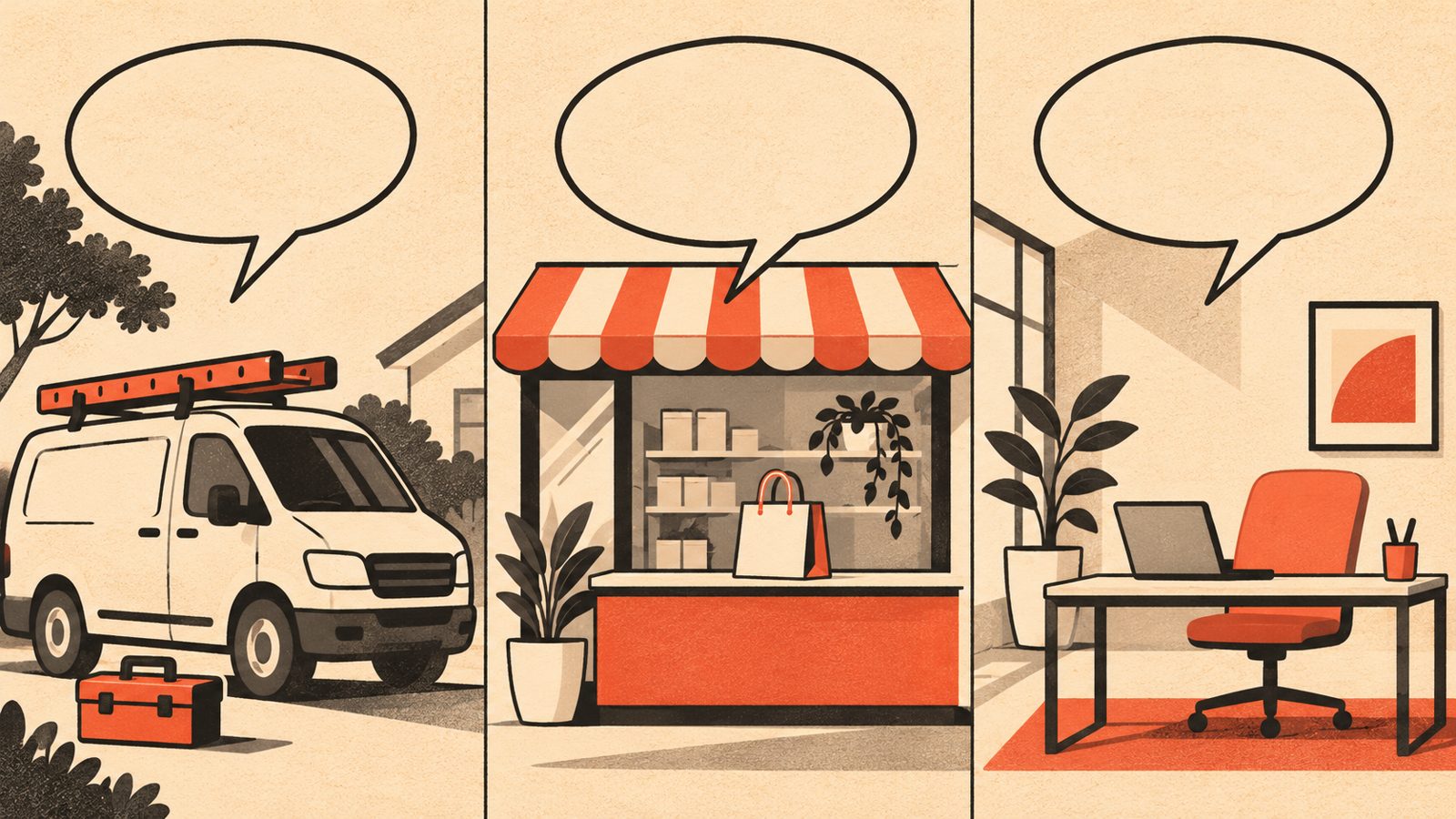
Example: a home services business (plumbing, HVAC, or similar) gets the same five questions on almost every call: whether they service a certain neighbourhood, what a typical callout involves, and how quickly they can come out. Five short website pages answering those exact questions, each reused as one social post, gives future callers an answer before they even pick up the phone, and gives the business owner five pieces of content without inventing a single new topic.
Example: a retail or personal services business (a shop, a studio, a salon) gets fewer phone questions and more walk in or social media questions: what is currently in stock, what a new customer should expect on a first visit, what makes this business different from the one two blocks over. Here, a photo with a short, specific caption usually outperforms a long written page, since the format matches how customers are actually browsing.
Example: a professional services business (accounting, consulting, a trade association member) gets questions that are harder to answer in one sentence: what a typical engagement involves, how pricing is usually structured, what documents a client should have ready. These suit a slightly longer written page more than a quick social post, since the reader is usually comparing options rather than browsing casually.
In all three cases, the starting question is the same: what do customers already ask, and where would they most naturally look for the answer.
A simple checklist before the first post goes out
Before publishing anything, it helps to check five things. First, is this answering a real question a customer has actually asked, not a topic that simply sounded relevant. Second, does the first sentence give the answer, rather than building up to it. Third, is there a clear next step at the end (a phone number, a WhatsApp link, or a page to visit) without turning the whole post into a sales pitch. Fourth, is the schedule behind this realistic for the next three months, not just the first week. Fifth, where will this content live permanently (a website page, a pinned post) so it keeps working after the day it was published.
A business that can answer yes to those five questions for a single post has a better starting plan than one with a detailed content calendar and no clear answer to any of them.
What this actually gets a small business
- +Customers get an answer before they call
A clear page or post answering a real question means fewer repeat phone calls about the same thing, and a customer who already feels informed before they reach out.
- +A library that gets reused, not rewritten
Content built around real customer questions does not expire the way a seasonal promotion does. The same answer can become a website page, a social post, and an FAQ entry, written once.
- +Something for search engines and AI tools to actually read
Search engines and newer AI answer tools both need real, specific content to point to. A generic homepage with no supporting content gives them nothing to work with; a set of plain answers to real questions gives them something concrete.
- +A foundation the rest of the business can build on
The same customer questions that shape good content also shape a clearer website and a better briefed AI receptionist, since all three are really answering the same handful of things customers want to know.
What this costs to do, and where Underdog fits in
There is no single honest price to quote here, because the cost depends on how much of this an owner wants to do personally versus hand off, how many pieces of content a month the business wants, and whether photography or video is involved. What actually drives the cost is time: writing, basic photography, scheduling, and keeping a consistent voice all take real hours every month, whether an owner does them personally or pays someone else to.
A reasonable way to evaluate any quote, from Underdog or anyone else, is to ask exactly how many pieces of content are included per month, in what formats, whether the price includes writing or only scheduling, and what happens to the content itself if the business ever stops the service.
Underdog Creative Solutions offers content creation as one of its core services, built around the same real customer question approach described above, alongside website solutions and an AI receptionist for Edmonton businesses that want their phone covered while their content runs in the background. None of these are sold as a forced bundle. If a business only wants help with content, that is a complete conversation on its own. Message Underdog on WhatsApp at +1 306-518-7811 or call +1 833-998-1234 to talk through what a realistic monthly plan would look like for this specific business.

How Underdog approaches this differently
Underdog Creative Solutions builds content plans around the real questions a specific business's customers ask, rather than a generic content calendar template applied to every client. The same team that can build or improve a website that search engines and AI tools can actually read is the one writing the content that gives those tools something to find, so the two pieces reinforce each other instead of living in separate silos.
No content plan promises a specific amount of reach, followers, or leads, since nobody can responsibly guarantee that outcome in advance, and no AI search tool can be promised or paid to recommend or cite a specific business. What a good content plan can promise is consistency: the same real answers, published on a schedule the business can actually keep, month after month.