// SMALL BUSINESS
AI Receptionist for Edmonton Small Businesses: What Changes When You Switch

If you are an [Edmonton](/locations/alberta/edmonton) business owner weighing whether to switch to an [AI receptionist](/ai-receptionist), here is the direct answer: every call gets answered the moment it rings, routine questions and bookings get handled without a person touching the phone, and anything that needs real judgment gets flagged or handed to someone who can deal with it properly. The switch is less about replacing a receptionist than about never losing a call again, whether it rings at 6am before a crew heads out into the cold or at 9pm when a customer finally has five minutes to make the call. Search for an AI receptionist in Edmonton right now and the results are a mix of vendor landing pages each pitching their own system, a scatter of job postings for virtual receptionist roles that have nothing to do with buying a service, and the occasional blog post written for an entirely different industry. Almost none of it is written for an Edmonton owner who is still deciding whether this is worth doing, what actually changes day to day, and what to ask before picking anyone. That is what this guide covers.
Why Edmonton business owners are looking at this now
A missed call rarely feels urgent in the moment. The phone rings out, the caller hangs up, and the job in front of you keeps going. But if that caller was choosing between you and the next business on their list, a missed call is often the whole decision made without you.
Edmonton runs on a wide mix of trades, home services and other appointment driven businesses, the kind where a ringing phone usually means a new job or a customer who needs something handled, not a cold call to ignore. Many of these businesses also feel a real seasonal swing: furnace trouble, frozen pipes and other cold weather emergencies tend to spike through the winter months, which is exactly when a missed call is most costly, since the caller rarely waits around for a callback.
A full time receptionist is a real cost, and the coverage still thins out at lunch, during a busy week, or whenever that person is simply away. A traditional after hours answering service helps, but it is usually billed by the minute, and the person on the other end does not know your business the way a trained employee would.
That gap is part of why AI receptionists have become easier to find in Edmonton. The harder part is the search results themselves: most of what comes up is either a provider pitching its own system, a job listing for a virtual receptionist position that has nothing to do with buying the service, or content written for a different industry altogether. Almost nothing is written for an owner who simply wants a plain explanation of what changes, what it costs to find out, and what to watch for before signing anything.

What actually changes when an Edmonton business switches to an AI receptionist
The core mechanics are similar across most providers, even though the marketing pages differ. Your existing business phone number is usually kept. Calls are either forwarded to the new system or the number is ported over, depending on your current phone provider and plan.
From there, three things typically work differently than with no receptionist, or a part time one. Every call is answered immediately, at any hour, with no ringing out and no voicemail nobody checks until the next morning, including the overnight calls that tend to spike during a cold snap. The system follows a script you have approved, a greeting, a handful of standard questions such as what service, what location and when, and either a direct booking into your calendar or a message logged for you to review. Anything outside that script, a complaint, an unusual request, a question about a quote, gets flagged or transferred to a person rather than guessed at.
What does not change matters just as much. You still decide pricing. You still approve any booking that needs judgment. Customers can still reach a person when they ask for one. An AI receptionist is meant to take on the repetitive, predictable part of your call volume, not replace every judgment call a receptionist makes.
How an AI receptionist is different from a call centre
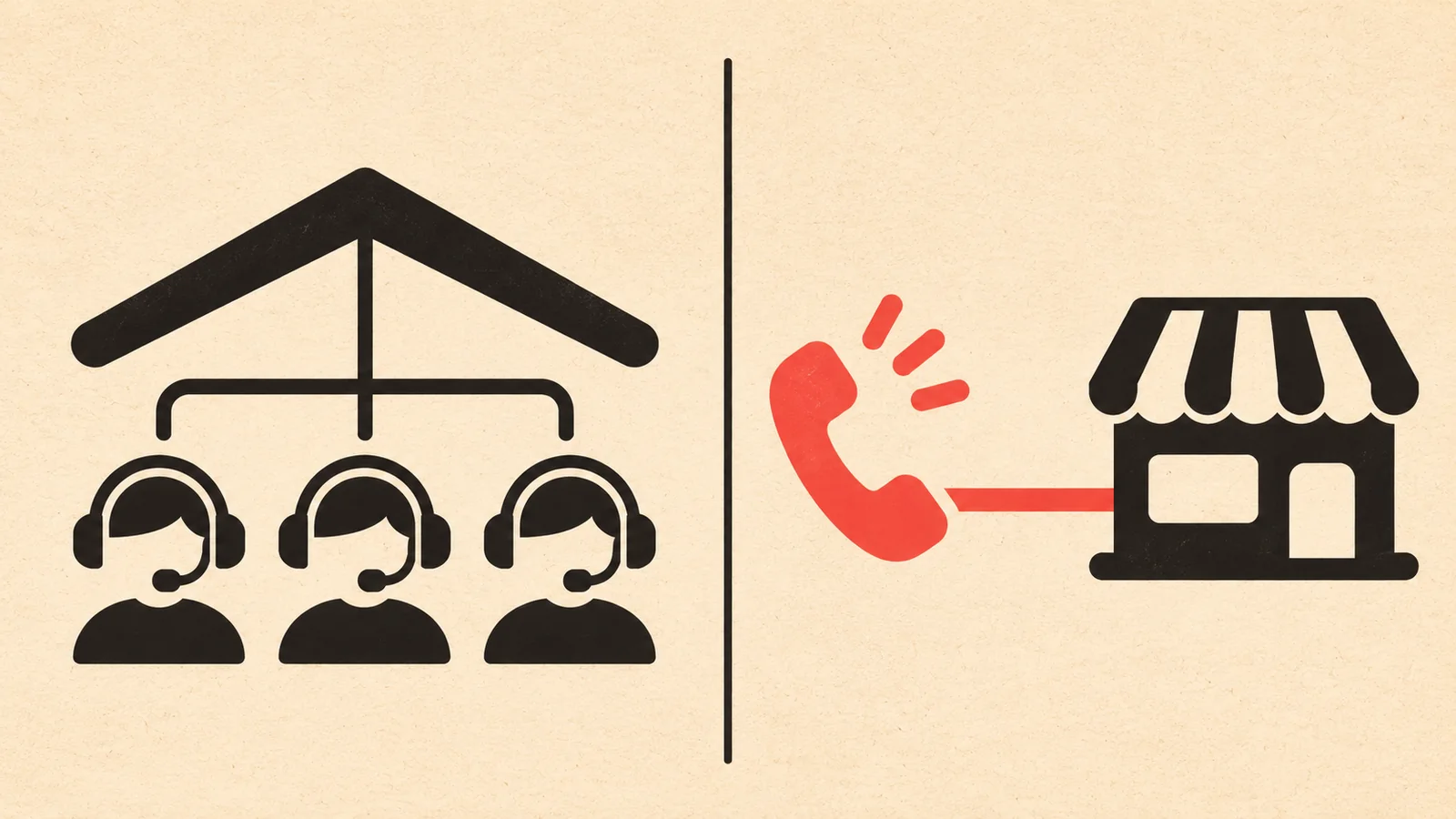
The two get confused often enough that it is worth separating them clearly. A traditional call centre is staffed by people, usually working from a script, often handling calls for several different businesses at once from a shared facility. Pricing is typically per minute or per agent hour, and the person answering does not know your business beyond whatever script they happen to be reading from.
An AI receptionist is software trained specifically on your business: your services, your hours, your service area and how you want calls handled. It answers every call instantly rather than queuing callers, it works around the clock without a shift schedule, and because it is not a shared pool of agents, it does not need to be told your business from scratch on every call. The tradeoff is that it works from rules set in advance. A call centre agent can improvise more freely; an AI receptionist follows the script and rules it has been given, which is why setup, deciding what it should say and when it should hand off to a person, matters more than it would with a human agent who can think on their feet.
For most small businesses, the practical difference shows up in cost and consistency. An AI receptionist tends to cost less than staffing a call centre line, and every caller gets the same accurate information about your hours, your services and your service area, rather than whatever a given agent happens to remember correctly that day.
What callers are told, and what happens when the AI cannot help
A caller should be told early in the call that they are speaking with an automated system, along with a clear, easy way to reach a person if they want one. Any provider you are considering should be able to walk you through exactly when and how that disclosure happens on a call, since this differs between systems and affects both how comfortable your customers feel and how the service reflects on your brand.
Escalation matters just as much as disclosure. A properly configured AI receptionist does not try to push through a call it cannot handle. Depending on the rules you set, it transfers the call live to a person, takes a detailed message flagged as urgent, or offers a callback window. Ask any provider to walk you through exactly what happens on a call that goes off script, not only what happens on an easy one, since the easy calls were never where the real risk sat.
Privacy and consent: what Alberta businesses need to know
Any system that answers your calls is collecting personal information: names, phone numbers, and sometimes an address or details about why someone is calling. In Canada, collecting that kind of information requires meaningful consent under the federal Personal Information Protection and Electronic Documents Act, usually called PIPEDA. Alberta also has its own private sector privacy law, the Personal Information Protection Act, which applies to organizations operating anywhere in the province, including Edmonton, and runs alongside the federal rules.
In practice, this means a business using an AI receptionist should be able to explain, in plain language, what information is collected on a call, where it is stored, who can see it, and how long it is kept. If calls are recorded or transcribed, callers should generally be told that near the start of the call. None of this is unique to AI. A human answering service or any recorded line carries similar obligations. Switching to a new system is simply a natural point to ask these questions directly and expect a clear answer, since most providers document their data handling as part of setup.
This is general information, not legal advice. If your business handles particularly sensitive information on calls, a short conversation with a privacy lawyer is worth more than relying on any provider's marketing claims.
Questions worth asking before you choose a provider
How is pricing structured, by the minute, a flat monthly plan, or a tiered plan based on features? Ask for a quote against your actual call volume rather than relying on an advertised starting price.
What happens to a call the system cannot handle? Ask for a specific walkthrough, not a general answer.
Does it work with the calendar or booking tool you already use, or will you need to change tools to make it work?
Can you keep your existing phone number?
How and when are callers told they are speaking with an automated system?
Where is call data stored, and who can access it?
Can you review and adjust the script yourself, or does every change need to go through the provider's support team?
How does the system handle a sudden jump in call volume, such as a cold snap that triggers a run of furnace or plumbing emergencies at once?
Is there a contract term, and what does it actually take to cancel or pause the service?
None of these questions are meant to catch a provider out. A business that has thought through its own setup carefully should be able to answer all of them clearly and without hesitation.

Who this suits, who it does not, and what to do first
An AI receptionist tends to suit Edmonton businesses where the phone rings often, where a good share of calls are routine (booking, hours, service area and pricing questions you can script an answer to), and where missing a call has a real cost. Trades, home services and other appointment driven businesses are common examples, especially ones that see call volume rise and fall with the weather.
It is probably not the right fit yet if your call volume is very low, if nearly every call needs genuine judgment such as a complex or highly variable quote, or if you are not ready to write down, even roughly, how you want calls handled. An AI receptionist follows the rules you give it. A business that has not settled those rules yet will find the automation inherits the same confusion.
What to do first: for a week, note every call that comes in, roughly what it was about, and whether a simple script could have handled it or whether it genuinely needed you. That short list is the most useful thing you can bring into a conversation with any provider, because it tells you how much of your call volume is actually a good fit for automation before you commit to anything.

What switching well can help with
- +Faster answers
Calls get picked up immediately instead of ringing out or going to voicemail, even during a cold snap when every line is busy.
- +Fewer missed bookings
Routine requests get logged or booked the moment they come in, not whenever someone finds time to check messages.
- +A consistent script
Every caller gets the same accurate information about hours, services and your service area.
- +Freed up time
Staff spend less time on repetitive calls and more on the job in front of them.
- +A record you can review
Calls and requests are logged somewhere you can check, instead of living only in someone's memory.
What it costs and how to take the next step
AI receptionist pricing varies by provider and depends on your call volume, the features you need such as booking integrations, multiple lines or after hours routing, and the level of support included. Because the market is still new and pricing models differ this much from one provider to the next, we do not publish a single number here, and any single advertised starting price is best treated as a floor rather than a quote for your business. For a closer look at how AI receptionist costs tend to compare with hiring staff, see our separate guide on AI receptionist cost in Edmonton. The fastest way to get a real answer for your own business is to describe your current call volume and what you want handled automatically, and ask for a quote against that.
If you want to talk through whether an AI receptionist is the right next step for your Edmonton business, message us on WhatsApp at +1 (306) 518-7811 or call +1 (306) 518-7811. You can also book a free 15-minute discovery call.
How Underdog approaches AI receptionists for Edmonton businesses
Underdog Creative Solutions is a Saskatoon based agency working with small and growing businesses across Canada and the United States, including a growing number of Edmonton clients across trades, home services and other local industries. Our AI receptionist service is built around how your business already answers calls, your script, your escalation rules, your booking process, rather than a generic template.
It also connects naturally to the rest of what we do. A website that is clear and easy for both customers and AI tools such as ChatGPT to read brings the enquiry in the first place. An AI receptionist answers and books it. AI business automation, including custom AI agents, CRM automation and AI integrations, carries that information into your calendar, your customer list and your follow ups. You do not need all of it at once. We would rather help you work out which piece is worth starting with than sell you a bundle you do not need yet.
Frequently Asked Questions
Talk to Underdog about your business
Have questions about switching to an AI receptionist in Edmonton, or about your website, content or automation more generally? Message us on WhatsApp at +1 (306) 518-7811 or call +1 (306) 518-7811. You can also email support@underdogcreativesolutions.com.
Follow Underdog Creative Solutions on Facebook, Instagram, LinkedIn, and YouTube for practical AI and marketing ideas for Canadian small businesses.