// AI VS ANSWERING SERVICE
AI Answering Service vs AI Receptionist: What Canadian Small Businesses Actually Need to Know
Here is the direct answer. "AI answering service" and "AI receptionist" usually describe the same kind of software: a system that answers your business phone, and often your texts, using artificial intelligence instead of a person. The two terms are used inconsistently across the market, so the label on a vendor's homepage tells you less than you would expect. What actually separates a basic answering tool from a fuller receptionist style system is whether it only takes a message, or whether it can book an appointment, check availability, update your calendar, and text a confirmation on its own. For example, a tradesperson in Saskatoon searching "AI answering service" and a bakery owner in Halifax searching "AI receptionist" could land on the exact same underlying product. This guide explains what to actually check before you buy, no matter which name a provider uses, and where a Canadian business should be a little more careful than most marketing pages let on.
Why the Two Terms Get Used So Loosely
Part of the confusion is not an accident. "Answering service" is an older, familiar term going back to live telephone operators who took messages for a fee. "AI receptionist" is newer and sounds more capable, so some vendors selling a basic message taking tool use the newer name simply because it sounds more modern. Other vendors selling a fuller system, one that can actually book a job into your calendar, still use "AI answering service" because that remains the phrase more people search for.
The result is that the name on a company's website tells you almost nothing reliable about what the software actually does. You have to look at the feature list, not the label, and that is where a lot of comparison content in this space falls short. Many pages explain the history of call centres or lean toward one specific product, without giving you a plain way to check what any given tool, under either name, can really do for a Canadian small business.
This matters because the gap between a message taking tool and a task completing one shows up the moment a real customer calls. A missed detail, a booking that still needs a callback, or a confirmation that never gets sent costs you time, and sometimes the job itself. For a breakdown of how those lost jobs add up, see the real cost of a missed call.
What Actually Separates the Two, Once You Look Past the Name
Strip away the marketing and there are really two capability tiers in this market, regardless of what either is called.
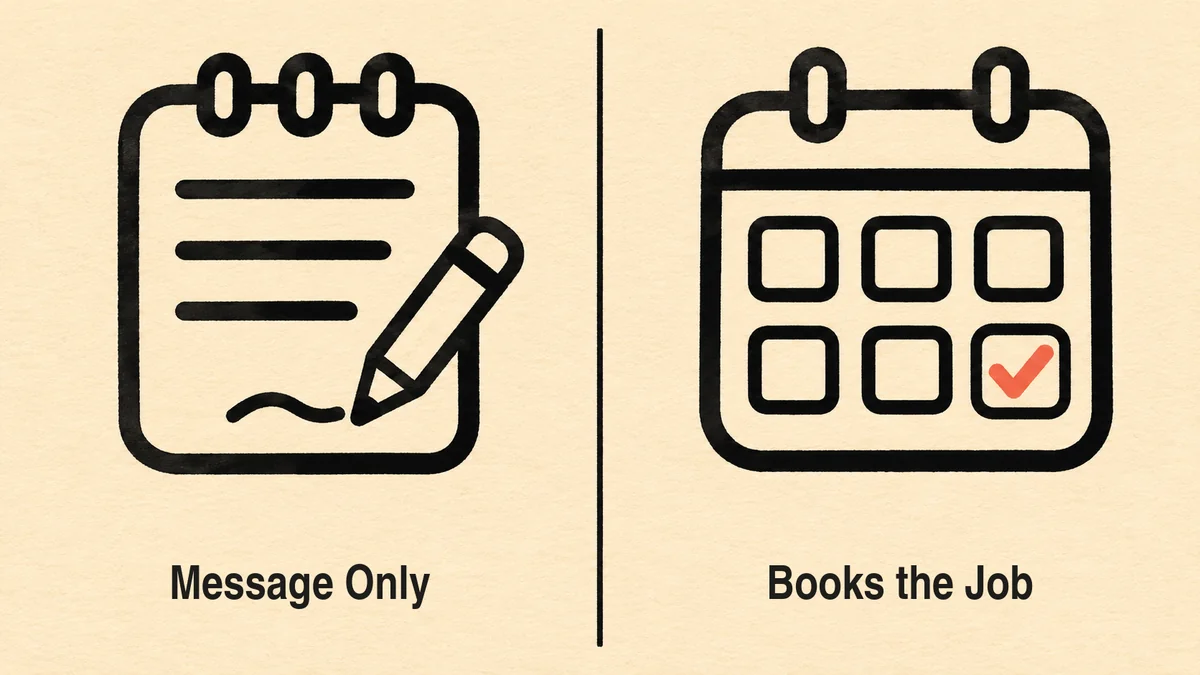
The first tier answers and informs. It picks up the call or text, gives basic information such as hours, services, or a general price range you have set up in advance, and takes a message with the caller's name, number, and reason for calling. This is the closest modern equivalent to a traditional human answering service: someone, or something, picks up so you are not sending customers to voicemail, but you still have to call them back to actually get anything done.
The second tier answers and completes the task. It can check your real calendar availability, book or reschedule an appointment, confirm the details back to the caller, send a text confirmation, and log the interaction in your system without you touching it. Some systems in this tier also route urgent or unusual calls to a person immediately, rather than leaving the caller waiting on a callback.
Neither tier is automatically the better choice. A business that mostly needs to stop missing calls and start returning them faster may do fine with the first tier at a lower cost. A business losing bookings specifically because nobody calls back fast enough usually needs the second. The mistake is assuming the name "AI receptionist" guarantees tier two, or that "AI answering service" means you are stuck with tier one. Ask about the specific capability, not the category name. If you want a feature by feature table, see our quick side by side comparison.
How a Modern System Actually Handles a Call
Whatever a provider calls their product, a capable system tends to follow a similar pattern on a real call.
It answers immediately, typically within the first few rings, so the caller does not reach voicemail. It identifies who is calling and what they need, usually by asking a short, natural set of questions rather than reading out a rigid menu. For a routine request, such as booking a service or asking about availability, it checks your actual schedule and either books the slot or explains the next available option. It confirms the details back to the caller in plain language, so a mistake gets caught in the moment rather than after the fact. It sends a text or email confirmation if that is part of the setup. For anything it cannot safely or confidently handle, a genuine emergency, a complaint, or an unusual request, it says so plainly and either transfers the call to a person or logs it clearly for a callback, rather than guessing.
That last step, knowing when to hand off, is one of the clearest signs of a system worth paying for. A tool that tries to handle everything itself, including situations it was never set up for, is more likely to frustrate a caller than a tool that is upfront about its limits.
Questions to Ask Before You Buy, Whatever It's Called
Use these questions with any provider, regardless of whether their homepage says answering service, receptionist, or something else entirely.
Does it complete tasks, or only take messages? Ask the provider to show you, not just tell you, what happens when a caller wants to book something. "It can take a detailed message" describes a different product than "it books directly into your calendar."
Does it connect to the calendar and tools you already use? A system that cannot see your real availability will either overbook you or send every caller back to a confirmation step later, which defeats much of the purpose.
What happens when it cannot handle a call? Ask specifically how escalation works: does it transfer live, send you an alert, or just log it for later? For a trades business, or anything with genuine emergencies, this answer matters more than almost anything else on this list.
Where is the call data stored, and who can access it? Canadian businesses collecting customer information by phone are subject to privacy law, PIPEDA federally, with provincial equivalents in some provinces. Ask plainly where recordings and transcripts are stored, how long they are kept, and whether the company can confirm this in writing. A vendor that cannot answer clearly is a reason for caution, not necessarily a dealbreaker, but a reason to keep asking.
Will callers know they are talking to AI? Practice varies by provider. Some systems state plainly at the start of the call that the caller has reached an automated assistant. Others are designed to feel more like a natural conversation without an explicit statement. Decide what you are comfortable with for your business and ask whether the provider lets you control that wording.
What does switching actually involve? Ask what happens to your existing phone number, how long setup takes, and whether you are locked into a long contract before you find out if it actually works for your business. A short trial period, or at least a clear way to leave if it is not a fit, is worth asking about directly.
Related reading: comparing human, AI, or both for your phones.

Who This Suits, Who It Doesn't, and What to Do First
This kind of system tends to suit a business where missed calls translate fairly directly into lost bookings or lost sales: trades and home services, salons and personal services, clinics and professional offices, and retail or hospitality businesses that take phone orders or reservations. If a stranger's first contact with your business is usually by phone, and some of those calls are currently going to voicemail, this is worth a serious look.
It suits you less if your business runs mostly on walk ins, referrals, or email, and rarely gets cold phone calls in the first place. In that case, the better first investment is usually a clearer website or a faster email response process, not a phone system upgrade.
For example, picture two small businesses. A plumbing company getting calls at all hours, including evenings and weekends when nobody is in the office, is a strong fit: a system that can book an emergency call out directly, even late at night, solves a real and recurring problem. A boutique accounting firm that mostly brings on new clients through email introductions and referrals has far less to gain from a phone focused tool, even though it is still a small business that gets occasional calls.
If you decide to move forward, start narrow. Set the system up for one or two of your most common call types first, such as booking requests and basic availability questions, and route everything else to a person while you see how it performs. Expand what it handles only once you have watched it work on real calls for a few weeks. This is also the point where a person should review a sample of real interactions regularly, not just at setup, since the way customers actually phrase requests tends to surprise even a well configured system.
Related reading: AI vs virtual receptionist in Canada.

What a Well Matched System Actually Changes
- +Fewer calls go to voicemail
Calls get answered on the first attempt instead of ringing out after hours or during a busy moment on the shop floor.
- +Bookings happen without a callback loop
A caller who wants to book something can often finish that in one call, instead of leaving a message and waiting for someone to call back and compare schedules.
- +A written record of every call
Most systems log or transcribe the interaction, which makes it easier to check later what was actually promised to a customer, without relying on memory.
- +Consistent answers to common questions
Hours, pricing ranges, and service details get repeated the same way every time, rather than depending on whoever happens to pick up the phone that day.
- +A clearer signal for when a person is actually needed
A system that escalates properly means your team's time goes toward calls that genuinely need a person, not routine questions that do not.
Where This Fits With the Rest of Your Online Presence
An AI phone system solves one part of a bigger picture: can a potential customer actually reach you, and can they find you in the first place. Underdog Creative Solutions works with small businesses across Canada on that fuller picture, which usually includes a modern website that both people and AI tools such as ChatGPT or Google's AI Overviews can read and understand, useful written content that answers the questions customers actually search for, and AI business automation that handles repetitive admin work behind the scenes, such as following up on leads, updating records, and sending reminders.
An AI receptionist or answering service is one piece of that automation layer, not a replacement for the rest of it. A business with an excellent phone system but a website that is hard to find, or that never follows up on leads coming in by email, is still leaving opportunities on the table. We never push a packaged bundle. The right starting point depends on where your business is actually losing opportunities right now, and that is worth figuring out honestly before spending on any one piece.
What It Costs and How to Start
Pricing in this market varies by a few real factors rather than a single number: how many calls or minutes you expect each month, whether you need booking and calendar integration or just message taking, whether multiple call types or languages are involved, and whether you want a person available for escalations around the clock or only during business hours. Providers price these differently, some per minute, some per call handled, some on a flat monthly tier with a call allowance, so the only reliable way to compare two quotes is to ask what is included at each tier and what happens if you go over it. For a fuller breakdown, see how AI receptionist pricing works in Canada.
Be cautious of any comparison that promises a fixed percentage of savings over hiring a person, or a flat number of calls you would supposedly stop missing. Those figures depend entirely on your own call volume and current miss rate, which nobody outside your business actually knows in advance.
If you want to talk through whether this fits your business, and see what a fuller setup covering your phone, your website, and your day to day automation could honestly look like, reach out to Underdog Creative Solutions. Message us on WhatsApp at +1 (306) 518-7811, call +1 (306) 518-7811, or book a free 15-minute discovery call. We will tell you plainly if an AI receptionist is not the right first step for your business yet.